Too Many Calls, Too Few Agents? AI Call Center Voice Agents Close the Gap

TL;DR
Call volumes rise faster than you can hire. Every peak means long holds, missed calls, and burnt-out agents.
AI call center voice agents answer instantly, handle thousands of calls at once, and resolve routine ones end to end, so humans only take the calls that need them.
The best ones are multilingual, speaking to each customer in their own language and accent, which is a deal-breaker for any global or multi-region deployment.
For regulated industries, what matters is that they run on-premise, integrate with your core systems, and keep every call inside your firewall.
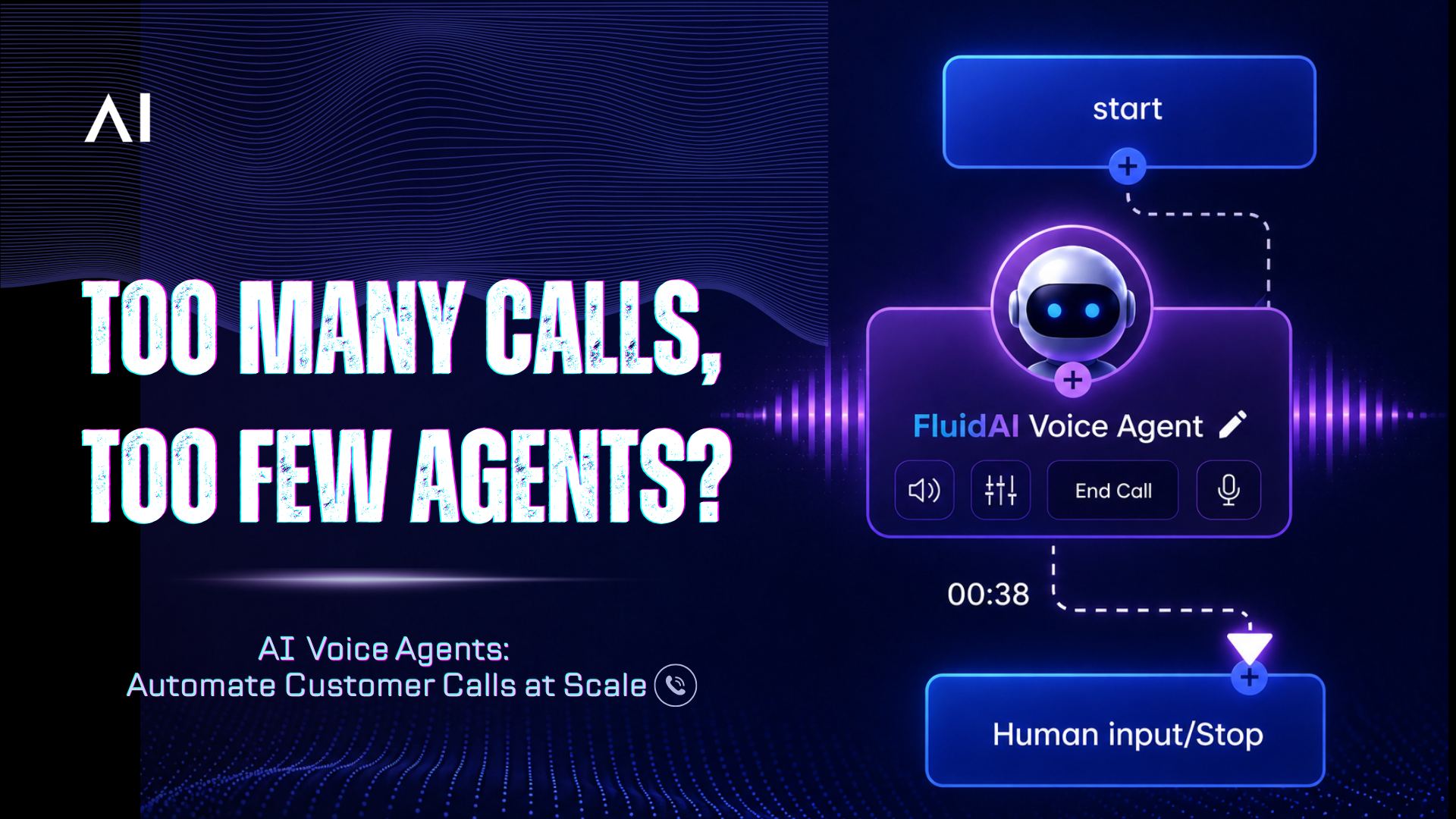
Call volumes don't arrive evenly.
A billing cycle can trigger a spike. A product issue can suddenly send thousands of customers to the phone. Month-end collections can overwhelm a team. A service outage can turn a normal day into hours of waiting.
But your call center still has the same number of human agents.
That creates a familiar problem:
More calls → longer queues → more pressure on agents → frustrated customers.
You can hire more people, extend shifts, or outsource capacity. But you can't realistically build your workforce around the busiest hour of every day.
This is where AI call center voice agents are changing how enterprises handle customer conversations.
Instead of making every caller wait for a human, voice AI agents can handle routine conversations, retrieve information, execute approved actions, and escalate complex cases when human judgment is needed.
The goal isn't to replace the call center.
It's to close the gap between call volume and available human capacity.
What Is an AI Call Center Voice Agent?
An AI call center voice agent is an AI-powered system that can understand spoken language, have a natural conversation, access relevant information, and take actions during a phone call.
Traditional IVRs usually work through fixed menus:
Press 1 for billing.
Press 2 for support.
Press 3 to speak to an agent.
An AI voice agent works differently.
A customer can simply say:
"I made my payment yesterday, but my account still shows it as pending."
The agent can understand the intent, verify the customer, retrieve the relevant information, explain the status, and take the next permitted action.
AI voice agents can:
Answer inbound calls
Understand customer intent
Retrieve account information
Verify customers
Answer questions
Schedule appointments
Process approved requests
Make outbound calls
Record interactions
Escalate complex conversations
The important difference is that voice AI can connect conversation with enterprise workflows.
It doesn't just talk.
It can act.
How Do AI Voice Agents Work?
A modern conversational AI call center typically combines several capabilities:
Listen → Understand → Retrieve → Reason → Act → Escalate
1. Listen
Speech recognition converts the customer's voice into information the AI can process.
2. Understand
The AI identifies the customer's intent rather than relying on a fixed menu.
3. Retrieve
The agent accesses relevant enterprise information from approved systems and knowledge sources.
4. Reason
It determines what response or action is appropriate based on the context, policies, and available information.
5. Act
If permitted, the AI can execute a workflow such as creating a ticket, checking an application, scheduling an appointment, or updating a record.
6. Escalate
If the request is outside its permissions or requires human judgment, the conversation moves to a human agent with the relevant context.
This is what makes an AI voice agent different from a traditional voice bot.
6 AI Call Center Voice Agent Use Cases
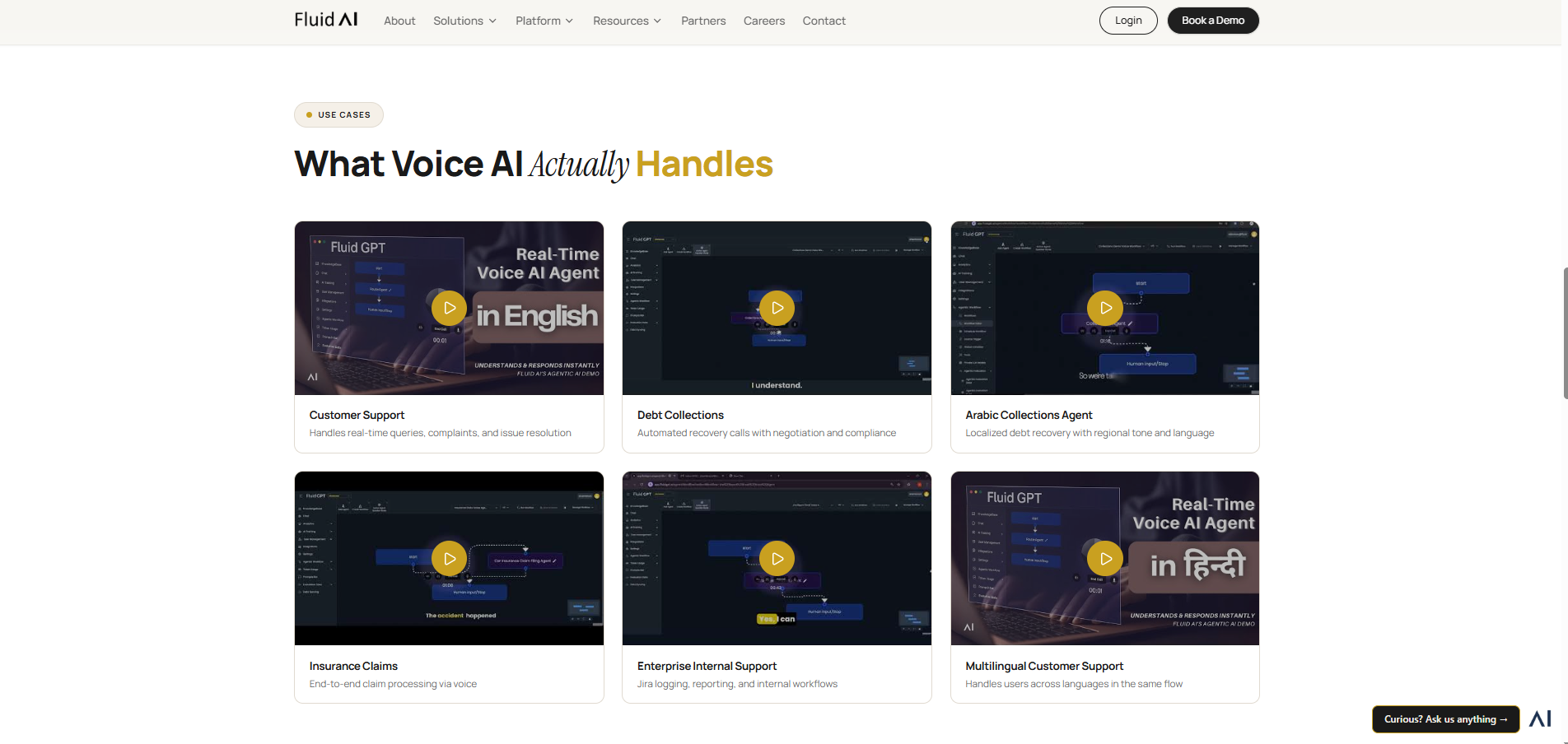
The strongest use cases usually have three things in common:
High volume + repetitive work + clearly defined workflows.
Here are some of the most practical applications for enterprises.
1. Customer Service and Support
Many call centers spend significant time answering predictable questions.
Customers want to know:
Where is my order?
What is my payment status?
When is my appointment?
What documents do I need?
What is the status of my request?
An AI call center voice agent can handle these conversations without putting every customer into a human queue.
Example:
A customer calls to check an order. The voice agent verifies the customer, retrieves the order status, provides the expected delivery date, and answers follow-up questions.
The human team can focus on complaints, exceptions, and complex cases.
2. Banking and Financial Services
Banking conversations often require access to multiple systems and strict controls.
Voice AI agents can support:
Loan application status
Payment queries
Account servicing
Customer verification
Collections
Document reminders
Application follow-ups
Example:
A customer calls to ask why their loan application is still pending.
The AI agent can retrieve the application status, identify a missing document, explain what is required, and trigger the appropriate follow-up.
Fluid AI's banking voice AI supports use cases such as customer support, collections, and loan-related workflows, with integrations into core banking environments.
3. Collections and Payment Reminders
Collections teams deal with large volumes of repetitive conversations.
An AI voice agent can support:
Payment reminders
Outstanding balance notifications
Follow-ups
Payment-intent capture
Callback scheduling
Basic account questions
Escalation of complex cases
Example:
A customer has an overdue payment.
The AI voice agent can verify the customer, explain the outstanding amount, answer permitted questions, capture payment intent, and schedule a follow-up.
If negotiation or human judgment is required, it can transfer the conversation.
This allows collection teams to spend more time on cases where human intervention actually matters.
4. Insurance Customer Service
Insurance involves many structured customer interactions that can be supported by conversational AI.
Common use cases include:
Claim status
Policy servicing
Renewal reminders
Document collection
Customer notifications
Appointment scheduling
Example:
A customer calls to check the status of an insurance claim.
The AI voice agent verifies the customer, retrieves the claim information, explains the current status, and provides the next step.
If the claim requires investigation, it can be escalated to the appropriate team.
5. Employee and IT Helpdesk
AI voice agents aren't limited to customer-facing call centers.
They can also automate internal conversations.
Common internal use cases:
IT support
Password and access issues
HR queries
Policy questions
Ticket creation
Employee service requests
Example:
An employee calls because they cannot access an internal application.
The voice agent can verify the employee, identify the issue, check available troubleshooting steps, initiate an approved workflow, or create a ticket for the IT team.
This turns an automated call center into an internal support layer as well.
6. Outbound Calls and Follow-Ups
Voice AI can also initiate conversations instead of simply answering inbound calls.
Common examples:
Payment reminders
Appointment reminders
Renewals
Customer follow-ups
Surveys
Notifications
Lead qualification
Example:
A healthcare provider needs to remind patients about upcoming appointments.
An AI voice agent can make the call, confirm the appointment, answer basic questions, and reschedule when permitted.
How AI Voice Agents Handle High Call Volumes
This is where call center automation becomes particularly valuable.
Call demand can spike suddenly, while human capacity remains relatively fixed.
AI voice agents can provide an additional layer of capacity for suitable interactions.
Instead of:
Customer → Queue → Available agent → Resolution
You can have:
Customer → AI voice agent → Resolution
or:
Customer → AI voice agent → Human agent with context
This can help enterprises:
Reduce waiting time
Handle repetitive calls automatically
Provide 24/7 support
Absorb demand spikes
Reduce repetitive workload for agents
Route complex conversations to the right team
Fluid AI's voice AI offering is built for enterprise-scale voice automation, with capabilities including 24/7 availability, multilingual conversations, enterprise integrations, and automated resolution.
Why Multilingual Conversational AI Matters
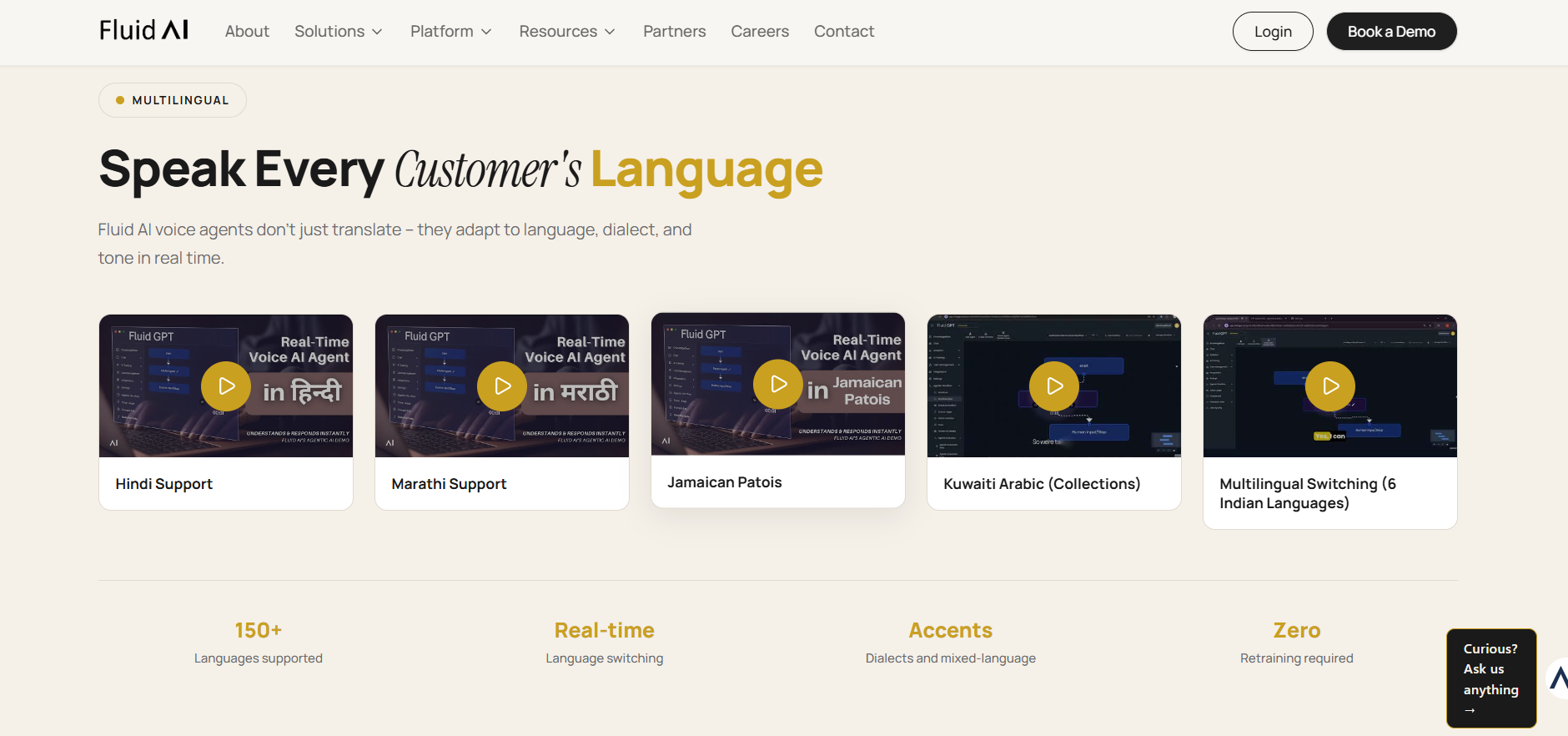
For enterprises operating across India and global markets, English-only voice AI isn't enough.
Customers may speak different languages, use regional accents, switch languages during a conversation, or use a mixture of local languages and English.
That's where multilingual conversational AI becomes important.
A multilingual voice AI agent should be able to:
Understand multiple languages
Respond in the customer's preferred language
Handle regional accents
Support different speech patterns
Maintain context during language switching
Continue the same workflow across languages
Example
A customer starts the call in Hindi:
"Mera payment abhi tak update nahi hua."
Then switches to English:
"But the amount has already been deducted."
A capable multilingual voice agent should understand both parts as one conversation.
The customer shouldn't have to restart.
Fluid AI supports 150+ languages, along with multilingual conversations, language switching, accents, and dialects.
For enterprises serving diverse markets, this makes multilingual voice AI more than a nice-to-have. It becomes part of the customer experience.
AI Voice Agents vs Traditional IVR vs Human Agents
The difference becomes clearer when you compare them:
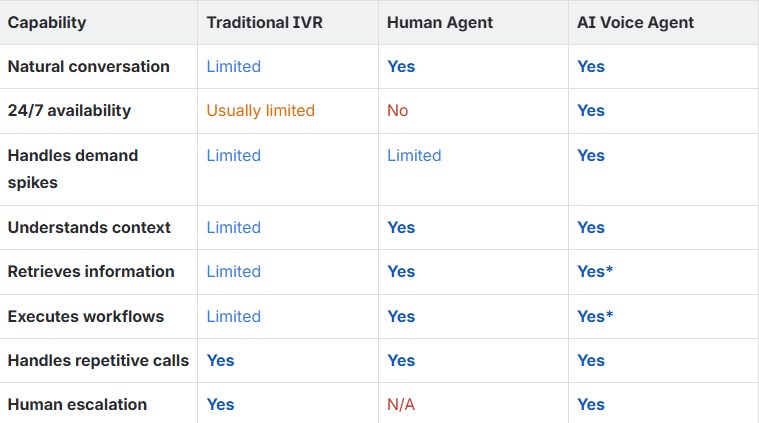
*Depends on integrations, permissions, and workflow design.
The biggest difference isn't simply IVR vs AI.
It's:
Routing vs resolution.
A traditional IVR helps customers reach the right place.
An AI voice agent can help them get the work done.
What Can Voice AI Agents Actually Do?
A useful way to think about voice AI agents is not as another customer-service channel, but as an interface to enterprise workflows.
For example:
A customer says:
"I want to change my delivery address."
The AI can:
Understand the request
↓
Verify the customer
↓
Find the order
↓
Check whether the order is eligible
↓
Update the address
↓
Confirm the change
The customer experiences one conversation.
Behind the scenes, the AI may interact with several enterprise systems.
That's where enterprise voice AI becomes significantly more powerful than a basic voice chatbot.
Enterprise Integrations: Where Voice AI Gets Real
An AI voice agent can only do as much as its access and integrations allow.
For enterprise deployment, it may need to connect with:
CRM systems
ERP platforms
Core banking systems
Ticketing platforms
Knowledge bases
Databases
APIs
Contact-center platforms
Workflow systems
Fluid AI's voice platform supports integrations across enterprise systems and platforms, including CRM, ERP, telephony, ticketing, and APIs.
This means the voice agent can become part of the existing technology environment instead of operating as another isolated chatbot.
Are AI Voice Agents Secure Enough for Enterprise Use?
For a consumer chatbot, a wrong answer may be inconvenient.
For a bank, insurer, or large enterprise, an incorrect action can have much bigger consequences.
That's why AI voice agent security needs to be considered from the beginning.
Enterprise deployments should address:
Authentication
Role-based access
Data protection
Permission controls
Audit trails
Human approvals
Escalation rules
Governance
Deployment requirements
The agent should not simply have access to everything.
It should have access to what it needs to perform the workflow - and nothing more.
For enterprises with stricter infrastructure requirements, deployment flexibility also matters.
Fluid AI supports enterprise deployment options including on-premise, VPC, and hybrid environments, alongside security and governance capabilities.
How to Implement AI Voice Agents in a Call Center
You don't need to automate the entire contact center on day one.
A better approach is:
1. Find one high-volume workflow
Look for a repetitive call with measurable business impact.
2. Define what the AI can do
Separate:
Can answer → Can recommend → Can execute → Must escalate
3. Connect the required systems
Give the AI access to the data, tools, and APIs needed to complete the workflow.
4. Test real conversations
Don't test only perfect scripts.
Test:
Different accents
Background noise
Interruptions
Multiple languages
Code-switching
Unexpected questions
Edge cases
5. Measure the outcome
Track metrics such as:
Resolution rate
Automation rate
Escalation rate
Average handling time
Customer satisfaction
Cost per interaction
6. Expand
Once one workflow works reliably, expand to additional call types, departments, and languages.
The Future of the Automated Call Center
The future isn't a call center with no humans.
It's a call center where AI handles volume and humans handle judgment.
A customer should be able to explain what they need naturally.
The AI should understand the request, retrieve the right information, take the action it's authorized to take, and know when a human needs to step in.
That's the shift from:
IVR → Voice Bot → Voice AI → AI Agent
The final stage isn't simply an AI that can talk.
It's an AI that can get the work done.
And that's how AI call center voice agents can close the gap between the number of calls customers want to make and the number of conversations your human team can realistically handle.
Fluid AI brings voice AI, enterprise data, integrations, and agentic workflows together to help enterprises move from simply answering calls to actually resolving them.
Book your Free Strategic Call to Advance Your Business with Generative AI!
Fluid AI is an AI company based in Mumbai. We help organisations kickstart their AI journey. If you're seeking a solution for your organisation to enhance customer support, boost employee productivity and make the most of your organisation's data, look no further.
Take the first step on this exciting journey by booking a Free Discovery Call with us today and let us help you make your organisation future-ready and unlock the full potential of AI for your organisation.
Frequently asked questions
1. What is an AI call center voice agent?
A voice AI agent that answers calls, understands the caller in natural language, and resolves the request end to end, or routes to a human with full context when needed. It replaces rigid IVR menus with real conversation and action.
2. Can AI voice agents handle high call volumes?
Yes. They handle thousands of calls simultaneously with no queue, which is what lets them absorb peak load that fixed headcount can't cover.
3. Do AI voice agents support multiple languages?
The best ones do. Multilingual conversational AI understands and responds in each customer's language, including regional accents and mixed-language speech, which is essential for global or multi-region deployments.
4. Are AI call center voice agents secure enough for banking?
When deployed on-premise with role-based access, verification, and full audit trails, yes. On-premise deployment keeps sensitive call data inside the enterprise firewall.
5. Do AI voice agents replace human agents?
No. They absorb high-volume routine calls so human agents can focus on complex, high-value conversations. Calls that need a person are routed with full context.
Where to start?
You don't automate every call on day one. Start with your highest-volume, most repetitive call type, the one your agents dread, prove a voice agent can resolve it end to end, then expand across call types and languages.
Want to see it on your call flows? Explore Fluid AI's Enterprise Agentic AI Platform
_1790254083168-CB8e8KXC.png)