What Is Super Intelligence? Understanding AI, AGI, ASI, SI and the Future of Intelligent Machines

TL;DR
Super intelligence refers to AI that could eventually outperform humans across a broad range of intellectual tasks. While artificial superintelligence (ASI) remains hypothetical, AI is already moving toward greater reasoning, tool use, autonomy, and multi-step execution through AI agents and agentic AI. This shift could fundamentally change how enterprises work, moving AI from simply answering questions to executing workflows, making decisions within defined boundaries, and helping employees get more done.
What Is Super Intelligence? SI, AI, AGI, ASI & the Future of AI
Artificial intelligence is moving into a new phase.
For years, the conversation was about whether AI could generate better text, images, code, or answers.
Now the question is getting bigger:
How intelligent can machines actually become?
That question leads to one of the most discussed ideas in AI: super intelligence.
Super intelligence describes AI that could eventually outperform humans across a wide range of intellectual tasks, rather than simply being better at one specific task.
It is still a hypothetical concept.
But the technologies leading toward increasingly autonomous AI are already being built.
What Is Super Intelligence (SI)?
Super intelligence refers to AI systems capable of performing intellectual tasks at a level that significantly exceeds human capabilities.
The term is often used interchangeably with artificial superintelligence (ASI), although there is an important distinction between the two.
In AI research, artificial superintelligence generally describes a hypothetical system that would outperform humans across a broad range of cognitive abilities, including reasoning, scientific discovery, planning, problem-solving, creativity, and decision-making.
Super Intelligence vs Superintelligence
There is an interesting distinction worth understanding.
Superintelligence has been used for years in AI research to describe hypothetical intelligence that surpasses humans broadly.
“Super Intelligence” is also increasingly being used in current AI policy discussions.
In September 2026, the U.S. government directed executive agencies to use the term “Super Intelligence” or “SI” instead of “Artificial Intelligence” or “AI” in many official communications. The order also asks for proposed legislative language establishing a federal definition of the term.
The terminology is therefore becoming part of the wider AI conversation.
But the technical concept remains different.
Today's AI is not the same thing as artificial superintelligence.
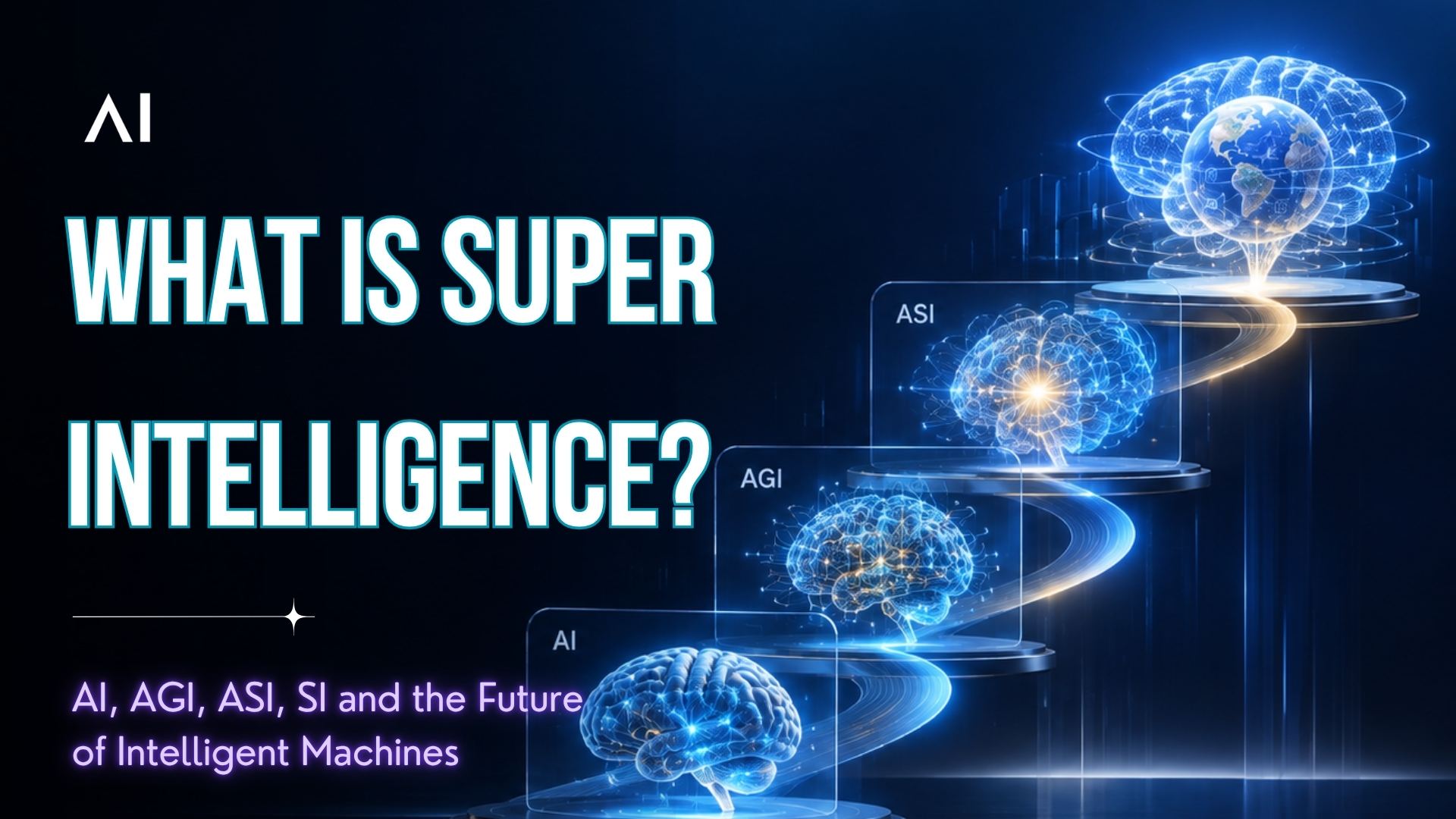
AI, AGI and ASI: What's the Difference?
These terms are often used together, but they describe different ideas.
AI Systems designed to perform tasks requiring capabilities associated with human intelligence Generative AI that creates content such as text, images, audio, video and code. AI Agents, AI systems that can reason through tasks, use tools and take actions. AGI Hypothetical, AI with broad, general human-level intelligence, ASI Hypothetical AI that surpasses human intelligence across many domains
A simple way to think about it:
AI can perform intelligent tasks.
Generative AI can create.
AI agents can act.
AGI would broadly understand and perform intellectual tasks like humans.
ASI would go beyond human capability.
There is no universally accepted test that tells us when AGI or ASI has been achieved.
Why Is Super Intelligence Suddenly Getting So Much Attention?
Because AI is changing.
The first major wave of generative AI was largely about answers.
You asked a question.
The model responded.
Now AI systems are increasingly moving toward reasoning and action.
They can:
Search for information
Read documents
Write and execute code
Use APIs
Interact with software
Analyze data
Coordinate multiple steps
Complete tasks with limited human intervention
That shift is driving the rise of AI agents and agentic AI.
And it changes the conversation.
The future of AI isn't only about building models that know more.
It is about building systems that can do more.
What Is Agentic AI?
Traditional AI often follows a simple pattern:
Question → Answer
Agentic AI works differently.
Goal → Plan → Tools → Actions → Result
Instead of simply telling an employee how to solve a problem, an AI agent can potentially carry out parts of the process itself.
For example:
An employee asks:
“Can you check the procurement policy, review this vendor request and prepare it for approval?”
An agentic system could potentially:
Find the relevant policy.
Retrieve the vendor information.
Check the request against predefined rules.
Identify missing information.
Prepare the required documentation.
Send it for human approval.
The AI isn't just generating text.
It is participating in the workflow.
Is Agentic AI Superintelligence?
No!
This distinction matters.
An AI agent can be highly capable without being superintelligent.
A system might execute a complicated workflow extremely well while still having significant limitations.
Superintelligence refers to something much broader: intelligence that substantially exceeds humans across many intellectual domains.
Agentic AI is better understood as one of the technological developments that could contribute to increasingly autonomous AI systems.
What Could Superintelligent AI Do?
The possibilities are theoretical, but researchers often discuss capabilities such as:
Accelerated scientific discovery
AI could analyze enormous amounts of scientific literature, generate hypotheses and help design experiments.
Advanced engineering
Superintelligent systems could potentially design and optimize complex machines, materials and infrastructure.
Software development
AI could develop, test, debug and improve increasingly complex software systems.
Medical research
AI could help researchers understand diseases, identify potential drug candidates and model biological systems.
Complex planning
AI could potentially reason through problems involving thousands or millions of variables.
AI research itself
Perhaps the most significant possibility is that advanced AI could help improve future AI systems.
This is one reason superintelligence is treated as such a consequential hypothetical.
What Would Make AI Truly Superintelligent?
It wouldn't simply be about having a bigger model.
A truly superintelligent system would likely need a combination of capabilities.
Reasoning
The ability to solve unfamiliar and complex problems.
Learning
The ability to acquire and apply new knowledge.
Planning
The ability to work toward long-term objectives.
Tool use
The ability to interact with software, databases, APIs and physical systems.
Memory
The ability to retain and use relevant information over time.
Adaptation
The ability to respond effectively when circumstances change.
Autonomy
The ability to perform multi-step work without constant human instructions.
The combination is what makes the idea of superintelligence fundamentally different from today's narrow AI systems.
The Enterprise AI Connection
For businesses, the most important development may happen before superintelligence ever exists.
Enterprise AI is already moving from answering questions to performing work.
Consider an internal operations workflow.
An employee might currently need to:
Search a policy → open an application → find customer information → prepare a document → submit a request → wait for approval
AI can increasingly connect these steps.
Instead of interacting with five different systems, the employee could interact with an AI system that understands the request and coordinates the workflow.
This is where enterprise AI, AI agents and workflow automation intersect.
The value isn't simply intelligence.
It's intelligence connected to enterprise context and action.
From AI Assistants to AI Workers
This represents a fundamental shift.
AI Assistant
“Here's how you can complete the task.”
AI Agent
“I can complete these steps for you.”
Future Superintelligence
“I can potentially solve problems and discover approaches beyond what humans can.”
These are very different levels of capability.
And enterprises will need different approaches to governance, security and human oversight at each stage.
What About Human Oversight?
More autonomy doesn't mean humans disappear from the process.
In enterprise environments, some decisions require accountability.
Financial approvals.
Compliance decisions.
Hiring decisions.
Legal judgments.
Safety-critical actions.
The more consequential the decision, the more important it becomes to define:
What can AI do independently?
What requires approval?
What must always remain human-led?
This is one of the central questions surrounding the future of agentic AI.
Super Intelligence and AI Safety
Greater intelligence could create enormous opportunities.
It could also create new risks.
That is why the conversation around superintelligence increasingly includes:
AI safety
AI alignment
Model evaluation
Security
Human oversight
Governance
Access controls
Responsible deployment
The challenge isn't simply making AI more capable.
It is making increasingly capable systems reliable, controllable and appropriately governed.
Recent discussions between the U.S. government and major AI companies have also focused on internal controls, external evaluation and oversight of frontier AI systems.
The Future: From Intelligence to Action
The story of AI is no longer just about making machines smarter.
It is increasingly about what those machines can do with that intelligence.
We have moved from:
Search → Chat → Generate → Reason → Act
The next step could be systems that combine these capabilities into increasingly autonomous workflows.
Whether that eventually leads to AGI or artificial superintelligence remains an open question.
But one thing is already clear.
AI is moving from a tool people use to a system that can increasingly participate in the work itself.
And for enterprises, that shift may matter long before superintelligence becomes reality.
Frequently Asked Questions(FAQs)
1. What is super intelligence?
Super intelligence refers to a hypothetical form of AI that significantly exceeds human intellectual capabilities across a broad range of domains.
2. What is artificial superintelligence?
Artificial superintelligence, or ASI, is the hypothetical stage of AI where systems outperform humans across many or most cognitive tasks.
3. Is AGI the same as superintelligence?
No. AGI generally refers to broad, human-level general intelligence, while ASI refers to intelligence that exceeds human capabilities.
4. What is the difference between AI and SI?
AI refers broadly to machines performing tasks associated with intelligence. Superintelligence(SI) refers to a hypothetical level where AI broadly surpasses human intellectual performance.
5. Will AI agents lead to superintelligence?
AI agents are not superintelligence. However, their ability to reason, use tools and execute multi-step tasks represents an important direction in the development of increasingly autonomous AI systems.
6. What does superintelligence mean for enterprises?
It points toward a future where AI could move beyond assisting employees to executing increasingly complex workflows, while making governance, security and human oversight increasingly important.
_1790254083168-CB8e8KXC.png)