Talk to Your Manufacturing Data: The Rise of Text-to-SQL

TL;DR
Text-to-SQL is AI technology that converts plain English questions into SQL queries, letting plant managers, supply chain leads, and operations teams pull answers from ERP, MES, and IoT databases without knowing a single line of code.
Instead of waiting on a data analyst for three days, someone on the floor can type "which production line had the most downtime last week" and get an instant answer pulled straight from the database.
Across the AI in manufacturing industry, this is turning out to be one of the fastest ROI use cases, precisely because it doesn't ask anyone to rebuild what's already running.
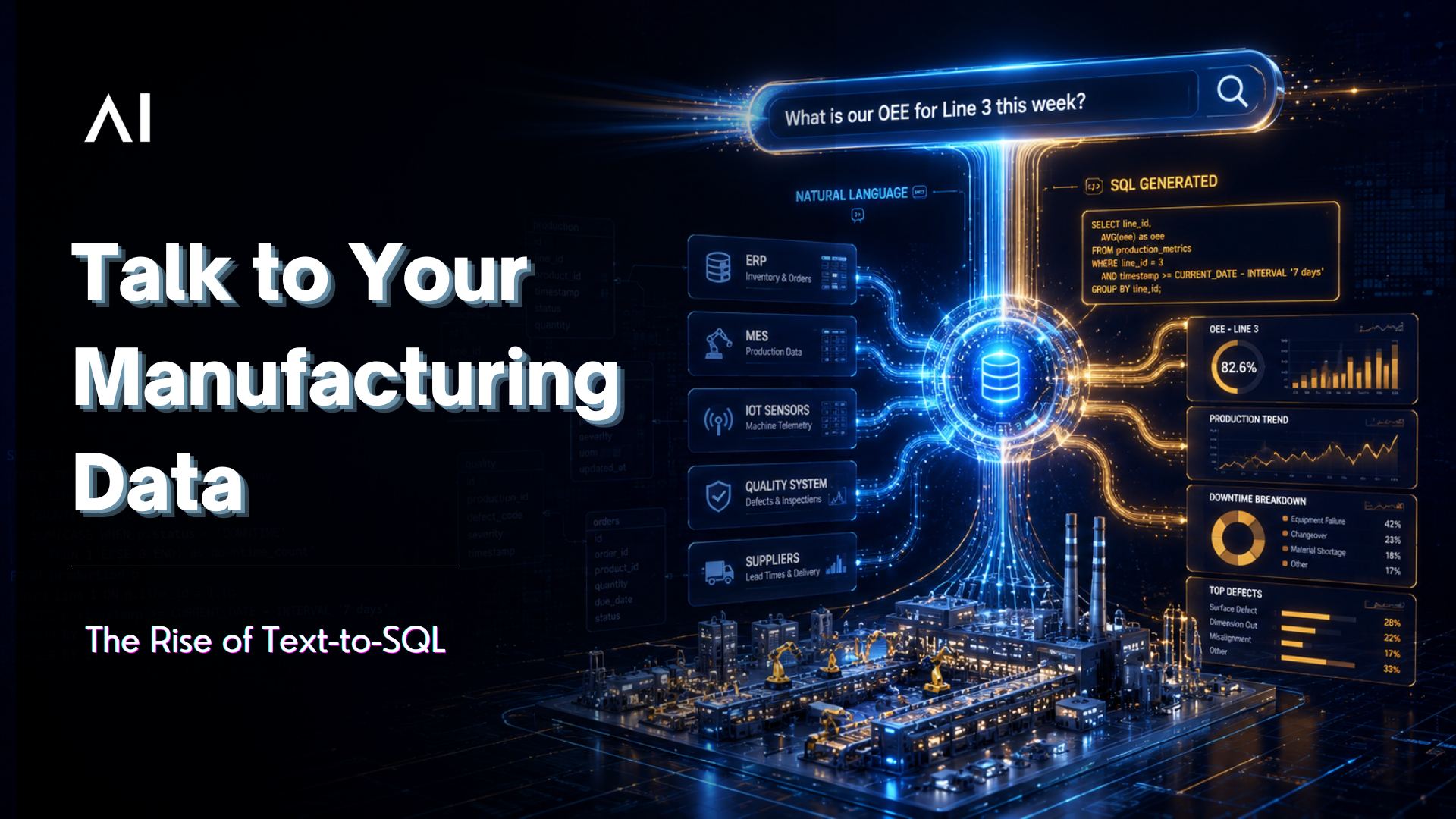
Manufacturing runs on data nobody can actually reach. Machine sensors log every cycle. ERPs track every part number. Quality systems flag every defect. And most of it sits locked behind a query language that only three people in the building know how to write.
That's the real bottleneck. Not the data itself, but the distance between the people who need answers and the people who know SQL.
What Text-to-SQL Actually Does
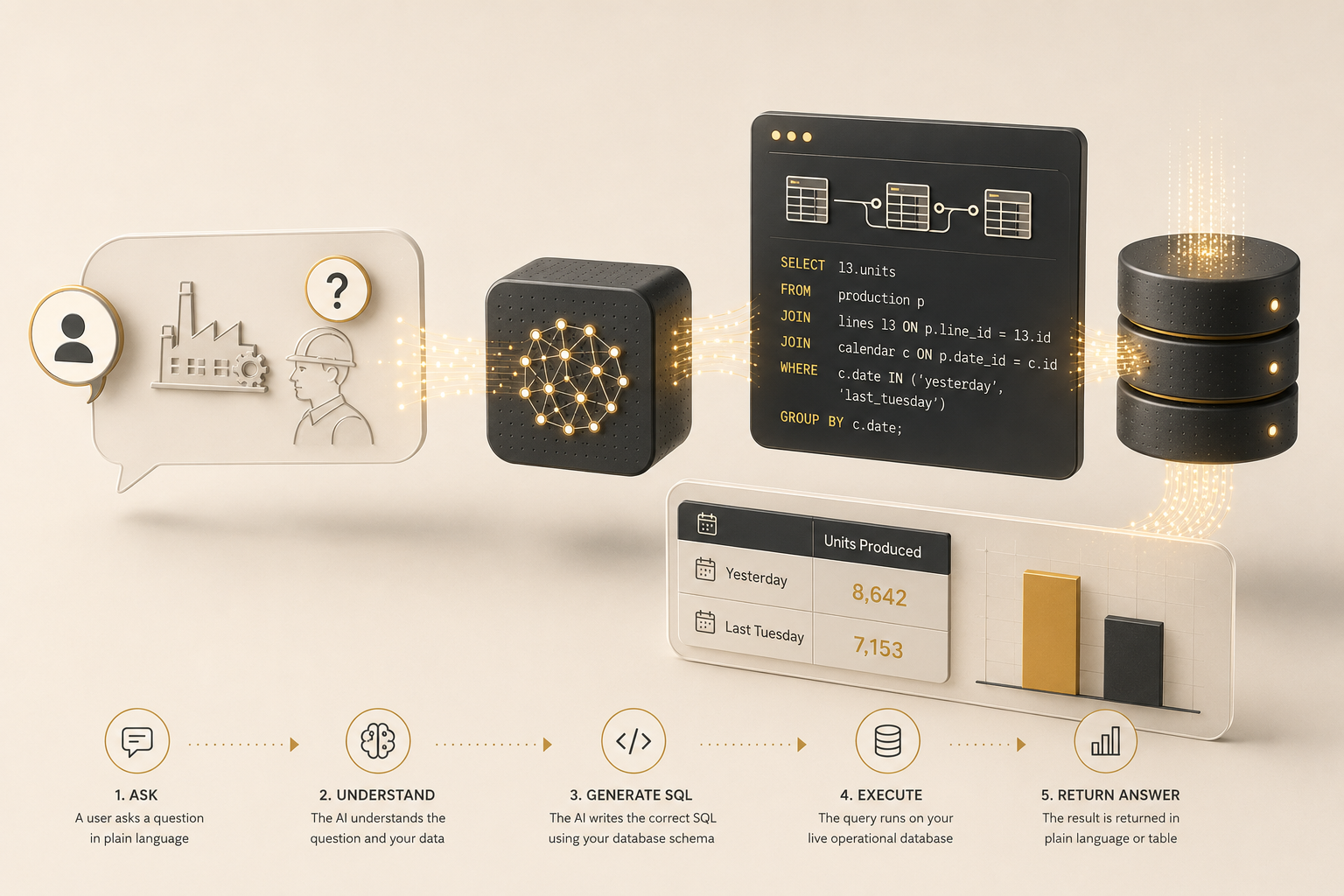
Text-to-SQL uses a large language model to translate a natural language question into a working SQL query, run it against your database, and return the result in plain language or a table. No middleman required.
A shift supervisor asking "how many units did line 3 produce yesterday compared to last Tuesday" gets a direct answer. The system reads the question, understands the schema behind it, writes the correct joins across production and calendar tables, and returns the number.
This isn't a chatbot bolted onto a dashboard. It's a live connection to your actual operational database, and one part of a much broader shift where agentic AI is transforming manufacturing from the factory floor to the back office.
Why Manufacturing Specifically Needs This
Manufacturing data is uniquely fragmented. A single plant might run:
→ An ERP for procurement and inventory
→ An MES for production tracking
→ A separate quality management system
→ IoT sensors feeding a time series database
→ Spreadsheets nobody officially owns but everyone depends on
Getting a single answer, like true cost per unit including scrap and rework, often means pulling from four of these systems and stitching it together manually. That's usually a request that sits in an analyst's queue for days.
Text-to-SQL agents can be connected across these sources at once. Ask "what's our scrap rate by shift this month" and the system pulls from MES and quality data together, without anyone writing a cross-database join by hand. It's the same fragmentation problem covered in how multimodal enterprise AI is transforming workflows, just applied to structured data instead of voice, text, and images.
Use Cases: Where This Shows Up on the Floor
a) Production Monitoring
Plant managers ask about output, downtime, and OEE in real time instead of waiting for the next scheduled report. "What was our downtime on line 2 this shift" gets answered before the shift even ends, not the next morning in a stand up meeting.
This changes how fast people react. A supervisor who notices output dipping can ask "which machine on line 4 has had the most stoppages this week" right then, instead of flagging it and waiting for someone else to pull the numbers.
→ Real time output tracking across lines and shifts
→ Downtime broken down by machine, cause, or operator
→ OEE trends compared week over week without building a new report each time
b) Inventory and Procurement
Supply chain teams check stock levels, reorder points, and supplier lead times without opening five different screens. Someone can ask "which raw materials are below reorder point right now" and get a live answer instead of cross referencing three spreadsheets and an ERP export.
It also catches things earlier. A procurement lead asking "which supplier has the longest average lead time this quarter" can spot a bottleneck before it becomes a stockout, not after production already stalled. This kind of on demand visibility is exactly where autonomous procurement is heading, replacing manual sourcing with agents that act on live data instead of waiting for a report.
→ Live stock levels across warehouses and plants
→ Reorder point alerts pulled on demand, not just on a schedule
→ Supplier performance comparisons without manual spreadsheet work
c) Quality Control
Quality leads trace a defect back to a specific batch, machine, or shift in one query instead of a multi-day root cause investigation. "Show me every defect linked to machine 7 in the last 30 days" used to mean pulling logs, cross checking timestamps, and looping in two other teams. Now it's one question.
This matters most when a defect shows up downstream and nobody's sure where it started. Instead of guessing, a quality lead can ask the question directly and narrow it down to the shift, operator, or machine in minutes. It's a smaller, more focused version of the pattern already showing up in manufacturing quality control powered by multimodal AI, where vision, sensor, and text data converge to catch issues before they scale.
→ Defect tracing back to batch, machine, or shift
→ Root cause patterns across multiple production runs
→ Faster containment before a defect scales into a recall
d) Maintenance Planning
Reliability engineers ask which machines are approaching failure thresholds based on sensor trends, without needing to know the underlying schema. "Which machines have shown a vibration increase over the last two weeks" turns sensor data that used to sit unused into something someone actually acts on.
This shifts maintenance from reactive to predictive, the same direction covered in Agentic AI's role in smart factories, where predictive maintenance is one of the clearest early wins for AI on the plant floor. Instead of fixing a machine after it breaks, or running maintenance on a fixed schedule whether it's needed or not, teams can ask targeted questions and catch problems while they're still cheap to fix.
→ Early failure signals pulled straight from sensor data
→ Maintenance scheduling based on actual machine condition, not a generic calendar
→ Fewer unplanned stoppages because the warning signs get caught early
Each of these used to require either a dedicated analyst or a canned report built weeks earlier for a slightly different question. Now it's a sentence typed into a chat box. If you're looking for concrete examples of AI in manufacturing that don't require a six-month rollout, this is one of the cleanest ones out there.
The Benefits, and the Honest Tradeoffs
The upside is speed and access. Answers that took days now take seconds, and they're available to anyone who can type a question, not just the analyst who knows the schema.
The tradeoff is trust. The obvious concern is whether an AI-generated SQL query is actually correct. This is a fair worry, and it's one of the real challenges of AI in manufacturing environments where a wrong number can mean a wrong decision on the floor.
A well-built system validates the generated query against the schema before execution, checks it against known business logic (like which tables represent "active" versus "archived" inventory), and in ambiguous cases, asks a clarifying question rather than guessing. This validation layer is what separates a genuinely useful production tool from a demo that looks impressive once and breaks the second someone asks an edge case question.
Getting Started Without a Rebuild
Manufacturers don't need to migrate off existing systems to use this. Text-to-SQL agents connect to databases that are already in place, whether that's an on-prem SQL Server instance running the MES or a cloud data warehouse aggregating multiple plants.
The rollout usually starts narrow. One team, one use case, like production reporting for a single line. Once the accuracy and trust are established, it expands to procurement, quality, and maintenance queries across the plant.
This matters because manufacturing environments are notoriously resistant to rip-and-replace projects. A tool that layers on top of what's already running, instead of demanding a new system, is the only kind that actually gets adopted on the floor.
What Changes When Everyone Can Query Data
The bigger shift isn't speed, though speed matters. It's who gets to ask questions in the first place.
Right now, curiosity about your own operational data is gated by SQL literacy. A line supervisor who has a hunch about a bottleneck can't test it themselves. They have to route it through someone else, wait, and often lose the thread of the original question by the time an answer comes back.
Text-to-SQL removes that gate. The person closest to the problem can ask the question directly, in the moment it occurs to them, and act on the answer before it stops mattering.
Book your Free Strategic Call to Advance Your Business with Generative AI!
Fluid AI is an AI company based in Mumbai. We help organisations kickstart their AI journey. If you're seeking a solution for your organisation to enhance customer support, boost employee productivity and make the most of your organisation's data, look no further.
Take the first step on this exciting journey by booking a Free Discovery Call with us today and let us help you make your organisation future-ready and unlock the full potential of AI for your organisation.
Frequently Asked Questions (FAQ) :
What is text-to-SQL in manufacturing?
It's AI technology that converts plain English questions into SQL queries, letting non-technical staff pull answers directly from ERP, MES, and IoT databases without writing code.
What are some real examples of AI in manufacturing?
Text-to-SQL for reporting, predictive maintenance from sensor data, computer vision for defect detection, and demand forecasting are among the most common examples in active use today.Do we need to replace our existing ERP or MES system?
No. Text-to-SQL connects to your existing databases and systems as they are, without requiring any migration or replacement.How accurate are AI-generated SQL queries?
Enterprise systems validate generated queries against the schema and business rules before execution, and ask clarifying questions when a request is ambiguous, which keeps accuracy high in production use.Can it pull data from multiple systems at once?
Yes. A well-connected system can query across ERP, MES, quality, and IoT data sources in a single request without manual joins.
_1790254083168-CB8e8KXC.png)