How Much Manual Work AI Agents Actually Remove From Loan Processing: A Data Breakdown

TL;DR
Banks deploying AI agents for loan processing see manual effort drop by 60 to 80 percent across document collection, verification, credit assessment, and compliance checks, with processing time falling from days to hours in most deployments. The biggest gains show up in document heavy stages like KYC and income verification, where agents can read, cross check, and flag inconsistencies without a human touching every file.

Loan processing has always been a paperwork problem wearing a banking costume. Every application means pulling documents, checking them against a dozen internal rules, verifying income, running credit checks, and making sure nothing violates a compliance requirement someone added three years ago. Most of that work isn't decision making. It's checking. And that distinction matters because it's exactly where AI agents make the biggest dent.
Where the manual hours actually go
Before agents enter the picture, a typical retail loan application moves through five to seven manual touchpoints.
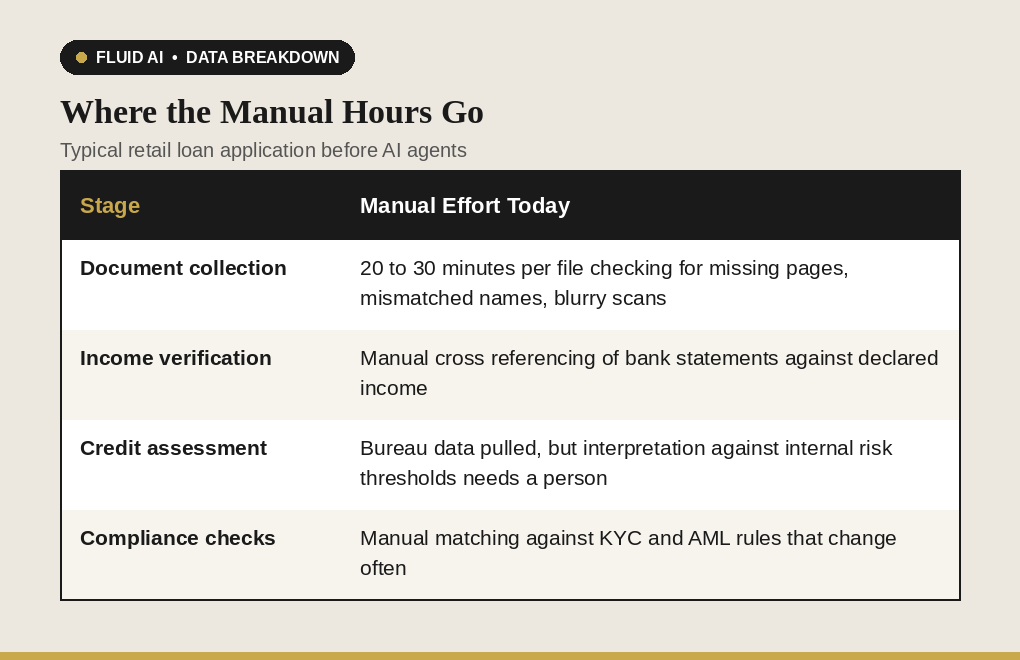
None of these steps need judgment in the way underwriting does. They need consistency. Consistency is the one thing manual review struggles to guarantee at scale, especially when volume spikes.
The data on what changes
Across deployments Fluid AI has worked on with banking clients, a few patterns repeat.
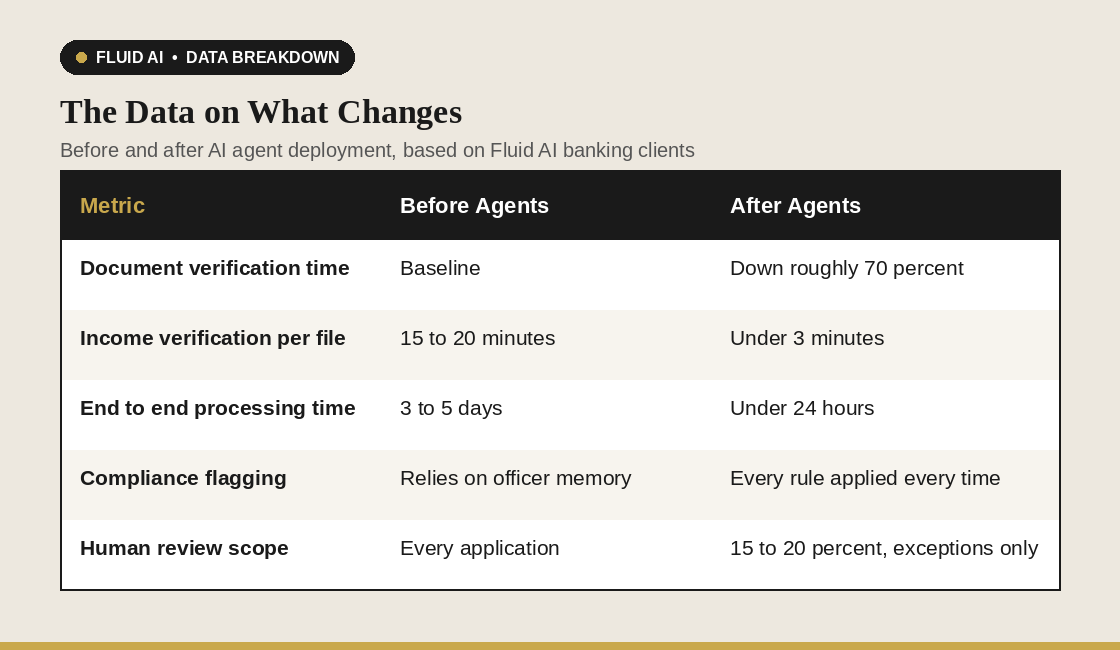
That last row is the real story here. AI agents don't remove humans from lending. They remove humans from the parts of lending that never needed a human in the first place.
The document heavy stages see the biggest gains
KYC and income verification are where the numbers move most. Both stages are fundamentally about checking one document against another and flagging what doesn't match. A human doing this all day will get slower and less accurate as volume rises. An agent doing this doesn't degrade. It applies the same extraction and cross check logic to file one and file one thousand.
This is also where fraud signals tend to hide in plain sight. Mismatched addresses, inconsistent income across statements, altered document metadata. Agents are well suited to catching this pattern level noise because they never get tired of checking the same field across a hundred documents.
Why the number isn't 100 percent
It's worth being honest about this. No serious deployment claims full automation of loan processing, and anyone promising that is overselling. Edge cases exist.
→ Applications with unusual income structures → First time borrowers with thin credit files → Cases involving fraud signals that need investigation, not just flagging
These still need a person to make the call. Agents are good at pattern matching against known rules. They're not a replacement for underwriting judgment on genuinely ambiguous cases.
What agents do well is triage. They sort the straightforward 80 percent from the complicated 20 percent, and they do it consistently, at any volume, at any hour. That's the actual value. It's not that agents are smarter than loan officers. It's that they never get tired, never skip a step, and never let volume pressure them into shortcuts.
Where banks see the ROI show up first
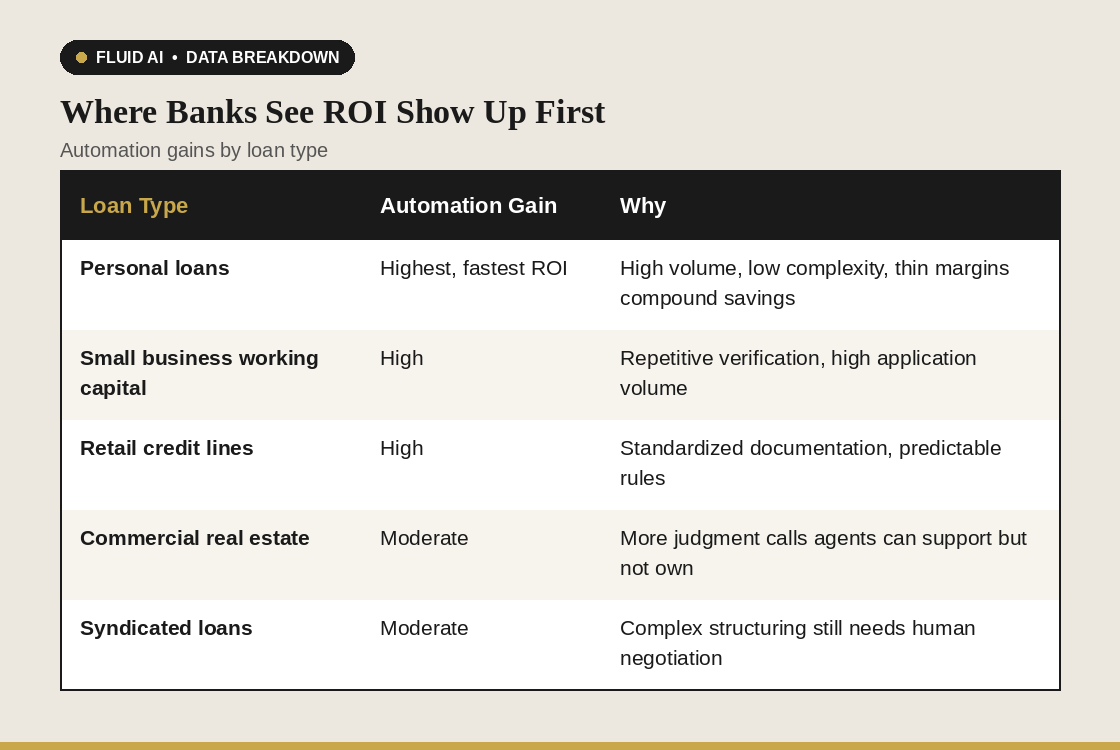
A bank processing 10,000 personal loan applications a month at 70 percent reduced manual effort isn't just saving officer hours. It's freeing up capacity to grow volume without growing headcount at the same rate.
Even on the commercial and syndicated side, document intake and compliance pre checks still get automated, which trims the front end of a process that used to take weeks.
The metric that actually matters
If a bank is still measuring loan processing efficiency in headcount, that's the wrong metric now. The better measure is exception rate: what percentage of applications actually require a human decision versus what percentage could have been fully automated.
Banks that track this find the number is often lower than they assumed, and that gap represents real, recoverable capacity. It also reframes the conversation internally. Instead of asking how many people are needed to process loans, teams start asking how many decisions actually need a person at all.
What this changes day to day
The manual work AI agents remove isn't glamorous. It's the checking, the cross referencing, the flagging. But that's most of what loan processing actually is. Removing it doesn't just save time. It changes what loan officers spend their day doing.
Officers stop being document processors and start being decision makers on the cases that genuinely need one. That shift is where the real competitive advantage sits, and it compounds every month a bank runs the process this way instead of the old one.
Book your Free Strategic Call to Advance Your Business with Generative AI!
Fluid AI is an AI company based in Mumbai. We help organisations kickstart their AI journey. If you're seeking a solution for your organisation to enhance customer support, boost employee productivity and make the most of your organisation's data, look no further.
Take the first step on this exciting journey by booking a Free Discovery Call with us today and let us help you make your organisation future-ready and unlock the full potential of AI for your organisation.
Frequently Asked Questions (FAQ) :
How much manual work do AI agents remove from loan processing?
Most deployments see manual effort drop by 60 to 80 percent across document verification, income checks, and compliance review.Do AI agents replace loan officers?
No. They handle repetitive verification work and route complex or ambiguous cases to human underwriters.What part of loan processing sees the biggest automation gains?
Document verification and income verification typically see the largest time reductions.How long does loan processing take with AI agents compared to manual review?
Many banks go from 3 to 5 days down to under 24 hours for standard applications.Can AI agents handle compliance checks accurately?
Yes, agents apply every regulatory rule consistently to every file, which often improves flagging accuracy over manual review.
_1790254083168-CB8e8KXC.png)