AI for Loan Origination: Automating the Entire Credit Workflow

TL;DR
AI is changing loan origination from a slow, manual process into an end-to-end automated workflow. Autonomous agents can handle document intake, data extraction, due diligence, credit policy checks, financial analysis, and credit memo drafting, while analysts stay in control of the final decision.
The result: work that takes 2–3 days can be completed in minutes, with the mechanical 80% automated, full audit trails, human oversight, and integration with existing banking systems.
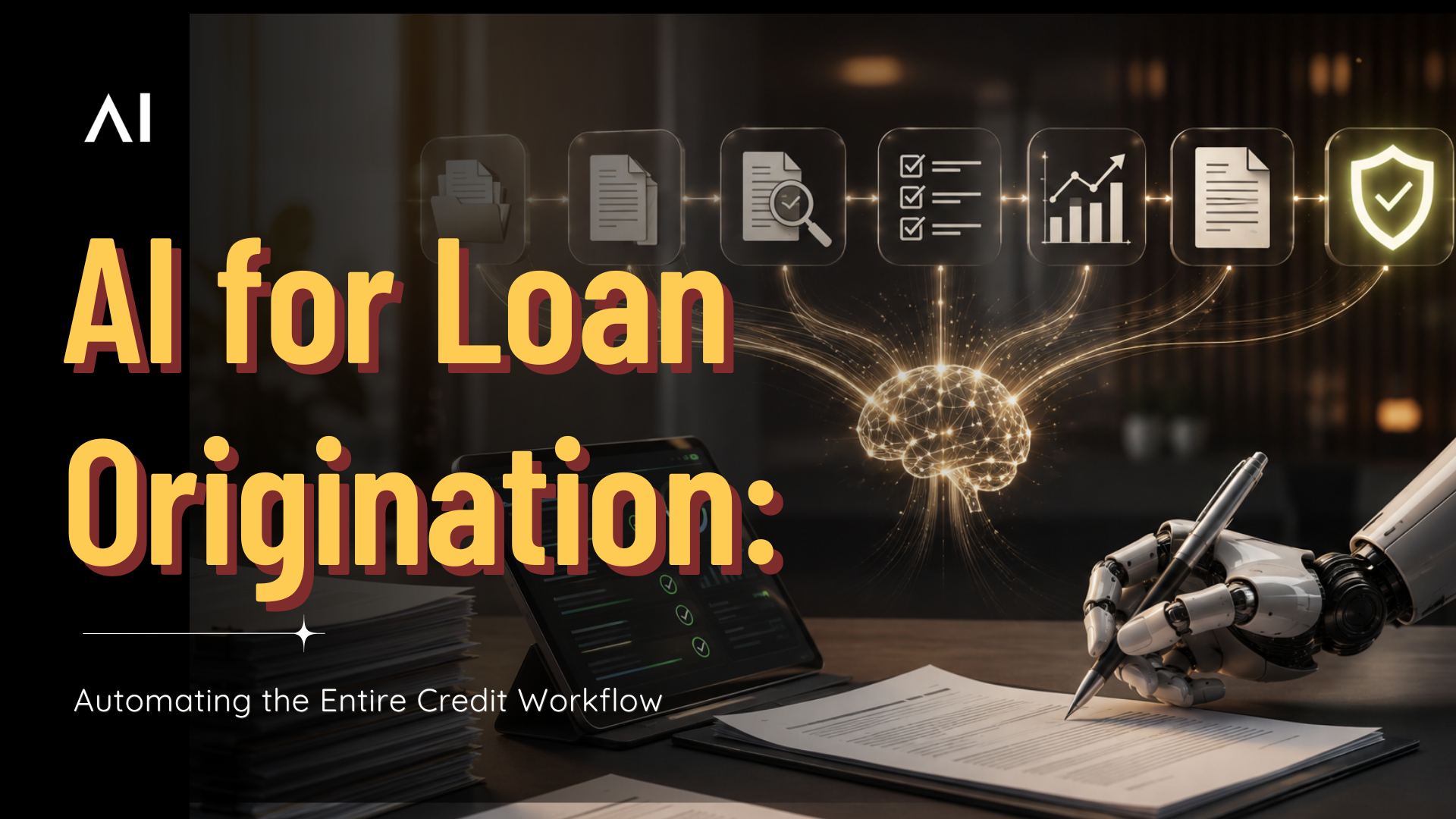
Loan origination automation used to mean a faster form and a few rules firing in the background. That is no longer the ceiling. With agentic AI, the entire credit workflow, from document intake to underwriting to a fully drafted credit memo, can now run on its own, with your analyst stepping in only to review and decide.
Here is the short version, if you only read one paragraph. A corporate loan origination process today takes two to three days and touches five to seven systems, and roughly 80% of that work is mechanical, not analytical. Autonomous AI agents collapse that mechanical 80% into minutes by reading the documents, pulling data from every system, applying your credit policy, and drafting the memo in your own format. The analyst keeps the judgment. The assembly disappears.
This guide breaks down how AI for loan origination actually works, where the time goes today, and what separates a real agentic system from a chatbot bolted onto a form.
What is loan origination?
Loan origination is the end-to-end process a lender runs from the moment an applicant applies to the moment a credit decision is made. For a commercial loan it typically includes application intake, document collection, KYC and onboarding, financial spreading, credit analysis, credit memo preparation, review, and the final approve or decline.
Most of this lives inside a loan origination system, or LOS, but the data an analyst needs is scattered far wider: core banking, the credit bureau, statement tools, borrower portals, spreadsheets, and email. That fragmentation is the root of the problem AI is now solving.
Why the loan origination workflow is so slow
Ask a credit analyst where their week goes and the honest answer is rarely "making decisions." It is gathering and re-keying data.
A single corporate credit memo touches five to seven systems. The analyst logs into the LOS, downloads documents, opens the core banking system, checks the bureau, spreads the financials into a spreadsheet, and reads through an email thread. Then they copy all of it into the bank's memo template by hand.
The result: a corporate credit memo takes two to three days of active work, and with backlogs it can be a week to ten days before a decision reaches the applicant. By then the borrower has often applied to three other lenders. When we asked credit teams how much of this work is genuinely analytical, the answer came back at 20%. The other 80% is mechanical, looking data up in one place and typing it into another.
That 80% is exactly what AI for loan origination is built to remove.
What "AI for loan origination" actually means in 2026
The term covers a wide range, and the difference matters.
The old approach was rules and RPA: an automated loan processing system that could route an application or flag a missing field, but that broke the moment a case fell outside its script. Lending is full of edge cases, which is why so much of it was never automated. You cannot write a flowchart for every application.
The new approach is agentic. Instead of a fixed script, you give an autonomous AI agent the documents and the template, the same way you would brief a junior analyst, and it figures out the steps itself. It reads unstructured documents, decides what data it still needs, retrieves it from the right system, applies your credit policy, and produces the output. This is the shift from an automated underwriting system that follows rules to an agentic one that reasons through the work.
This agentic approach is the foundation Fluid AI's platform is built on, and it is the distinction that decides whether AI actually helps: a chatbot answers questions, an agent completes the task.
The end-to-end automated loan origination workflow, step by step
Here is what a fully agentic loan origination system workflow looks like in practice, using credit memo generation as the example.
Intake. The application and its documents land in the LOS: PAN, GST, audited financials, incorporation papers, and a due diligence report. The analyst uploads once. That is the only manual step.
Information retrieval. An agent reads the application and the uploaded files and structures them into clean, usable data, pulling directly from the LOS and core banking rather than waiting for a human to download PDFs.
Due diligence. A second agent takes the extracted company identifier and fetches independent company data from external sources such as the corporate registry and tax databases, connected through the Model Context Protocol so integrations stay clean and governed.
Credit policy scoring. A third agent applies the bank's own credit policy, a document that can run hundreds of pages, and assesses the application against it consistently, the same way every time.
Autonomous credit memo generation. A final autonomous agent takes everything the chain produced, drafts the full memo in the bank's template, organizes prior-year financials into clean tables, flags early warning signals, and writes the compliance and due diligence sections. It then uploads the finished memo back into the LOS through the API.
This is exactly the workflow Fluid AI runs in production today. What comes out is a complete, 24-page credit memo. What used to take two to three days is done in minutes, and the analyst opens a finished draft to review and decide.
From point tools to autonomous agents: the real difference
Most "AI lending" tools automate one step. A document reader here, a scoring model there. The gap between that and an agentic system is where the value sits.
Autonomous agents run the whole workflow, not a slice of it. And they use a sub-agent architecture: a master agent can spawn specialized sub-agents to handle parts of the task in parallel. If it needs to research five entities, it does not do them one after another, it dispatches five sub-agents at once. That makes the work faster, and it makes each agent more accurate, because each one holds only the context it needs instead of drowning in everything.
Three design choices make this work inside a bank, and they are the ones Fluid AI treats as non-negotiable:
Model Context Protocol (MCP) lets the agents talk to your LOS, core banking, bureau, and government data sources through a standard interface, so integrations are governed and portable rather than hand-wired.
Human in the loop is built in. The agent drafts to the best of its ability and red-flags anything that needs an analyst's eye, like a mismatch between the bureau figure and the core banking figure, right inside the memo. The analyst reviews the red lines and decides.
Guardrails against hallucination ensure that when the system moves a number from one system into the memo, it moves it exactly, with no invented figures. Where data genuinely is not found, it is marked as not available rather than guessed.
This is why agentic AI unlocks loan origination automation that rules engines never could. You are not spending six months codifying a process. You brief the agent like an employee and it goes.
Loan origination: manual vs agentic, side by side
The difference shows up at every step of the process.
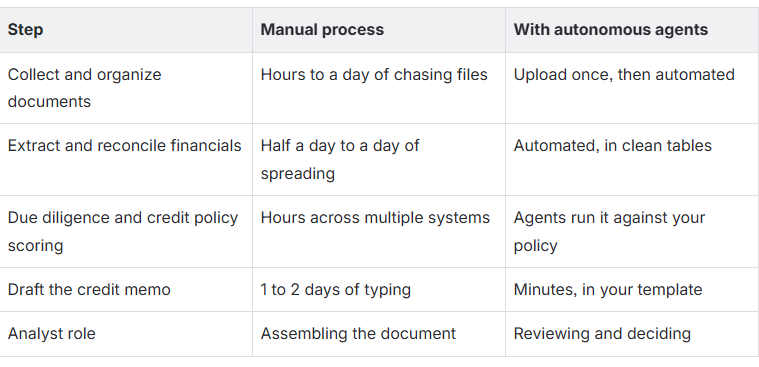
What used to take two to three days is done in minutes.
What to look for in an AI loan origination system
If you are evaluating an automated loan approval system, four things separate a real one from a demo.
It connects to your systems. It should work inside your existing LOS and core banking, not sit in a silo. If your team still does the data gathering, you have a glorified chatbot.
It runs on-premise. Loan applications are among your most sensitive data. The AI and the models should come to your environment, not send your data to a third-party cloud.
It keeps a full audit trail. Every extraction and action logged, because lending is a regulated environment and you will need to explain any decision later.
It keeps the analyst deciding. The system should remove the assembly, not the judgment.
An AI loan origination platform that does all four speeds the work without moving the risk. This checklist is a fair way to test any vendor, Fluid AI included.
Security and compliance for banks
Speed only matters if it fits a regulated environment. A serious agentic system deploys on-premise or in your private cloud, so borrower data never leaves your infrastructure. It logs every action for a complete audit trail, and its outputs stay aligned with your internal controls and regulatory obligations.
Fluid AI is ISO 27001 certified and SOC 2 Type II audited, supports 60+ languages, and typically deploys in about 12 weeks. We run 14+ live production solutions with enterprises including Bank of America, Barclays, and Mastercard, so the approach is proven in exactly these environments, not theoretical.
How Fluid AI automates your loan origination workflow
Fluid AI is an enterprise agentic AI platform built for banks and financial institutions. The loan origination workflow described above is not a concept, it is what our autonomous agents do in production: read the documents, pull data from your LOS, core banking, and bureau sources through MCP, apply your credit policy, and draft the full credit memo in your own format, with your analyst reviewing and deciding.
The result for a lending team is straightforward. The mechanical 80% of credit work runs in minutes instead of days, throughput goes up without adding headcount, and your best analysts spend their time on judgment rather than data entry. All of it runs on-premise, backed by ISO 27001 and SOC 2 Type II, with a full audit trail and a human in the loop at every decision.
How to get started with Fluid AI
Book a demo at http://fluid.ai and see the agents run a credit memo end to end on a sample application.
Share a sample workflow. Bring one of your real loan origination flows and we will map how the agents would handle it, including the systems they need to connect to.
Run a scoped pilot. We deploy on-premise, integrate with your LOS and core banking, and typically go live in about 12 weeks.
Scale across use cases. Once credit memos are running, the same agentic approach extends to KYC, collections, customer support, and more.
To start, visit http://fluid.ai and book a demo, or reach the team directly at info@fluid.ai.
Book your Free Strategic Call to Advance Your Business with Generative AI!
Fluid AI is an AI company based in Mumbai. We help organisations kickstart their AI journey. If you're seeking a solution for your organisation to enhance customer support, boost employee productivity and make the most of your organisation's data, look no further.
Take the first step on this exciting journey by booking a Free Discovery Call with us today and let us help you make your organisation future-ready and unlock the full potential of AI for your organisation.
_1790254083168-CB8e8KXC.png)