Agentic AI in Healthcare: From Hospital Backlogs to Autonomous Care Workflows

TL;DR
Hospitals don’t struggle with medical expertise — they struggle with coordination.
Agentic AI fixes the slow handoffs across triage, labs, radiology, discharge, insurance, and patient support.
Multi-agent workflows + secure on-prem LLMs unlock automation that’s safe for PHI.
Staff get hours back, patients move faster, operations stop depending on human “glue.”
Multi-LLM orchestration (a core Fluid AI strength) drives accuracy, safety, and auditability.

The Real Bottleneck in Healthcare Isn’t Medicine — It’s Movement
Agentic AI in healthcare is not about replacing clinical judgment. It is about fixing the coordination that slows every hospital down. Walk into a hospital on any Monday morning: triage is backed up, radiology is scrambling, labs are out of sync, billing is behind, and the discharge list barely moves.
The issue isn’t clinical skill. The issue is that one patient journey touches 7–12 systems, none of which talk to each other.
EHR
PACS
LIS
Pharmacy
Insurance portals
Billing
Care coordination tools
Humans end up serving as the hospital’s unofficial API layer.
And that’s exactly where agentic AI fits.
A Quick Story: Asha’s Hospital Journey
Asha arrives with chest discomfort.
Here’s how her day usually goes:
She waits 40 minutes at triage.
Her ECG is done, but the report reaches the cardiologist late.
Radiology has an open slot, but no one noticed.
Insurance pre-auth pauses treatment for 6 hours.
Discharge takes 4 hours because pharmacy, billing, and housekeeping aren’t aligned.
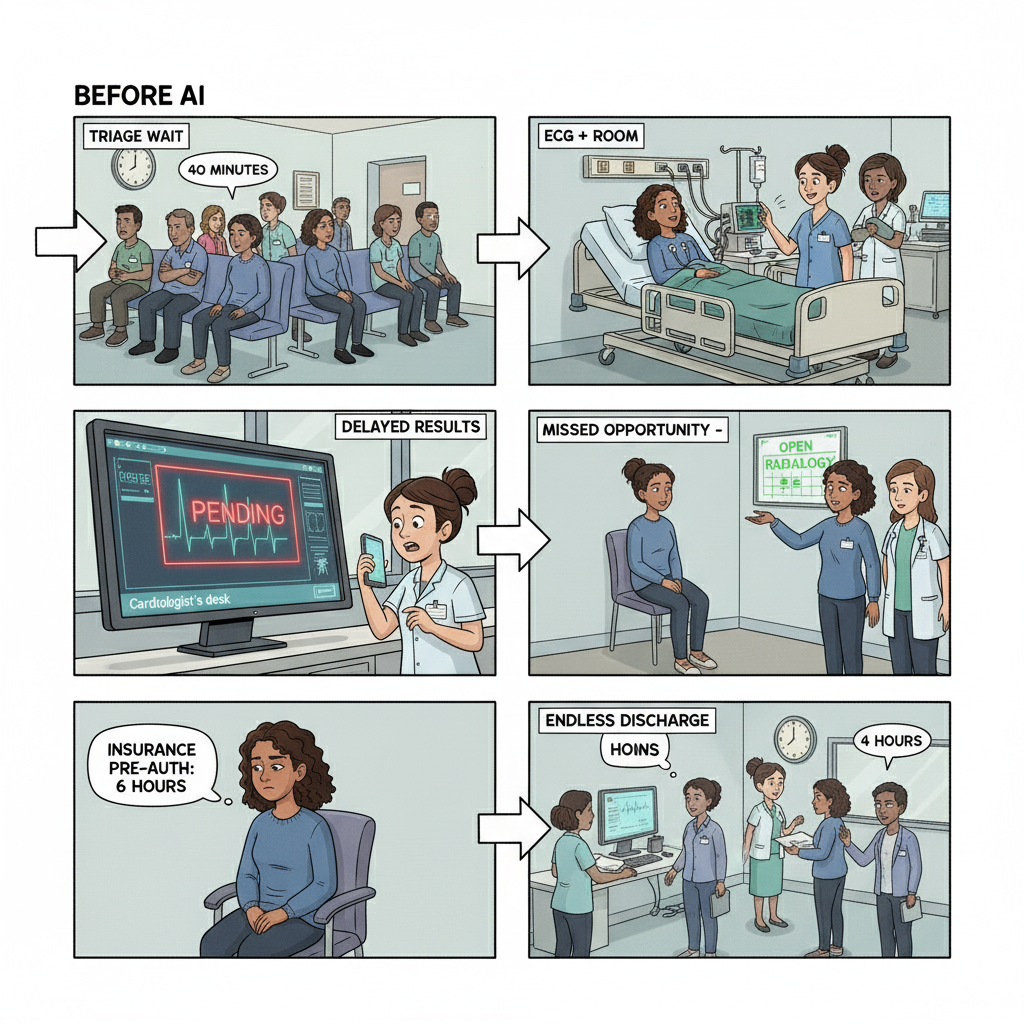
Patients Journey in a Hospital before any AI Implementations
Now layer in agentic AI:
Intake is done automatically before she reaches the desk.
ECG + labs sync in real time.
Radiology slot gets booked instantly.
Pre-auth packet goes out in minutes, not days.
Discharge collapses from hours to under 45 minutes because every team gets triggered at the right moment.
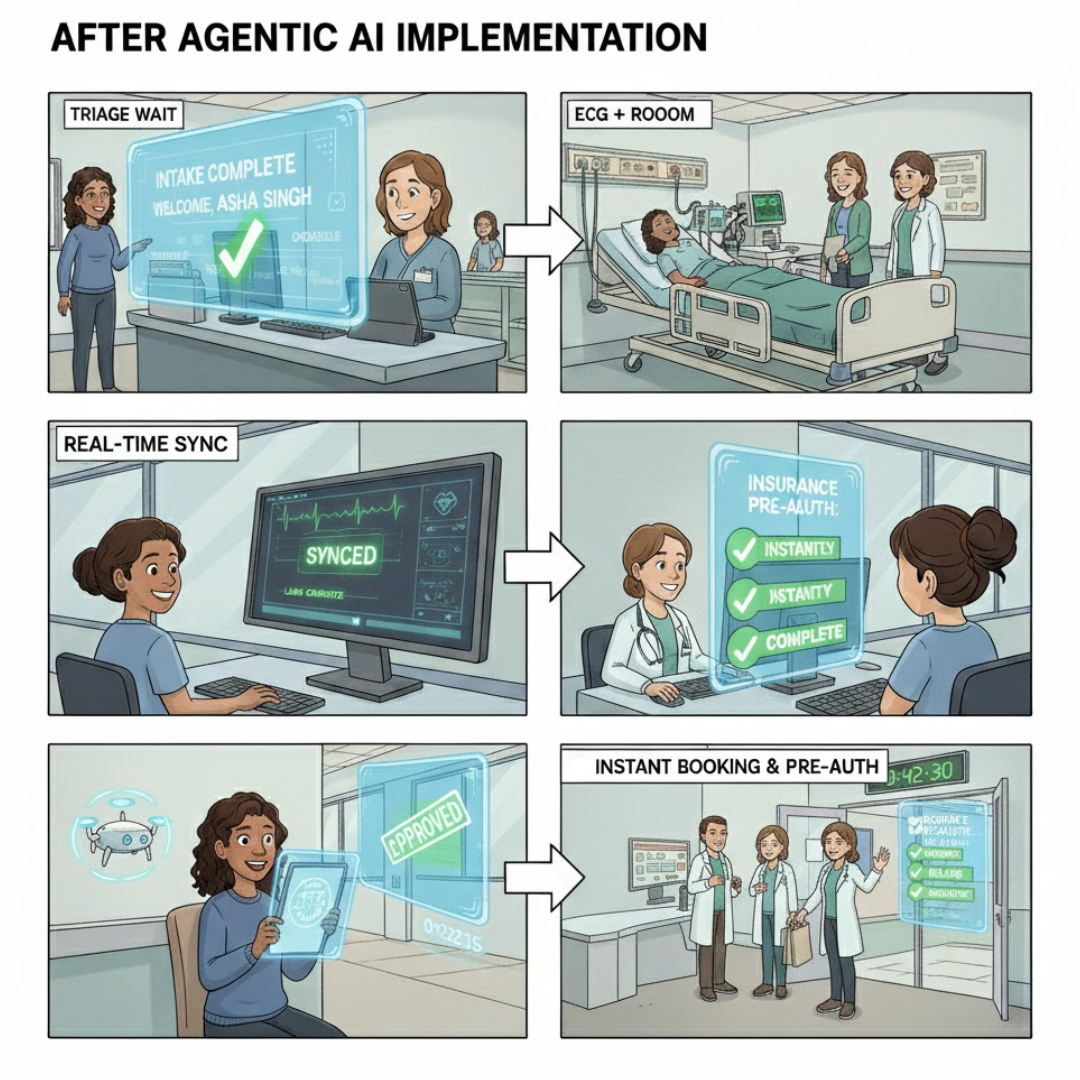
Patients Journey in a Hospital after Agentic AI is Implemented
Same hospital. Same doctors.
Just better coordination.
How Agentic AI in Healthcare Actually Works
Agentic AI in healthcare works by putting a layer of coordinating agents across the systems that already exist, EHR, PACS, LIS, pharmacy, insurance, and billing, so a patient journey moves without a human stitching each step together. One agent watches for the ECG report and routes it to the cardiologist the moment it is ready, another books the open radiology slot, another starts the insurance pre-auth in parallel instead of in sequence. The clinical decisions stay with clinicians. The movement between steps, the part that actually causes the backlog, becomes autonomous.
What Agentic AI Actually Does Inside a Hospital
It’s not a chatbot with medical trivia.
It’s a digital workforce that can:
interpret clinical + admin data
trigger workflows across systems
schedule, track, escalate
write back into the EHR/RIS/LIS
coordinate transport, pharmacy, housekeeping
keep a full audit trail
ask humans for approvals when needed
It doesn’t replace clinicians — it replaces the busywork that slows clinicians down.
Agents can do all of this in seconds:
auto-generate radiology orders
complete insurance packets
track lab samples
draft discharge summaries
escalate risky symptoms
guide patients on WhatsApp or IVR
sync pharmacy + billing + transport
6 Hospital Workflows Agentic AI Can Automate Today
Patient Support & Navigation
Appointment reminders, FAQs, billing, routing, WhatsApp follow-ups.AI-Driven Triage & Intake
Symptoms, history, insurance, ID, urgency scoring.Lab & Radiology Orchestration
Orders, slots, tracking, notifications, next-step triggers.Insurance Pre-Auths & Claims
Extraction, form-fill, submission, follow-ups, escalation.Bed Management & Discharge
Summary drafting, pharmacy readiness, cleaning triggers, bed release.Clinical Documentation
SOAP notes, consults, radiology narratives — clinicians just edit & sign.
Why Healthcare Is Practically Built for Agentic AI
The entire ecosystem is:
rule-driven
predictable
cross-department
time-sensitive
high volume
fully auditable
And here’s the thing:
Platforms like Microsoft Healthcare Agent Orchestrator already validate that AI can safely coordinate imaging, EHR, billing, and oncology workflows.
A Little on Risk (and How You Control It)
You can’t allow an AI system to:
mis-route a high-risk patient
hallucinate clinical data
violate PHI protection
bypass approvals
make undocumented decisions
That’s why the governance layer matters:
on-prem or private cloud
RBAC + strict permissions
zero external API calls
human-in-loop checkpoints
full action logging
Get this right, and you get safe automation that scales.
Before vs After: What Hospitals Actually Feel

Workflow Before After Triage Queues + manual collection Automated intake + instant routing Radiology Delays, missed slots Always-on scheduling + tracking Insurance Weeks of chasing AI does submission + follow-ups OT Scheduling Chaos, overlaps Optimized, updated in real time Discharge 3–6 hours 30–45 minutes Patient Support Long waits 24/7 automated, multilingual
But How Should Hospitals Start?
1. Pick high-pressure workflows
Where the time loss is obvious:
radiology
pre-auths
discharge
patient support
2. Launch one workflow agent
Ideal first steps:
radiology orchestration
24/7 patient support
insurance automation
3. Expand into multi-agent coordination
Once ROI is clear, layer on:
bed management
OT scheduling
clinical documentation
lab–pharmacy–billing sync
The Near Future: Hospitals That Think While You Heal
You’ll see hospitals where:
routing is automatic
care teams get real-time updates
insurance no longer causes delays
patients feel guided and informed
operations run without micromanagement
This isn’t a “future of healthcare” prediction. It’s already happening in parts of India, the US, and Europe — just unevenly distributed.
Conclusion
Hospitals don’t need bigger dashboards.
They need workflows that move.
Agentic AI fixes the invisible bottlenecks that slow care and drain staff capacity. With a secure, multi-agent, multi-LLM setup, hospitals unlock:
faster care delivery
reduced burnout
smoother insurance cycles
higher throughput
better patient experience
The organizations that adopt this early won’t just streamline operations — they’ll set the benchmark for what modern patient-centered healthcare feels like.