Which Task Is a Generative AI Task? Understanding Generative vs Predictive AI

TL;DR
A generative AI task is any task where the AI creates new content: writing text, generating images, producing code, summarizing documents, or composing audio. If the AI produces something new, it is generative. If it only sorts, scores, predicts, or classifies existing data (spam detection, fraud scoring, churn prediction), it is not, that is predictive or traditional AI. The simple rule: generative AI makes, traditional AI decides. In enterprises, the two work together, a generative model drafts the output while a governed layer decides what happens next.
A generative AI task is any task where the AI creates something new, such as writing text, generating an image, producing code, drafting a summary, or composing audio. If the model produces fresh content, it is a generative AI task. If it only sorts, scores, predicts, or labels existing data, it is not.
That single line is the whole answer. The rest of this guide shows you exactly which tasks count, which ones do not, and how generative AI differs from the predictive and traditional AI it often gets confused with.
Quick answer: generative vs not generative
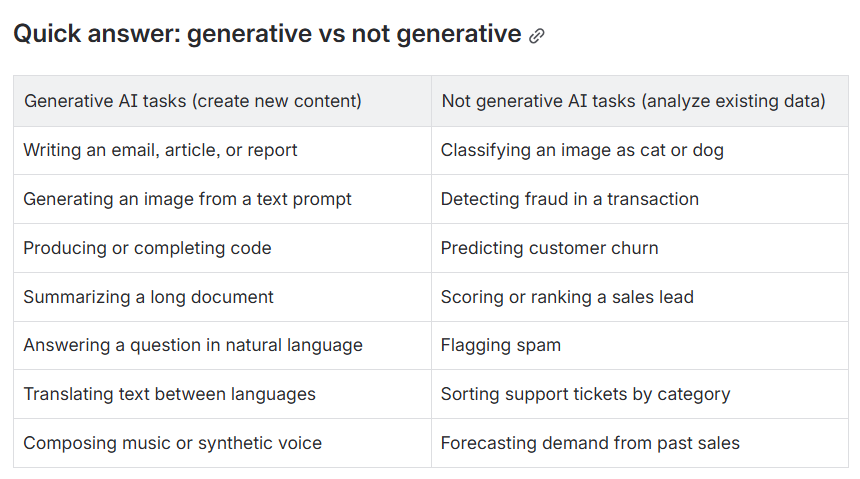
The pattern is simple: generative AI makes, traditional AI decides.
What makes a task a generative AI task?
A task is generative when the output is new content that did not exist before, produced from patterns the model learned during training. Generative models learn the underlying structure of language, images, or code, then generate original outputs that fit that structure.
This is what makes generative AI unique. Previous AI systems have been created to identify and respond – perhaps what class the thing is in or what number comes next. Generative AI is designed to create. It can write a first draft of an image, a policy or a function and produces the artifact instead of evaluating one that exists.
So the test for any task is one question: is the AI producing new content, or is it making a decision about existing data? Producing content is generative. Making a decision is not.
Which tasks are generative AI tasks?
These are simple use cases of Generative AI tasks:
Text generation: drafting emails, blog posts, product descriptions, or summaries.
Code generation: writing functions, converting requirements into code, or explaining a code block.
Image generation: creating a visual from a prompt or editing an existing image with new elements.
Audio generation: synthesizing speech, cloning a voice, or composing music.
Conversation: producing natural-language answers in a chatbot or assistant.
Data-to-text: turning a table of numbers into a written narrative.
Translation and rewriting: converting text into another language, tone, or format.
When you are filling out an exam or certification question, and one of the options is to create, draft, generate, summarize, or compose, chances are high that you are being asked to perform a generative AI activity.
Which tasks are NOT generative AI?
These are some typical non-generative AI tasks. They analyze or predict, but don't create with machine learning:
Classification: labeling an email as spam or not spam.
Prediction: forecasting next quarter's sales.
Detection: spotting fraud or anomalies.
Recommendation: ranking products a user might like.
Clustering: grouping customers by behavior.
Optimization: choosing the fastest delivery route.
The work of predictive and traditional AI. They are useful and strong, but they do not create new content, they are not generative AI tasks.
Generative AI vs predictive, traditional, and conversational AI
The categories are often confused, which is the source of most of the confusion with "which task is a generative AI task". Let's take a look at their differences.
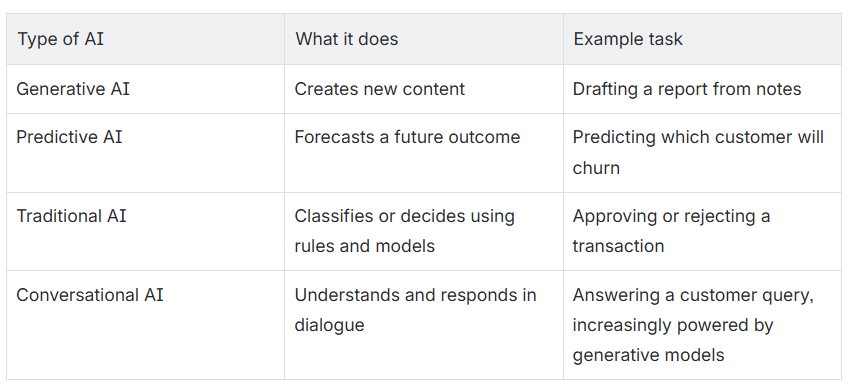
Conversational AI is the overlap that trips people up. Older chatbots followed scripted rules and were not generative. Modern conversational AI is usually generative underneath, because it produces its replies rather than picking them from a fixed list.
What would be an appropriate task for using generative AI?
A generative AI task is a task that ends with a useful artifact that needs to be generated rapidly, such as a first draft or a summary or a response or a piece of code or a design. It's a good match for content-heavy work, work that is repetitive to type, and work that would be useful to have reviewed by a human as a starting point to work on quickly.
In an enterprise, the most valuable generative activities are grouped around:
Creating and summarising documents, contracts and reports.
Providing answers to employee and customer queries from within the organisation.
Creating and checking code.
Creating initial marketing, support and policy materials.
The application of generative AI is less suitable when the task requires one right and verifiable answer – like granting a credit card or rejecting a fraudulent request. Those are predictive or rules-based tasks, and treating them as generative is a common and costly mistake.
Where generative AI fits in an enterprise stack
In production, generative AI rarely works alone. The strongest enterprise systems combine both kinds of AI: a generative model drafts the response, and a predictive or rules-based layer decides what is allowed to happen next. A generative model can write a customer reply, while a separate governance layer decides whether it can be sent, escalated, or blocked.
This is the transition from monolithic to agentic systems with generative reasoning encapsulated in orchestration, guardrails and access to real enterprise data. This is where content creation turns into something that a regulated business can truly utilize. Self-service with generative answers, under the control of an enterprise control layer, serves more than 60,000 employees a day for enterprises running Fluid AI.
It's helpful in understanding the difference between agentic AI vs generative AI and to review real agentic AI use cases before deciding where generative fits.
Book your Free Strategic Call to Advance Your Business with Generative AI!
Fluid AI is an AI company based in Mumbai. We help organisations kickstart their AI journey. If you're seeking a solution for your organisation to enhance customer support, boost employee productivity and make the most of your organisation's data, look no further.
Take the first step on this exciting journey by booking a Free Discovery Call with us today and let us help you make your organisation future-ready and unlock the full potential of AI for your organisation.
Frequently asked questions
1. What is the difference between AI and generative AI?
AI is a term that encompasses all the machines that can do something that normally requires human intelligence. Generative AI is one aspect of it, specifically generating new content instead of just classification and prediction.
2. How does generative AI work?
It learns from a huge number of training examples, and then produces new examples, one by one, that are consistent with the structure it learned. It makes predictions and generates the next token in a loop until the response is finished for text.
3. What is a non-generative AI task?
Any work which is based in analysis of the data rather than generating new content, like spam detection, fraud scoring, churn prediction, or image classification.
4. What makes generative AI unique?
Generative AI, as opposed to recognition or decision-making AI, can create original content, with the power to draft, design and compose rather than just judge.
5. What are the advantages of generative AI?
It accelerates the process for content-rich production, offers solid first drafts, facilitates large-scale knowledge access and allows teams to shift their attention from blank pages to review and judgment.
6. What would be an appropriate task for using generative AI?
Generating a draft, a summary, an answer, an image or a piece of code, particularly when read by a human. It is not suitable for answering questions that require one right, verifiable answer.
_1790254083168-CB8e8KXC.png)