Types of Neural Networks Explained: What Each One Is Actually Good For

TL;DR
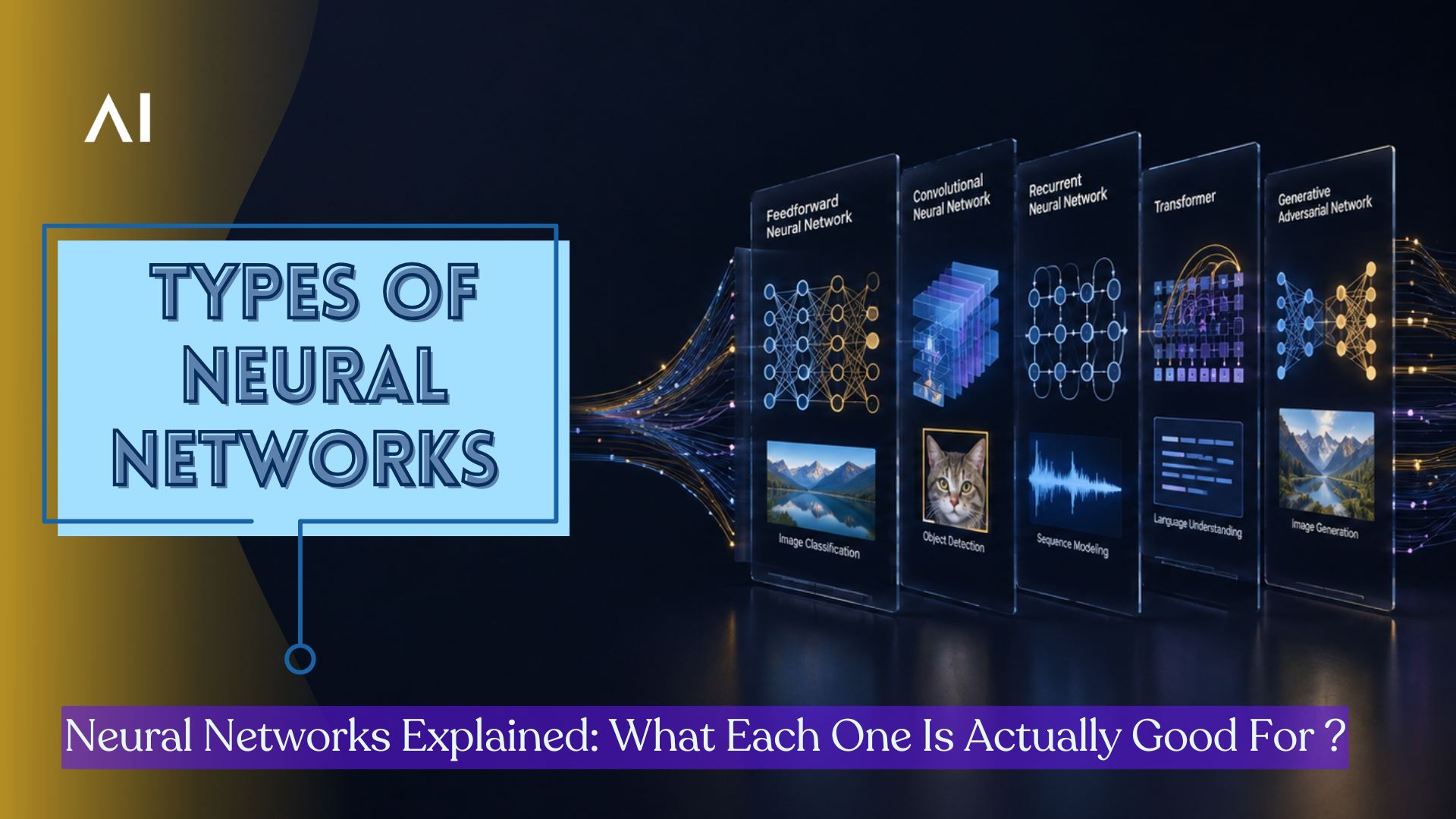
Neural network types aren't interchangeable, each is built for a different shape of data, and picking the wrong one is why projects underperform.
Feedforward (FNN/MLP): structured, tabular data.
CNNs: images and spatial data.
RNNs / LSTMs: sequences and time-series.
Transformers: language and any task where relationships across the whole input matter (the architecture behind every LLM).
GANs / diffusion: generating content and images.
GNNs: relationship and network data (fraud rings, recommendations).
The rule: match the architecture to the structure of your problem, and you're halfway there before training begins.
Most explanations of neural networks stop at the neuron-and-layers diagram and call it a day. Useful once. But if you're a developer or analyst deciding what to actually build with, the question isn't "what is a neural network", it's "which type fits my problem, and why."
Because they're not interchangeable. A network that's brilliant at images is poor at sequences. The one powering ChatGPT would be overkill for a tabular fraud model. Picking the wrong architecture is how projects end up slow, expensive, and underperforming for reasons that have nothing to do with the data.
Here's a practical tour of the main types of neural networks, what each is genuinely good at, where it breaks, and when to reach for it.
1. Feedforward neural networks (FNN / MLP)
The original and simplest architecture. Data flows one direction, input to hidden layers to output, with no loops. Also called a multilayer perceptron.
Good at: structured, tabular data. Classification and regression where the input is a fixed set of features (credit scoring, churn prediction, demand forecasting).
Where it breaks: anything with structure across space or time. It treats every input feature as independent, so it has no concept that pixels near each other are related, or that word three comes after word two.
Reach for it when: you have a clean feature table and a straightforward predict-a-number-or-class problem. Honestly, for a lot of tabular tasks, a gradient-boosted tree still beats it, so use an FNN when you specifically want a neural approach or need it to slot into a larger network.
2. Convolutional neural networks (CNNs)
The architecture that made deep learning famous. CNNs use convolutional layers, filters that slide across the input detecting local patterns (edges, then shapes, then objects), building from simple features to complex ones.
Good at: anything spatial. Images above all, image classification, object detection, medical imaging, but also any grid-like data. In enterprise settings this is your document scanning, defect detection on a production line, and computer-vision safety checks.
Where it breaks: sequences and long-range dependencies. A CNN sees local patterns well but doesn't naturally model "this depends on something that happened much earlier."
Reach for it when: the input is an image or has spatial structure. If you're doing OCR, visual inspection, or anything with a camera, you're almost certainly using a CNN somewhere.
3. Recurrent neural networks (RNNs), and LSTMs / GRUs
Built for sequences. RNNs process data step by step, carrying a hidden "memory" of what came before, so order matters. Because plain RNNs forget across long sequences, the practical versions are LSTMs and GRUs, variants with gating mechanisms that hold onto information longer.
Good at: ordered data where context accumulates, time-series forecasting, sensor streams, early speech and text work, log analysis.
Where it breaks: long sequences and speed. Because they process step by step, they're slow to train and still struggle to connect things very far apart in a sequence. This is exactly the weakness transformers were invented to fix.
Reach for it when: you have genuine sequential/time-series data and moderate sequence lengths, forecasting, anomaly detection on sensor data. For language specifically, transformers have largely replaced them.
4. Transformers
The architecture behind the modern AI wave, and the one every LLM is built on. Transformers dropped step-by-step recurrence in favour of attention, a mechanism that lets the model weigh how much every element of the input relates to every other, all at once. That solves the two RNN problems in one move: it captures long-range dependencies and it parallelises, so it trains far faster at scale.
Good at: language above all (translation, summarisation, generation, the whole LLM stack), but attention turned out to be general, so transformers now also do vision, audio, and multimodal tasks.
Where it breaks: cost and data hunger. Attention scales quadratically with sequence length, so very long inputs get expensive, and big transformers need enormous data and compute to train from scratch (which is why most teams fine-tune existing ones rather than build their own).
Reach for it when: the task is language, or any problem where relationships across the whole input matter. For most enterprise NLP now, you're using a pretrained transformer, not training one.
5. Generative architectures: GANs and diffusion models
Two families built to create rather than classify.
GANs (generative adversarial networks) pit two networks against each other, a generator making fakes and a discriminator trying to catch them, until the fakes are convincing. Strong for image generation and synthetic data, though notoriously tricky to train stably.
Diffusion models generate by starting from noise and progressively refining it into a coherent output. They now power most state-of-the-art image generation, having largely overtaken GANs for quality and stability.
Reach for these when: you need to generate content, synthetic data, images, augmentation, rather than make a decision about existing data.
6. Graph neural networks (GNNs)
The specialist worth knowing. GNNs operate on graph-structured data, nodes and the connections between them, learning from relationships rather than a fixed feature table.
Good at: problems that are natively networks, fraud rings, recommendation systems, supply-chain and logistics graphs, molecular structures. Anywhere the connections carry the signal, GNNs see what a tabular model can't.
Reach for it when: your data is fundamentally about relationships between entities, not just the entities themselves. Fraud detection across linked accounts is the classic enterprise case.
How to actually choose?
Strip away the names and the choice comes down to the shape of your data:
Tabular / structured → feedforward network (or often a boosted tree).
Images / spatial → CNN.
Sequences / time-series → RNN/LSTM, or a transformer for longer or language-heavy sequences.
Language / relationships across a whole input → transformer.
Generating content → diffusion (or GAN).
Relationship / network data → GNN.
Match the architecture to the structure of the problem, and half the battle is won before you write a line of training code. Get it wrong, and no amount of hyperparameter tuning saves you.
Conclusion
Neural networks look like one technology, but in practice they're a toolbox, and the skill isn't knowing they exist, it's knowing which one fits the problem in front of you. A CNN on tabular data or an RNN on a task that needed a transformer will underperform no matter how much you tune it, and the fix is almost never more epochs. It's the right architecture.
So the useful mental model isn't "neural networks are powerful." It's "each type is powerful at one shape of data." Get that match right, tabular to feedforward, images to CNNs, sequences to RNNs or transformers, language to transformers, generation to diffusion, relationships to GNNs, and the architecture stops being the hard part. Then you can spend your effort where it actually pays off: the data, the problem framing, and the deployment.
Book your Free Strategic Call to Advance Your Business with Generative AI!
Fluid AI is an AI company based in Mumbai. We help organisations kickstart their AI journey. If you're seeking a solution for your organisation to enhance customer support, boost employee productivity and make the most of your organisation's data, look no further.
Take the first step on this exciting journey by booking a Free Discovery Call with us today and let us help you make your organisation future-ready and unlock the full potential of AI for your organisation.
Frequently asked questions (FAQs)
1. What are the main types of neural networks?
The core types are feedforward networks (tabular data), convolutional networks or CNNs (images), recurrent networks and LSTMs (sequences), transformers (language and long-range relationships), generative models like GANs and diffusion (creating content), and graph neural networks (relationship data).
2. What is the difference between a CNN and an RNN?
A CNN is built for spatial data like images, detecting local patterns with sliding filters. An RNN is built for sequential data, processing step by step and carrying memory of previous steps. Different data shapes, different architectures.
3. Why did transformers replace RNNs for language?
Transformers use attention to relate every part of the input at once, which captures long-range context better than step-by-step RNNs and trains far faster because it parallelises. That combination made large language models possible.
4. Which neural network should I use?
Match it to your data: feedforward for tabular, CNN for images, RNN or transformer for sequences, transformer for language, diffusion/GAN for generation, GNN for relationship data.
_1790254083168-CB8e8KXC.png)