Reinventing Merchant Support with Agentic AI — The End of Frustrating Complaint Loops

TL;DR
TL;DR
- Merchant complaints are often slow, manual, and repetitive — draining resources and damaging trust.
- A four-agent Agentic AI Complaint Management Workflow automates resolution with intelligent routing, troubleshooting, and service requests.
- Agents follow document-driven troubleshooting steps, ensuring consistency, compliance, and auditability.
- Results: complaints resolved in minutes instead of days, happier merchants, and reduced operational costs.
- Banks and payment providers gain a new merchant experience edge while freeing up human teams for high-value tasks.

Why Merchant Complaint Management Is Broken
If you’ve ever spoken with a merchant struggling with their POS terminal, you know the frustration. A printer jam during peak hours. A card reader battery that dies mid-transaction. Missing e-statements at month’s end.
The complaint journey today looks like this:
- Merchant calls support.
- Support agent logs complaint manually.
- Issue gets routed (sometimes misrouted) to technical or service teams.
- Merchant repeats their problem to every new person they’re connected with.
- Delays stretch from hours to days.
For merchants, this isn’t just an inconvenience — it’s lost revenue. For banks and payment providers, it’s increased support costs and churn risk.
The core problem? Complaint management is still manual, reactive, and siloed.
Agentic AI: A Merchant-Focused Fix
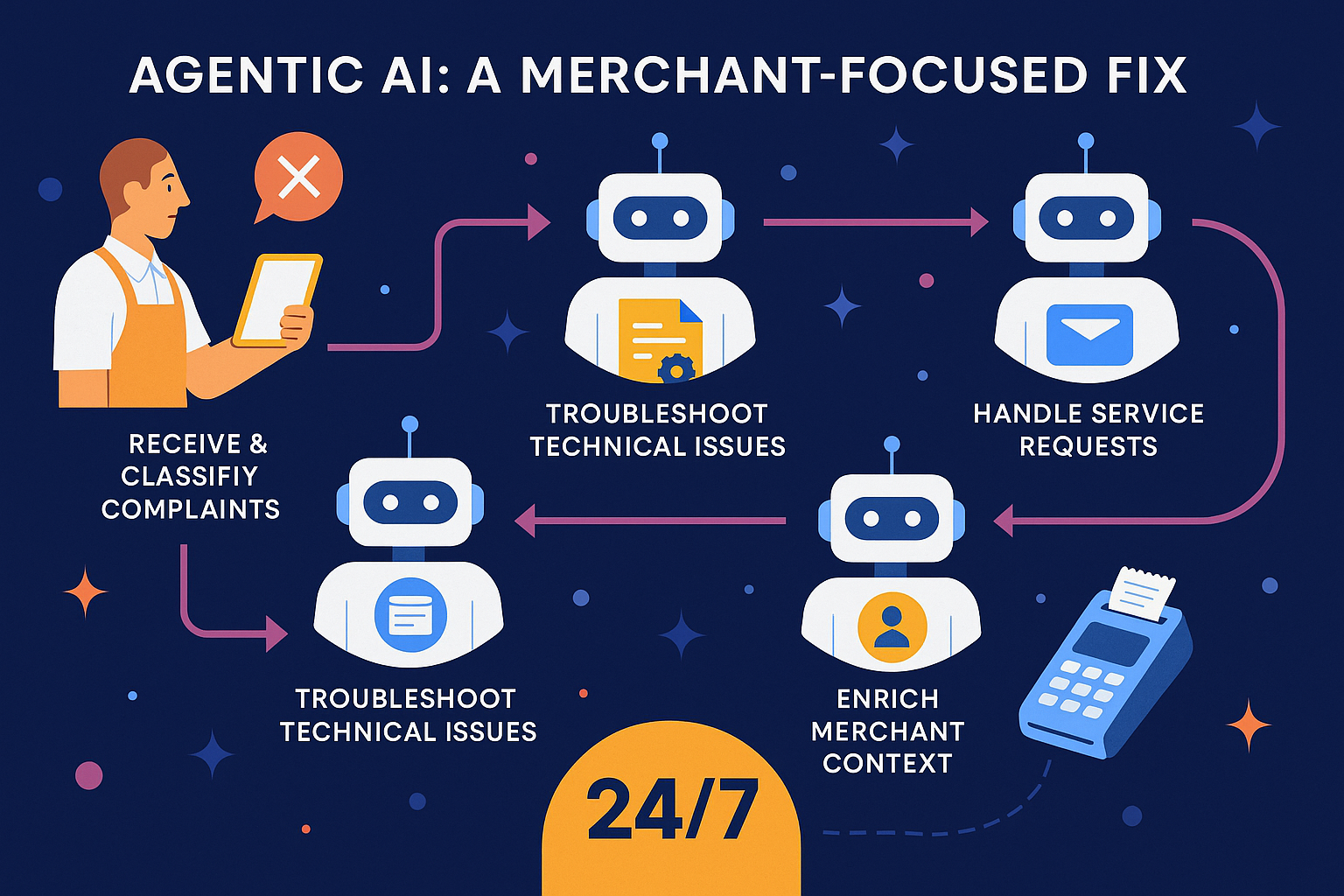
Enter Agentic AI workflows — where complaints don’t bounce between departments but flow intelligently through specialized agents that:
- Receive and classify complaints
- Troubleshoot technical issues using document-based steps
- Handle service requests like e-statements or consumables
- Enrich context with merchant-specific data
Instead of one bloated chatbot that tries (and fails) to do everything, an orchestrated set of micro-agents works in harmony.
Think of it as a digital operations team for merchants — available 24/7, consistent, explainable, and lightning fast.
| Learn more about multi-agent orchestration here..
Smarter Complaint Management with Agentic AI
Traditional complaint desks treat every issue the same, often leading to delays, repeat calls, and frustrated merchants. With Agentic AI, complaints are broken down intelligently and routed to the right resolution path — whether that’s a technical fix, a service request, or contextual account support.
Instead of a one-size-fits-all bot, specialized micro-agents collaborate behind the scenes: some focus on troubleshooting devices, others handle service requests, while others pull in account context to personalize responses. The result is faster resolutions, fewer escalations, and a proactive experience where merchants feel understood, not just processed.
The key difference? AI agents follow structured, approved steps from documentation — no improvisation, no missed checks. Every case is handled consistently, and when human intervention is needed, the system already provides a full log of what’s been attempted.
This streamlined, multi-agent approach turns complaint management from a cost center into a differentiator for merchant experience.
Why Document-Driven Agents Matter
One of the most powerful elements of this workflow is its use of document-based troubleshooting.
Most service organizations already have manuals, Excel sheets, and step-by-step guides for resolving common complaints. But in reality:
- Support agents often forget or skip steps.
- Merchants get inconsistent answers depending on who picks up the call.
- Updates to processes may take weeks to filter through teams.
By embedding these documents directly into the Agentic AI workflow:
- Consistency: Every merchant gets the same resolution path.
- Compliance: Steps are logged and traceable.
- Scalability: New troubleshooting instructions can be added instantly.
It’s not just automation. It’s automation with discipline.
From Chaos to Calm: Merchant POV Benefits
For merchants, this transformation feels immediate:
- No more repeating issues across multiple agents.
- Instant guidance for common terminal problems.
- Transparency: AI shows the troubleshooting steps it has followed.
- Resolution in minutes, not days.
For banks and payment providers, the benefits are equally massive:
- Reduced call center load by 40–60%.
- Lower complaint escalation costs.
- Improved merchant retention — because smoother support is a differentiator.
- Audit trails built automatically for compliance reporting.
In an industry where complaint resolution can make or break trust, Agentic AI provides a merchant experience advantage that competitors will struggle to match.
Use Cases: Complaint Management in Action
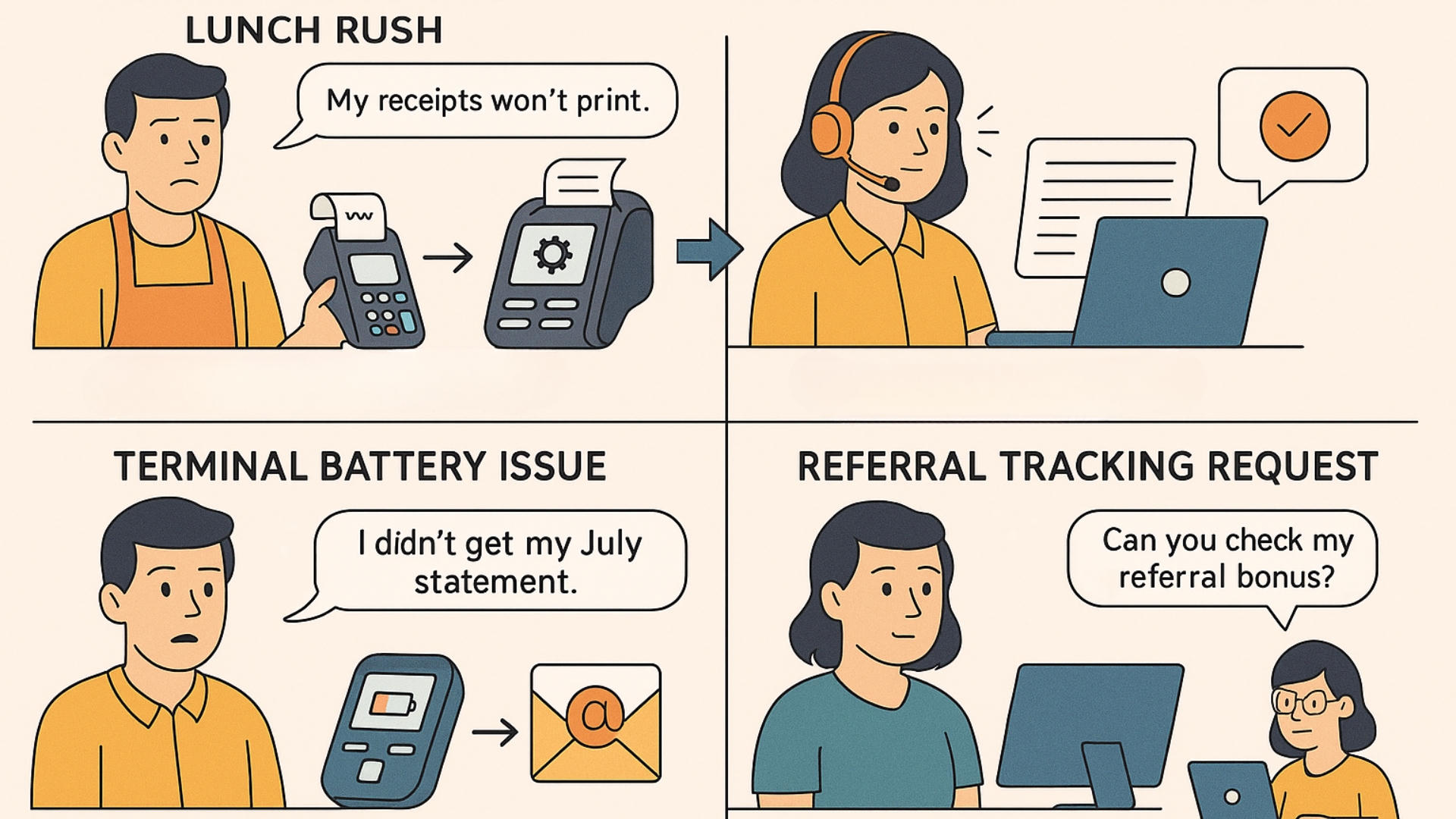
Here’s how the 4-agent system plays out in real-world merchant scenarios:
- Printer Jam During Lunch Rush
- Merchant: “My receipts won’t print.”
- ReceiverAgent → TroubleshootingAgent.
- Troubleshooting runs through printer jam SOP from docs.
- Merchant fixes in 2 minutes instead of waiting 2 hours for tech support.
- Missing Monthly E-Statement
- Merchant: “I didn’t get my July statement.”
- ReceiverAgent → ServiceEnquiryAgent.
- Statement pulled instantly from SQL store, delivered to email.
- Terminal Battery Issue
- TroubleshootingAgent runs diagnostics from docs.
- If unsuccessful, automatically triggers ServiceEnquiryAgent for replacement device, MerchantDataAgent updates merchant on shipment status.
- Referral Tracking Request
- Merchant: “Can you check my referral bonus?”
- ReceiverAgent → MerchantDataAgent.
- Provides real-time referral status and estimated payout.
Why Complaint Management Needs Agentic AI Now
2025 isn’t business as usual. Merchants expect instant, app-like support from their providers. Competitors are already piloting AI-driven workflows. Regulators are demanding auditability of complaint handling.
Without AI:
- Support costs rise unsustainably.
- Complaint turnaround time frustrates merchants.
- Banks risk losing SME and MSME clients to fintech challengers.
With Agentic AI:
- Complaints are logged, routed, resolved, and reported automatically.
- Human teams focus on complex, high-value cases.
- Merchant experience becomes a competitive moat.
Explore Fluid AI’s customer support solutions here..
Integration With Merchant Ecosystems: Beyond Complaint Resolution
Merchants don’t operate in silos. Their POS terminals, ERP systems, CRMs, and accounting platforms are deeply connected — meaning every complaint touches multiple parts of their business.
Agentic AI workflows can integrate directly with these systems so that resolving a complaint isn’t just about fixing the immediate issue but also about syncing the resolution across the merchant’s ecosystem.
- A device replacement request automatically updates the merchant’s inventory and finance systems to reflect shipping, billing, and warranty details.
- A service enquiry like an e-statement retrieval can feed directly into the merchant’s accounting software, ensuring books are closed without delays.
- A referral query can be tied back to CRM data, allowing banks and providers to track merchant satisfaction alongside relationship growth.
This ecosystem-level integration transforms complaint management into a value-add service layer. Merchants see their providers not just as problem solvers but as operational partners — making them harder to switch away from.
Learn about Fluid AI integrations here..
Looking Ahead: Complaint Management as Strategy
This isn’t just an operational fix. It’s a strategic differentiator.
Imagine complaint data feeding into predictive analytics:
- Identifying which terminals are most prone to failure.
- Flagging recurring issues before they spike.
- Creating proactive alerts: “Your device battery is at end-of-life — replacement has been shipped.”
Complaint management shifts from reactive firefighting to predictive service design.
Start building your enterprise Agentic AI playbook here..
Closing Thought: From Burden to Differentiator
Complaint management has always been seen as a cost center. But with Agentic AI, it becomes a brand builder.
Merchants stop viewing support as a burden. They see it as trustworthy, responsive, and proactive. Banks and payment providers slash costs, win loyalty, and satisfy regulators with transparent pipelines.
The future isn’t “call, wait, repeat.”
It’s complain, resolve, move on.
And the shift starts with Agentic AI.
_1790254083168-CB8e8KXC.png)