How to Measure AI ROI in Banking: 5 Signs Your AI Investment Is Paying Off

TL;DR
Measure AI ROI using business outcomes, not just automation rates.
Track cost per transaction to verify actual savings after deployment.
Successful AI integrations should stay within scope and be production-ready in about 60 days.
Compliance and data security are essential for sustainable AI ROI in banking.
Review AI performance every 6–12 months to optimize costs, scalability, and long-term business value.

Most banks are measuring the wrong thing
Ask ten bank CTOs how their AI deployment is performing and eight of them will quote you an automation percentage. Sixty percent of tickets resolved without a human. Seventy percent of KYC cases cleared automatically.
That number feels like proof. It isn't, not on its own.
Automation percentage tells you the system is doing work. It doesn't tell you whether that work is cheaper than what it replaced, whether it's holding up at real volume, or whether it's quietly creating a compliance gap that hasn't surfaced yet. Real ROI is a different question entirely, and it takes longer to answer than a dashboard metric does.
Sign one: the savings show up in your actual cost per transaction
This sounds obvious. It's the check most teams skip.
Pull your cost per interaction or cost per case from before the deployment. Pull it again after six months. If the number hasn't moved in a way that matches what the vendor projected, something's off, whether that's lower than expected automation rates, more exceptions routing to humans than planned, or hidden infrastructure cost eating into the savings.
A vendor's projected ROI is a hypothesis. Your own cost data six months in is the answer.
The gap between those two numbers tells you more than either number alone. A small gap means your model was sound. A large gap means either the deployment underperformed or the original business case was built on assumptions that didn't survive contact with your actual transaction volume.
Sign two: the integration didn't eat your timeline or your engineering team
This is the one that separates deployments that scale from deployments that stall in pilot forever.
A well scoped integration with a banking core, done by a vendor who's actually built connectors for systems like yours before, should land close to 60 days for a single use case. If you're six months in and still fighting authentication layers, data mapping, or middleware quirks nobody flagged upfront, that's not a technical hiccup. That's a sign the ROI model you approved didn't account for the real cost of getting this thing live.
Ask yourself honestly:
→ Did the engineering hours spent match what was scoped, or did they quietly double
→ Is your internal team now capable of maintaining this without the vendor on speed dial
→ Would a second use case take another six months, or would it reuse most of what you already built
If the answer to that last question is "another six months," your ROI math needs to include that as a recurring cost, not a one time setup fee.
Sign three: it survives an audit without anyone sweating
This is the sign most cost benefit spreadsheets miss entirely, and it's the one that matters most in BFSI specifically.
A deployment can hit every savings target and still be a bad investment if it creates regulatory exposure nobody priced in. Where does customer data sit during processing. Does it ever leave your perimeter. Can you explain, in plain terms, to an RBI examiner or an internal compliance team, exactly what happens to a customer's information when the AI system touches it.
On premise and air gapped deployment options exist for exactly this reason. When the model runs entirely inside your own infrastructure, that entire line of questioning gets a lot shorter, and a lot less stressful, than when you're explaining a third party cloud vendor's security posture on someone else's behalf.
If your compliance team needs a week and a lawyer to answer a basic data residency question about your AI deployment, you don't have a finished ROI case. You have an open liability with a good dashboard.
The reverse test: how you know it's not working
Sometimes the clearer signal is the negative one. A few patterns that mean your AI investment isn't paying off, even if the automation numbers look fine on paper:
→ Your contact centre headcount hasn't moved and neither has average handling time, despite a high reported automation rate
→ Exceptions and edge cases are piling up faster than your team can review them, quietly creating a backlog that offsets the speed gains
→ Nobody on your team can explain how the model makes a decision when a customer or regulator asks
→ The vendor relationship feels more like a dependency than a partnership, and every change request comes with a new invoice
Any one of these on its own is worth investigating. Two or more together usually means the deployment needs a hard look before you expand it further.
The ROI Timeline
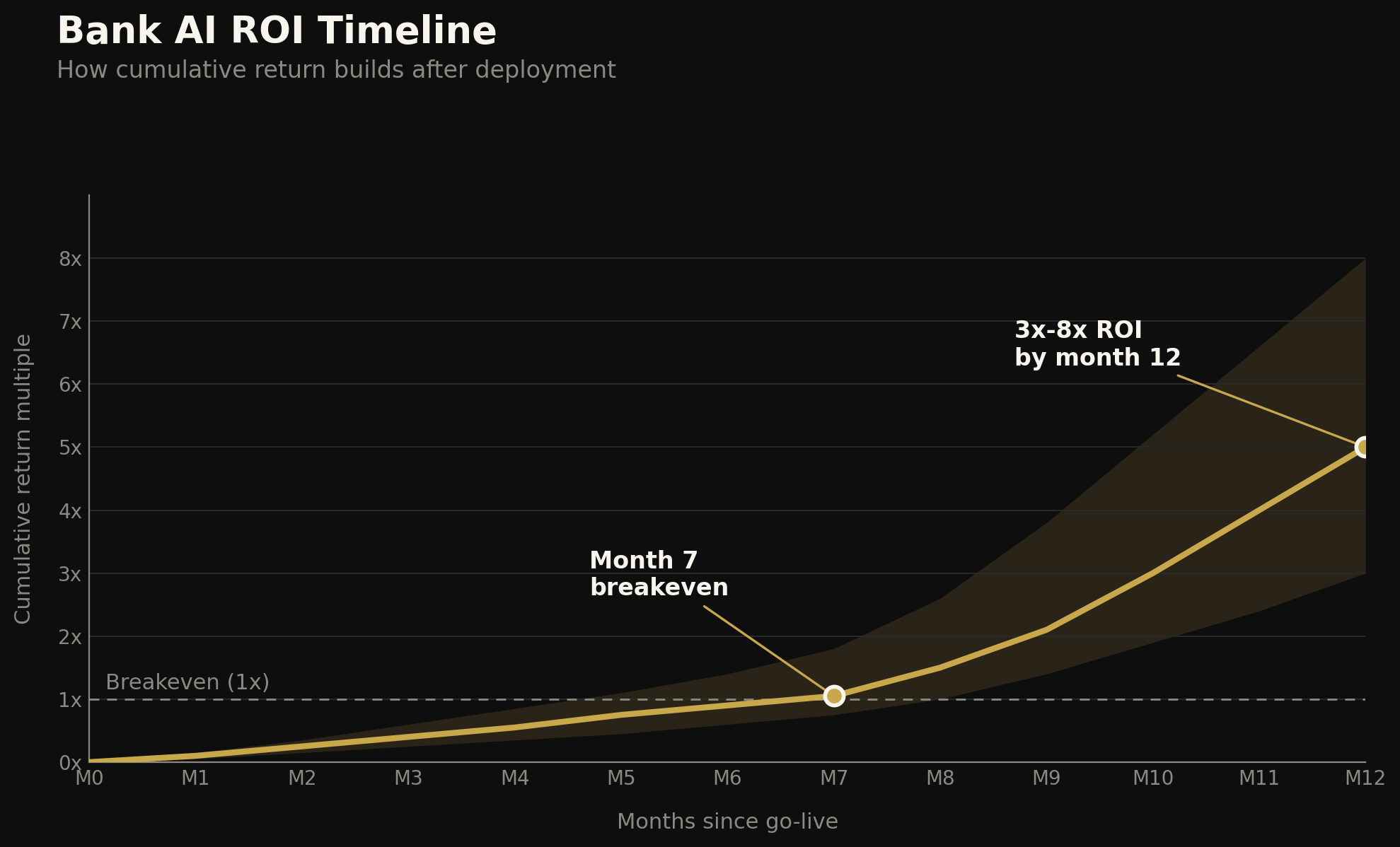
What proven ROI actually looks like at scale
Across enterprise banking deployments Fluid AI has run with institutions like ICICI, HDFC, Barclays, Emirates NBD, HSBC, and NABARD, the pattern that shows up in genuinely successful rollouts is consistent. Deployment timelines land around 60 days. Payback shows up within 6 to 9 months once the system is handling real volume, not pilot volume. ROI in year one lands between 3x and 8x depending on the use case. And the deployments that hold up longest are the ones running on premise or air gapped, because they never generate a compliance question that stalls expansion to a second or third use case.
That last part is easy to underweight when you're focused on getting one use case live. It's the difference that decides whether year two looks like scaling a proven system or restarting the evaluation process from zero because the first deployment created more risk than it removed.
A quick gut check before you present ROI numbers upward
Before you take a number to your CFO or your board, run it through this:
→ Is this savings number based on your actual post deployment data, or the vendor's pre deployment projection
→ Does the total cost of ownership include maintenance, monitoring, and the engineering hours to keep it running, not just the license fee
→ Has this system been tested against your actual peak volume, not average volume
→ Could you explain your data residency setup to a regulator in one sentence
→ If this vendor disappeared tomorrow, what would it cost you to replace or maintain this internally
If you hesitate on more than one of those, the ROI case needs more work before it's ready to scale.
Book your Free Strategic Call to Advance Your Business with Generative AI!
Fluid AI is an AI company based in Mumbai. We help organisations kickstart their AI journey. If you're seeking a solution for your organisation to enhance customer support, boost employee productivity and make the most of your organisation's data, look no further.
Take the first step on this exciting journey by booking a Free Discovery Call with us today and let us help you make your organisation future-ready and unlock the full potential of AI for your organisation.
Frequently asked questions
1. How do banks measure AI ROI?
Banks measure AI ROI by tracking key metrics such as cost per transaction, automation rates, operational efficiency, customer satisfaction, compliance performance, and total cost of ownership. Comparing these metrics before and after deployment provides a clear picture of business impact.
2. How long does it take to see ROI from AI in banking?
Most enterprise AI deployments in banking begin delivering measurable ROI within 6 to 9 months, while full returns typically become evident within the first year once the solution is operating at production scale.
3. What KPIs should banks use to measure AI ROI?
The most important KPIs include cost per interaction, average handling time (AHT), first-contact resolution (FCR), automation rate, customer satisfaction (CSAT), compliance accuracy, and overall operational cost savings.
4. What factors affect AI ROI in banking?
AI ROI depends on several factors, including implementation speed, integration complexity, data quality, user adoption, compliance readiness, infrastructure costs, and the ability to scale AI across multiple banking use cases.
5. What are the signs of a successful AI implementation in banking?
A successful AI deployment reduces operating costs, improves customer service metrics, shortens processing times, scales without major engineering effort, and meets regulatory and security requirements while delivering measurable business value.
_1790254083168-CB8e8KXC.png)