Don't Just Generate, Understand! How Retrieval Augmented Generation Makes AI More Insightful
.png)
Large language models (LLMs) have swept the globe. Their skill in developing unique content of any kind, converting languages, and producing text that is understandable by humans is simply impressive. But there are restrictions, just like with any new technology. LLMs, despite their vast knowledge base, can struggle with tasks that require factual accuracy and keeping information up-to-date. This is where Retrieval Augmented Generation (RAG) steps in, offering a powerful approach to make AI more insightful and reliable.
Understanding the Limits of LLM Knowledge
LLMs are trained on massive amounts of text data. This data allows them to learn statistical relationships between words and sentences. They can use this knowledge to generate creative text formats, translate languages, and comprehensively answer your questions. However, LLMs have two key limitations:
- Static Knowledge Base: LLMs are trained on a fixed dataset. This means their knowledge is limited to what they've been exposed to during training. If a new event, discovery, or trend emerges after training, the LLM won't have access to this information.
- Hallucination: When faced with a question outside their knowledge base, LLMs can resort to "hallucination." This means they might fabricate information that sounds plausible but is ultimately incorrect.
These limitations can be problematic for tasks requiring factual accuracy and up-to-date information. Imagine asking an LLM about a recent scientific breakthrough. It can cause an instructive answer, but in the absence of the most recent research, the data might be false or misleading.
Must Read- Unleash the capability of Explainable Artificial Intelligence (XAI) within the power of Gen AI
Retrieval Augmented Generation (RAG) is introduced.
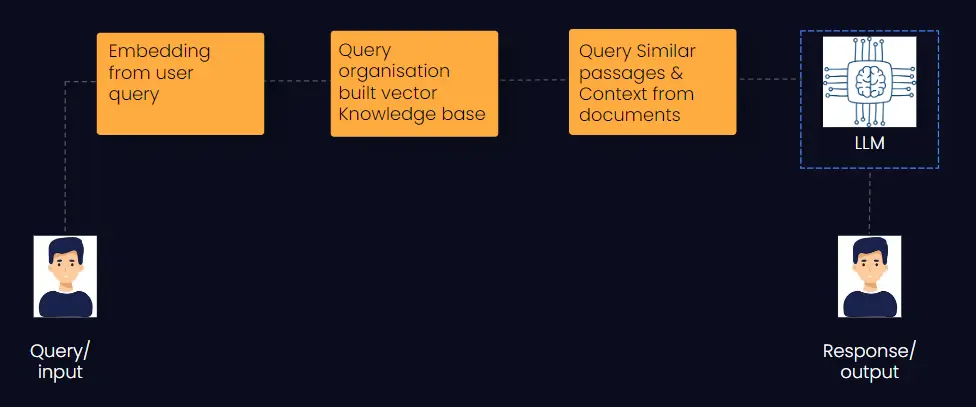
RAG bridges the gap between LLM capabilities and the need for factual accuracy. This framework combines the creation of text with the retrieval of information. Here's how it operates:
- Retrieval: RAG looks up pertinent information in an external knowledge base first when it gets an inquiry. This knowledge base could be a vast collection of documents, scientific papers, news articles, or any other source containing reliable data.
- Augmentation: Once relevant information is retrieved, RAG uses it to "augment" the question itself. This might involve rephrasing the question with specific details or adding keywords to ensure the LLM focuses on the most pertinent aspects.
- Generation: Finally, the augmented question is passed on to the LLM. With a more focused prompt and access to relevant information, the LLM can generate a more insightful and accurate response.
Benefits of RAG for AI Applications
RAG offers several advantages over traditional LLM approaches:
- Enhanced Accuracy: RAG reduces the possibility of hallucinations and ensures that the AI produces accurate and reliable outcomes by anchoring responses in genuine data.
- Greater Contextual Understanding: The context provided by the retrieved data helps the LLM to produce more useful and complex responses.
- Dynamic Knowledge Access: RAG allows AI to access and leverage the ever-growing pool of information in the external knowledge base. This keeps the AI's knowledge base current and relevant.
- Reduced Training Costs: Instead of constantly retraining LLMs with new information, RAG allows them to adapt to new knowledge through the external database.
- Transparency and Trust: By providing access to the sources used to generate responses, RAG fosters transparency and builds trust in the AI's decision-making process.
Conclusion: The Future of AI with Understanding
RAG represents a significant step forward in making AI more insightful and reliable. By combining retrieval with generation, AI can move beyond simply producing text to generating knowledge-driven responses. This opens doors for a variety of applications, including:
⦁ Advanced Chatbots: RAG-powered chatbots can have more meaningful conversations with users while giving them accurate and current information.
⦁ Intelligent Search Engines: By utilizing RAG, search engines can provide users with more relevant and contextually aware results when they request.
⦁ Enhanced Educational Tools: AI-powered tutoring systems can personalize learning experiences by drawing on real-world data retrieved through RAG.
As research in RAG continues, we can expect even more innovative applications that leverage the power of AI to understand and generate insightful responses. The future of AI lies not just in generating text, but in generating understanding.