The Hidden Costs of Agentic AI: Why Cost Per Task Matters More Than Cost Per Token

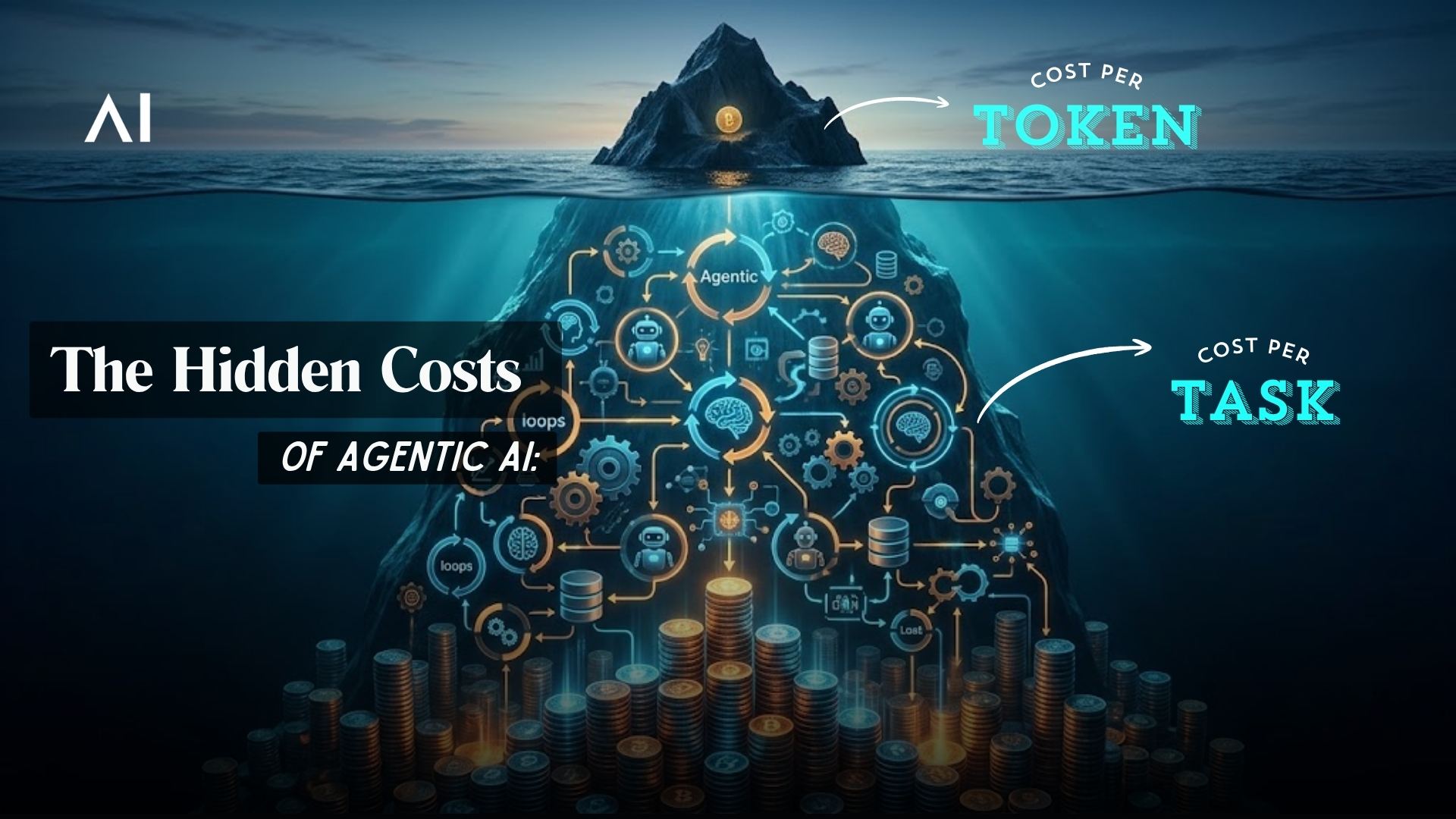
Judging agentic AI by cost per token is like judging a taxi fare by the price of petrol per litre. It tells you nothing about how many wrong turns the driver takes before reaching the destination.
Model providers keep announcing lower per-token prices, yet enterprise AI bills keep climbing. Demos show a clean prompt-and-response; production agents run non-linear, multi-step loops. One user query stops being one API call and becomes a spiderweb of plans, lookups, code executions, self-corrections, and handoffs between agents.
To understand why agentic projects blow past budgets, you have to shift from token economics to cost per completed task.
TL;DR
One agentic request isn't one call. It explodes into 10 to 50+ model calls through the agent's loop.
Failures cost more than successes, so the real metric is cost per successful task, not cost per token.
A cheap model that loops and fails can cost more than a frontier model that succeeds on turn two.
Hidden costs pile up beyond the LLM: retrieval, tool and API fees, multi-agent handoffs, plus run-to-run variance.
Mature teams control it with prompt caching, model routing, circuit breakers, and deterministic code.
Why Cost Per Token Is the Wrong Metric
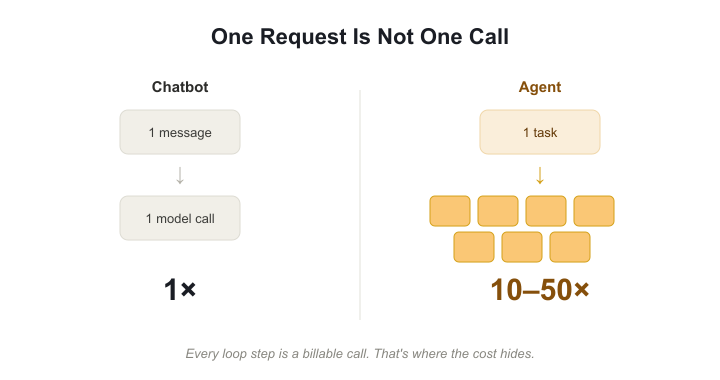
Cost per token is the price an AI model charges to process one unit of text. Cost per token measures a single call, not the cost of completing a full task.
That distinction is everything. In standard chat, one prompt yields one response. In an agentic workflow, one request routinely explodes into dozens of calls.
1 chatbot message = 1 model call.
1 agentic task = 10 to 50+ model calls.
So even as the price of a token falls, the tokens processed per task rise far faster. An 80% drop in token price means nothing if the task now processes 30 times more tokens. Lower unit price, higher total bill.
The Context Tax: Why Agents Burn So Many Tokens
The context tax is the extra token cost agents pay because AI models are stateless. The agent must resend its instructions, tools, and full history on every step of its loop.
How the plan-act-observe loop multiplies token use
The plan-act-observe loop is the cycle an AI agent repeats to complete a task: plan a step, act by calling a model or tool, observe the result, and reason again. This loop often runs dozens of times per request.
Observe → Reason → Act → Observe → Reason → Act → … until done
Each pass = at least one model call.
The cumulative context explosion
Because the model has no memory between calls, each turn re-sends everything. If an agent takes 15 turns to resolve a ticket, by turn 15 it's re-reading the entire history, every tool output, and all retrieved documentation for the fifteenth time. The context grows with each step, and you pay for it again every step.
Cost Per Successful Task: The Math That Actually Matters
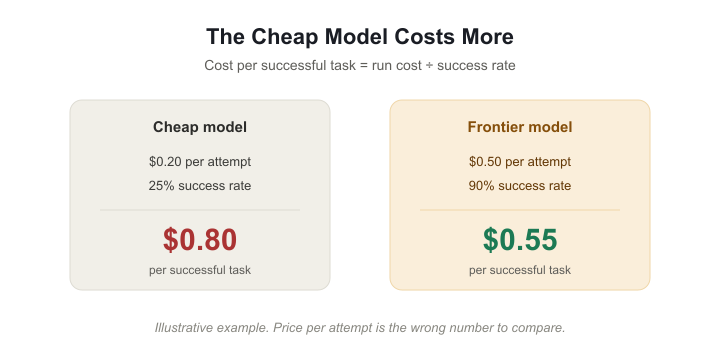
Cost per successful task is the average cost of an agent run divided by its success rate. Cost per successful task shows the true cost of completing a task because it includes failed, retried runs.
In traditional API pricing, a failed run costs the same as a successful one. In agentic workflows, failures cost more. When an agent hits a dead end, it enters self-correction: re-evaluating, trying alternate tools, burning thousands of reasoning tokens before it succeeds or times out.
Cost per successful task = Average run cost ÷ Task success rate
Why a cheaper model can cost more
Illustrative example, not a benchmark:
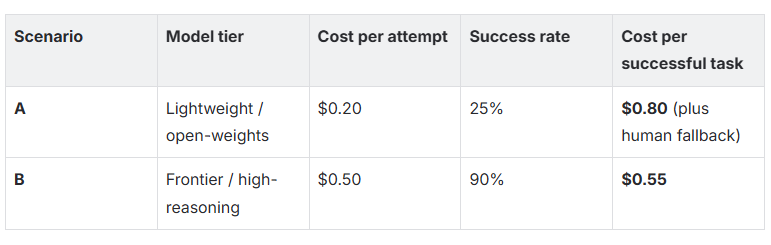
The "cheap" model looks 60% cheaper per attempt. But failing three out of four times makes it more expensive per actual result, before you count the human cleaning up the failures.
$0.20 model at 25% success = $0.80 per result.
$0.50 model at 90% success = $0.55 per result.
The "expensive" model is cheaper.
The Hidden Infrastructure Costs Behind Every Agent
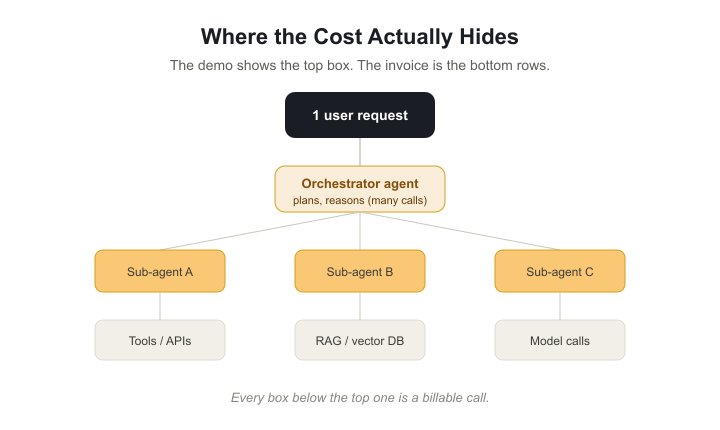
Focusing only on the LLM invoice hides the rest of the stack an agent needs to function.
RAG and retrieval overhead
RAG overhead is the cost of retrieval-augmented generation in an AI agent, including vector database reads, embedding calls, and reranking fees charged each time the agent retrieves information. Five retrievals in a task means those pipeline costs compound alongside the model costs.
Tool and API execution fees
Agents don't work in a vacuum. They call external services, CRM, support, payments, web tools, and each call can carry its own fee. A single autonomous run might consume a dozen API credits across several services before producing an answer.
Multi-agent communication costs
Multi-agent communication cost is the expense created when AI agents hand tasks to each other. Each handoff reloads context and serializes state, so one request can carry the cost of several agents.
Total task cost = model calls + tool/API fees + each sub-agent's full task cost
Execution Variance: Why Agentic Costs Are Hard to Forecast
Execution variance is the run-to-run difference in an AI agent's cost for the same task. It happens because the agent can take different tool paths each time, which makes agentic AI spend hard to forecast.
In SaaS, unit economics are clean: a fixed price per seat. Agents break that. Give an agent the same prompt twice and you can get two very different runs.
Same task, Run A: 3 turns, 8,000 tokens.
Same task, Run B: 18 retries, 120,000 tokens.
A 15x cost swing on identical input.
That unpredictability is why forecasting agentic spend without runtime guardrails is a CFO's nightmare.
How to Reduce Agentic AI Costs in Production
Mature teams optimise task unit economics, not raw token discounts. Four levers do most of the work.
Prompt caching
Prompt caching reuses already-processed static content, such as system prompts and tool schemas, instead of reprocessing it on every call, reducing repeated input-token costs significantly.
Model routing and small models
Model routing sends simple AI steps to small, cheap models and escalates to expensive reasoning models only at critical decisions or when the agent gets stuck. Routing intent classification, tool formatting, and routine reasoning to small language models lowers the effective cost per task.
Circuit breakers
Circuit breakers are hard limits on an AI agent's turns, tool calls, and context growth that stop unproductive loops before they drain the budget. They turn an unbounded worst case into a capped one.
Deterministic subroutines
Deterministic subroutines replace agentic reasoning with fixed code wherever autonomy isn't required. A hardcoded workflow or a script removes model calls entirely, and their cost with them.
The Takeaway: Measure Outcomes, Not Tokens
The cost nobody puts in the demo isn't hidden because it's complex. It's hidden because the demo shows one task, once. At production scale, the loop, every reason-act-observe cycle, every retrieval, every tool call, every nested agent, is where the money goes.
Stop optimising for cost per token. Optimise for cost per completed task.
Design agents to finish in as few calls as possible, and evaluate systems on the price of an outcome, not the price of a word. In agentic AI, the cheapest model can run the most expensive system, and the only way to know is to do the task-level math.
Frequently Asked Questions
1. What is cost per task in agentic AI?
Cost per task in agentic AI is the total cost to complete one request end to end, every model call, tool and API call, and sub-agent handoff in the agent's loop, not the price of a single token.
2. Why is agentic AI more expensive than a chatbot?
A chatbot makes one call per message. An agentic task runs a plan-act-observe loop that explodes into 10 to 50+ model calls, re-processing context each time, so one request costs many times more.
3. What is cost per successful task?
Cost per successful task is average run cost divided by task success rate. It captures failed, retried runs, which is why a cheap model that fails often can cost more than a reliable frontier model.
4. bHow do you reduce agentic AI costs?
Reduce agentic AI costs with prompt caching for static context, model routing to small models for simple steps, circuit breakers to cap runaway loops, and deterministic code to replace unnecessary reasoning.
5. Is cost per token a useful metric for agentic AI?
Cost per token is not enough on its own. Per-token prices keep falling while agentic bills rise, because the number of calls per task, and the failures, drive cost far more than the price per token.
Book your Free Strategic Call to Advance Your Business with Generative AI!
Fluid AI is an AI company based in Mumbai. We help organisations kickstart their AI journey. If you're seeking a solution for your organisation to enhance customer support, boost employee productivity and make the most of your organisation's data, look no further.
Take the first step on this exciting journey by booking a Free Discovery Call with us today and let us help you make your organisation future-ready and unlock the full potential of AI for your organisation.
_1790254083168-CB8e8KXC.png)