The New CFO Playbook: Measuring ROI in the Age of Agentic Intelligence

TL;DR
- Agentic AI is changing how enterprises define “return.” It’s no longer just cost-cutting—it’s about decision acceleration, risk reduction, and continuous adaptability.
- Traditional ROI frameworks fail. Time-saved and headcount-reduced metrics miss the exponential compounding effect of self-improving systems.
- CFOs need new levers of measurement: cognitive load reduction, data liquidity, orchestration efficiency, and outcome velocity.
- The smartest finance teams are already reclassifying Agentic AI not as a tech expense—but as an asset class that compounds insight, productivity, and organizational learning.
The CFO’s Dilemma: Automation Numbers Don’t Add Up Anymore
For the last decade, CFOs have built business cases for automation in a predictable way:
reduce manual work, cut costs, improve throughput, report faster. Done.
But here’s the thing—Agentic AI breaks that math.
Unlike traditional automation, these systems don’t just execute processes; they think, remember, reason, and collaborate across departments. They self-learn from context, re-optimize workflows, and often uncover revenue or efficiency opportunities humans didn’t even know existed.
So, the old “X hours saved = Y dollars saved” formula? It’s like using a ruler to measure gravity. You need a new playbook.
For a closer look at how enterprises are deploying reasoning-driven systems, explore how LLM-powered AI agents form the foundation of adaptive automation.
From Automation ROI to Intelligence ROI
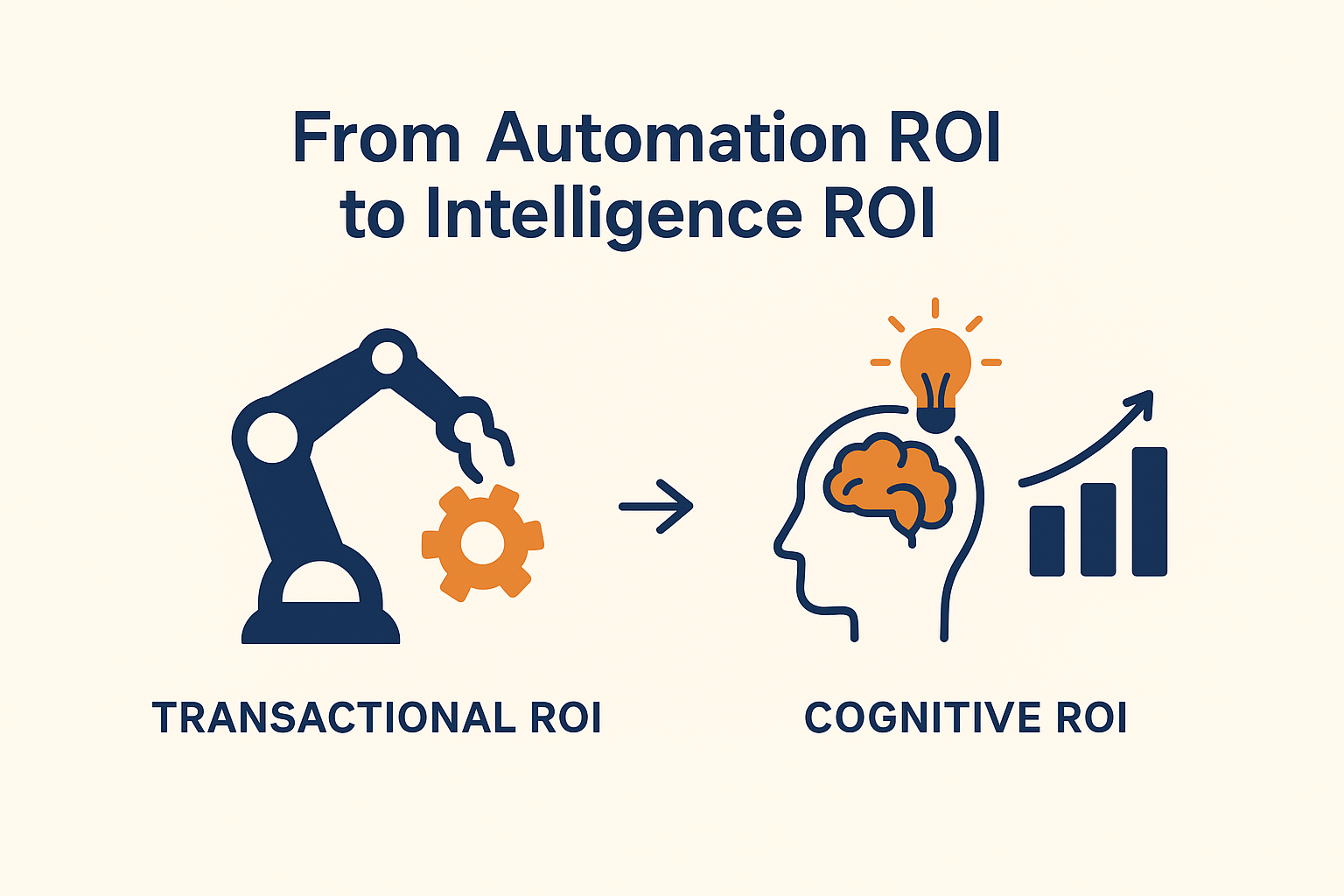
Let’s break this down. Traditional automation ROI is transactional—it’s about replacing repeatable human effort.
Agentic Intelligence ROI is cognitive. It compounds over time as the system builds memory, contextual intelligence, and reasoning depth.
The key difference:
- Automation stops when the workflow ends.
- Agentic AI keeps learning after every execution.
For CFOs, that means value shifts from efficiency metrics to intelligence metrics. You’re not just cutting costs—you’re compounding insight.
Think of it as moving from static productivity to dynamic adaptability.
The Three Hidden Layers of Agentic ROI
To measure Agentic Intelligence properly, finance leaders need to look beyond visible productivity gains and start quantifying the hidden layers of value creation.
1. Cognitive Load Reduction
Your teams aren’t just slower because of volume—they’re slower because of mental clutter.
Agentic systems lift that burden by automatically triaging, summarizing, and prioritizing.
Quantify this by:
- Measuring drop in task-switching frequency per employee
- Tracking improvement in first-contact resolution rates
- Calculating reduction in cognitive time wasted (average time to context-switch × # of daily switches × # of employees)
Every minute saved from context chaos is a minute redirected toward strategic thinking. That’s not soft ROI—it’s tangible focus capital.
2. Data Liquidity
Every enterprise CFO knows that information asymmetry kills agility.
Agentic AI dissolves that by making data liquid—flowing seamlessly across silos, accessible in real time, and interpretable through natural language.
You can track this through:
- Time-to-insight (from data collection to executive visibility)
- % of unstructured data converted to usable insights
- Reduction in dependency on BI analysts or IT intervention
Data liquidity turns decision-making from a bottleneck to a bloodstream. It’s the quiet foundation of faster, smarter enterprises.
Many banks have already seen this transformation firsthand—Fluid AI’s AI in banking and finance is shifting from static automation to fluid, reasoning-driven decision ecosystems.
3. Outcome Velocity
This is where the compounding magic shows up.
When AI agents collaborate autonomously—triaging support tickets, orchestrating customer communications, preparing financial summaries—outcomes accelerate in ways that ripple across the organization.
Indicators of outcome velocity include:
- Shorter process cycles (from lead to cash, or request to resolution)
- Faster decision turnaround times
- Greater throughput without added human capital
You’re no longer measuring productivity per person—you’re measuring speed per system.
Redefining Value Creation for CFOs
CFOs traditionally benchmarked automation success by:
- Headcount reduction
- Time saved per process
- Cost per transaction
In the age of Agentic Intelligence, that’s table stakes. The real winners measure across four value dimensions:
| Dimension | Old Metric | Agentic Metric |
|---|---|---|
| Productivity | Hours saved | Cognitive load reduced |
| Cost Efficiency | Headcount reduction | Insight-per-dollar ratio |
| Risk | Error rate | Adaptive mitigation speed |
| Growth Enablement | Process uptime | Decision velocity & foresight |
What this really means is: you’re no longer measuring what people do—you’re measuring how effectively intelligence flows.
Memory, Compounding, and the New Enterprise Asset Class
Here’s the most overlooked part: Agentic systems remember.
When an AI agent learns how to triage a customer issue, it doesn’t forget. When it sees how your pricing model performs, it retains that insight. That memory compounds value daily—like intellectual capital that never sleeps.
From a finance perspective, this reclassifies AI from an expense to an appreciating digital asset.
Imagine a balance sheet where:
- Data is the raw material
- Agents are the operating machinery
- Memory and reasoning are the capital assets that grow over time
The longer your Agentic ecosystem runs, the sharper, faster, and more valuable it becomes. That’s not depreciation—it’s cognitive appreciation.
As enterprises begin deploying agent ecosystems, autonomous AI agents are emerging as the real drivers of resilience, adaptability, and enterprise defense.
Why Traditional Payback Models Fail
Most CFOs still use static ROI models—calculate implementation cost, estimate annual savings, divide. Simple. But Agentic AI doesn’t follow linear returns.
Instead, its ROI curve looks exponential:
- Month 1: Cost savings from automation
- Month 3: Process intelligence increases, reducing rework
- Month 6: Agents start orchestrating across departments
- Month 12: System memory + reasoning drive predictive, not reactive, operations
Your cost doesn’t change, but your decision velocity and insight precision explode. Static payback models can’t capture that curve.
The new ROI horizon: think in compound value cycles, not payback periods.
The CFO’s New KPIs for Agentic ROI
Here’s a practical framework CFOs can adopt to move from automation-era metrics to Agentic-era metrics.
| Category | Traditional KPI | Agentic KPI |
|---|---|---|
| Operational | Tasks automated | Tasks autonomously orchestrated |
| Financial | Cost per FTE | Cost per cognitive transaction |
| Strategic | Project ROI | Decision ROI (decisions per dollar) |
| Human Capital | Productivity per person | Productivity per cognitive agent |
| Learning | Training hours | System self-learning iterations |
| Resilience | SLA adherence | Adaptive recovery speed |
These new KPIs shift your focus from effort saved to intelligence multiplied.
What Early Adopters Are Doing Right
Forward-looking CFOs in banking, telecom, and manufacturing are already reframing their financial narratives around Agentic ROI.
Here’s how they’re structuring their playbooks:
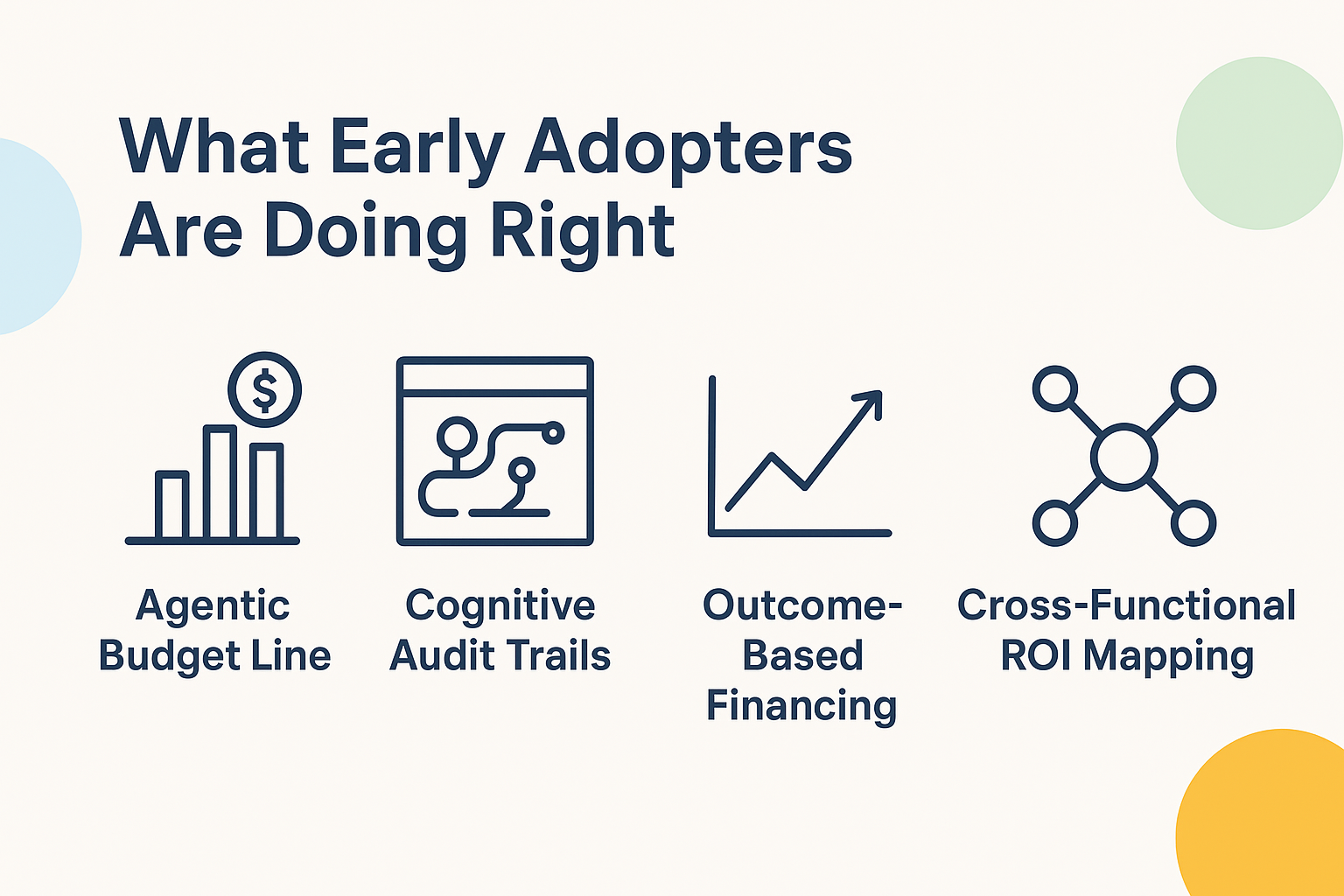
- Agentic Budget Line: Treat AI orchestration layers as a CapEx item with long-term yield potential.
- Cognitive Audit Trails: Create dashboards that track reasoning paths and decision logs, not just transactions.
- Outcome-Based Financing: Tie AI vendor payments to measurable cognitive outcomes, not licenses or usage hours.
- Cross-Functional ROI Mapping: Assign ROI not per department but per agent ecosystem—customer support agents, compliance agents, or supply chain agents.
These companies aren’t just cutting costs—they’re building intelligence infrastructure.
Want to see how internal ecosystems evolve around these new KPIs? Check out Fluid AI’s internal-facing AI solutions that build cognitive efficiency across finance, HR, and operations.
The Human Multiplier
There’s a myth that Agentic AI replaces people. In reality, it multiplies them.
When cognitive agents handle routine reasoning—like report preparation, data validation, or context summarization—humans move up the value chain. They focus on strategic modeling, interpretation, and creativity.
For CFOs, that translates to:
- Higher-value decision-making per salary dollar
- Lower burnout and attrition costs
- Faster business agility in volatile markets
Agentic AI doesn’t make humans obsolete—it makes judgment the new premium skill.
The Final Shift: ROI as a Living Metric
In a traditional world, ROI was a quarterly report.
In an Agentic world, ROI is a real-time organism.
Your AI agents continuously track, predict, and optimize outcomes—feeding CFO dashboards that evolve daily. Imagine seeing:
- “Cognitive Cost-to-Serve” updating in real time
- “Decision Throughput” graphs adapting as agents learn
- “Autonomous Uptime” reports showing where reasoning improved workflows overnight
It’s not just finance observing performance. It’s finance orchestrating intelligence.
The Takeaway: Build the Balance Sheet of the Future
CFOs who adapt to Agentic Intelligence aren’t just modernizing—they’re future-proofing.
Because in five years, enterprises won’t ask, “What’s our automation ROI?”
They’ll ask, “How intelligent is our organization’s capital?”
And those who’ve built memory-driven, reasoning-rich agent ecosystems will already have the answer.
The new ROI isn’t just measured in dollars saved. It’s measured in decisions accelerated, risks prevented, and intelligence retained.
That’s the new CFO playbook—and the foundation of enterprise value in the Agentic Age.
_1790254083168-CB8e8KXC.png)