AI Scales Vertically: When Specialization and Power Trump Spread

TL;DR
- Vertical scaling means deeper, more powerful systems
- Best for inference, edge AI, and domain-specific deployments
- Can be automated with profiling and VPA
- Complements horizontal scale in hybrid AI architectures
As the demand for enterprise AI continues to rise in 2026, organizations face an architectural decision: Should they scale wide or deep? While horizontal scaling gets the spotlight for distributed, multi-agent systems, vertical scaling still plays a vital role in enterprise AI—especially in specialized, performance-intensive environments.
But what does it really mean when we say "AI scales vertically"? And where does it make the most impact?
What Is Vertical Scaling in AI?
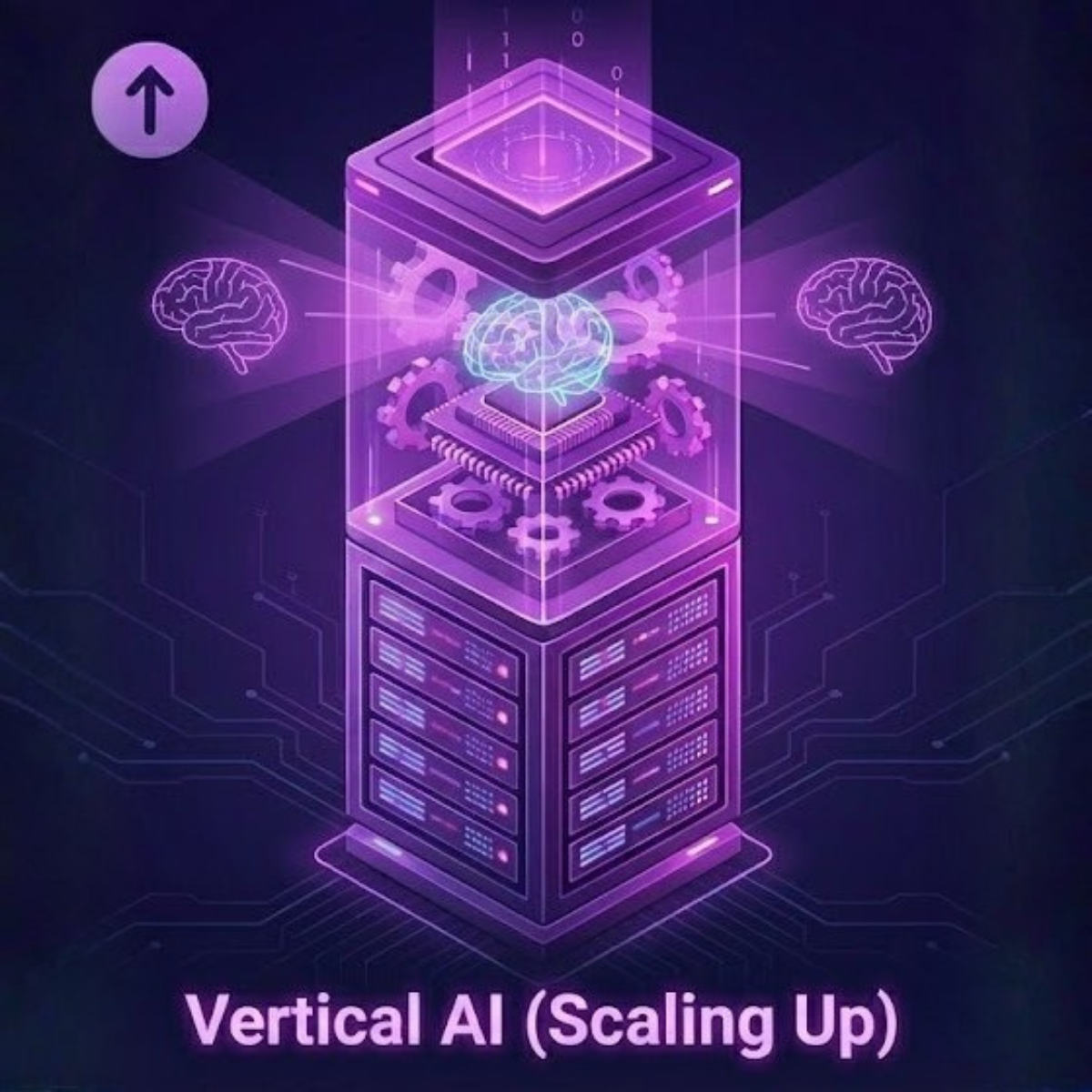
Vertical scaling means increasing the capacity of a single system—more powerful GPUs, faster memory, and larger model deployments—rather than distributing tasks across multiple smaller nodes.
In the AI context, vertical scaling often refers to:
- Running larger models on fewer, more powerful machines
- Serving high-throughput inference pipelines
- Powering single-purpose, domain-specific applications
Vertical scaling prioritizes depth over breadth—stacking compute and intelligence into specialized systems optimized for a focused task.
Use Cases Where Vertical Scaling Wins
Not all AI workloads benefit from distribution. Here’s where vertical scaling shines:
✅ High-Volume Inference
If your application serves millions of predictions per second (e.g., ad targeting, recommendation engines), you benefit from low-latency, high-throughput servers—better handled through vertical scale.
✅ Specialized Enterprise Models
Industries like finance or healthcare often rely on proprietary LLMs or structured decision trees trained on regulated data. These models run in isolated, secure environments where horizontal scaling adds complexity.
✅ Edge AI & On-Prem Deployments
Running on telecom towers, manufacturing lines, or defense systems? These AI deployments must run locally with limited physical infrastructure—vertical scaling is the only option.
These are the same verticalized edge scenarios explored in Agentic AI in Telecom and Predictive Maintenance in Telecom.
✅ LLM Fine-Tuning & Transfer Learning
Vertical scale becomes important during fine-tuning large language models (LLMs) where large amounts of memory and compute are required. Rather than distributing training jobs across multiple nodes, organizations often prefer high-spec machines to fine-tune efficiently and reduce cross-node overhead.
✅ RAG (Retrieval-Augmented Generation)
In RAG pipelines where you combine search with generation in real-time, vertical scaling reduces latency and enables tighter coupling between vector search, embedding models, and language models—all on a single node.
Horizontal vs Vertical Scaling
Wondering how this stacks up against horizontal scale?
| Feature | Vertical Scaling | Horizontal Scaling |
|---|---|---|
| Architecture | One powerful system | Distributed, scalable clusters |
| Use Case Fit | Inference, MVPs, edge AI | Training, orchestration, RAG, multi-agent systems |
| Fault Tolerance | Low | High |
| Cost Efficiency | Poor at scale | Improves with scale |
| Flexibility | Limited | High |
See our full comparison in Horizontal vs Vertical Scaling in AI. And for how orchestration at scale works, read AI Scales Horizontally.
Can Vertical Scaling Be Automated?
While horizontal scaling benefits from orchestration frameworks and load balancers, vertical scaling is increasingly automated as well:
- Auto-scaling VMs that ramp up specs based on model load
- Memory and compute profiling to dynamically allocate system resources
- VPA (Vertical Pod Autoscaler) in Kubernetes-based environments
Still, vertical scaling is less fault-tolerant than horizontal, as it introduces a single point of failure. But redundancy and active monitoring can bridge that gap.
What Are AI Verticals?
In addition to infrastructure scaling, there's another meaning to vertical in AI—industry-specific applications.
Think of:
- Retail AI: Dynamic pricing, churn prediction
- Healthcare AI: Diagnosis support, radiology assistance
- Finance AI: Fraud detection, KYC automation
These are AI solutions built for a domain, often requiring both deep model understanding and vertical scaling to deploy effectively. For example, agent-based fraud detection models discussed in Agentic AI in Telecom often run in secure, vertically scaled environments.
Challenges of Vertical Scaling
Like any approach, it comes with trade-offs:
| Challenge | Mitigation |
|---|---|
| Single point of failure | Use backups, redundancy |
| Cost increases linearly | Optimize inference, batch processing |
| Scaling ceiling | Plan for horizontal migration over time |
| Limited fault tolerance | Add observability, autoscaling safeguards |
| Deployment rigidity | Use containerization for portable scaling |
That’s why even vertically scaled deployments benefit from the observability and orchestration patterns discussed in AI Scales Horizontally.
When Should You Scale Vertically?
Consider vertical scale if:
- You’re optimizing for ultra-low latency inferences
- You operate in a regulated or air-gapped environment
- You’re training or fine-tuning LLMs on-prem
- You’re deploying AI at the edge with physical limitations
But also ask: can this workload benefit from distributed scale? Often, the best architecture blends both.
Final Thoughts
Vertical scaling isn’t outdated—it’s optimized.
For inference-heavy apps, compliance-sensitive workloads, or edge-based deployments, going deep with powerful AI systems remains the best choice.
But vertical and horizontal scaling aren’t mutually exclusive. Modern AI architecture often blends both:
- Run vertical at the edge or for core inference
- Run horizontal for agentic workflows, batch jobs, or multi-agent orchestration
The future is hybrid. And depending on your use case, vertical may be the best place to start.