AI for Tender & RFP Automation: From Intake to Compliant Response

TL;DR
Enterprise RFP responses consume hundreds of hours across sales, bid, legal, technical, finance, and subject-matter teams.
Most of that effort goes into finding information, extracting requirements, rewriting existing answers, and maintaining compliance matrices.
AI RFP response automation can handle this work before the bid team starts its strategic review.
The business value isn't simply faster proposals. It's more bids handled by the same team, better compliance, and less time spent chasing internal answers.
For government, PSU, banking, and regulated tenders, security and deployment architecture matter as much as AI capability.
A 300-page tender lands on Monday. By Tuesday, the bid team is still working out what the buyer is actually asking for.
Requirements have to be extracted. Questions assigned. Technical teams dig for old answers. Legal reviews clauses. Someone builds the compliance matrix. And everyone double-checks the response follows the buyer's format.
Here's the frustrating part: your team has already answered most of these questions before. The information sits across past proposals, product docs, compliance certificates, shared drives, and CRMs. The problem was never a lack of information. It's the time to find it, shape it into a response, get it reviewed, and make sure nothing was missed.
That's what RFP automation removes. Not to let AI write your proposal, but to automate the work around it so your people spend time on the decisions that decide the outcome.
What is RFP automation?
RFP automation uses AI and workflow software to streamline how organisations respond to RFPs, tenders, RFQs, and questionnaires.
A traditional response is manual end to end: read the document, extract questions, distribute them, search old proposals, collect inputs, assemble, check compliance, submit.
RFP automation changes where you start. Instead of a blank spreadsheet, the system starts by understanding the tender. It identifies requirements, mandatory conditions, technical and commercial specs, submission instructions, and the questions that need an expert.
The output isn't AI-generated filler. It's a structured view of what the buyer asked, what you can answer, what evidence backs it, and what still needs a human. That distinction is the point.
Why enterprise RFP responses still take days
The writing is rarely the bottleneck. The time goes into everything around it.
A serious tender pulls in sales, proposal teams, solutions engineers, product, legal, finance, security, and compliance. Each owns a different piece of the answer.
That creates coordination overhead. A technical question goes to engineering, a security section to InfoSec, a clause to legal, pricing to commercial. Meanwhile the bid team tracks who answered what.
The loop is familiar: RFP arrives, spreadsheet created, questions distributed, emails sent, answers collected, rewritten, compliance checked, document assembled.
It works. It just doesn't scale. As tender volume grows, teams add people, and the organisation gets better at managing RFP admin instead of better at winning RFPs.
AI changes the equation by automating the repetitive retrieval and coordination underneath the response.
Which parts of the process AI can automate
Not everything should be automated. The strongest use cases are repetitive, document-heavy, and dependent on information you already hold.
Requirement extraction. AI reads a large tender and pulls out individual requirements instead of forcing someone to comb every page. For long documents, where requirements hide in tables and appendices, this alone saves the first day.
Requirement classification. Once extracted, AI sorts requirements, technical, commercial, legal, security, compliance, eligibility, and flags the mandatory ones that need immediate attention.
Knowledge retrieval. This is where enterprise AI beats a generic chatbot. You don't lack answers; you lack a fast way to find the right one. The system searches past proposals, product docs, certifications, and policies to surface relevant, approved content per requirement, instead of someone asking an SME "have we answered this before?"
First-draft responses. With the right information found, AI drafts a response. The key difference from a general model: an enterprise system drafts from what your organisation actually has, not plausible-sounding claims. A convincing but unsupported product claim is worse than no answer.
Compliance matrix. This is one of the most important pieces of a bid. AI maps requirement to response to evidence to owner to status, and flags gaps where a mandatory requirement has no answer. Compliance shifts from a last-minute panic to something monitored throughout.
How AI turns a tender into a workflow
The value shows when these capabilities work together.
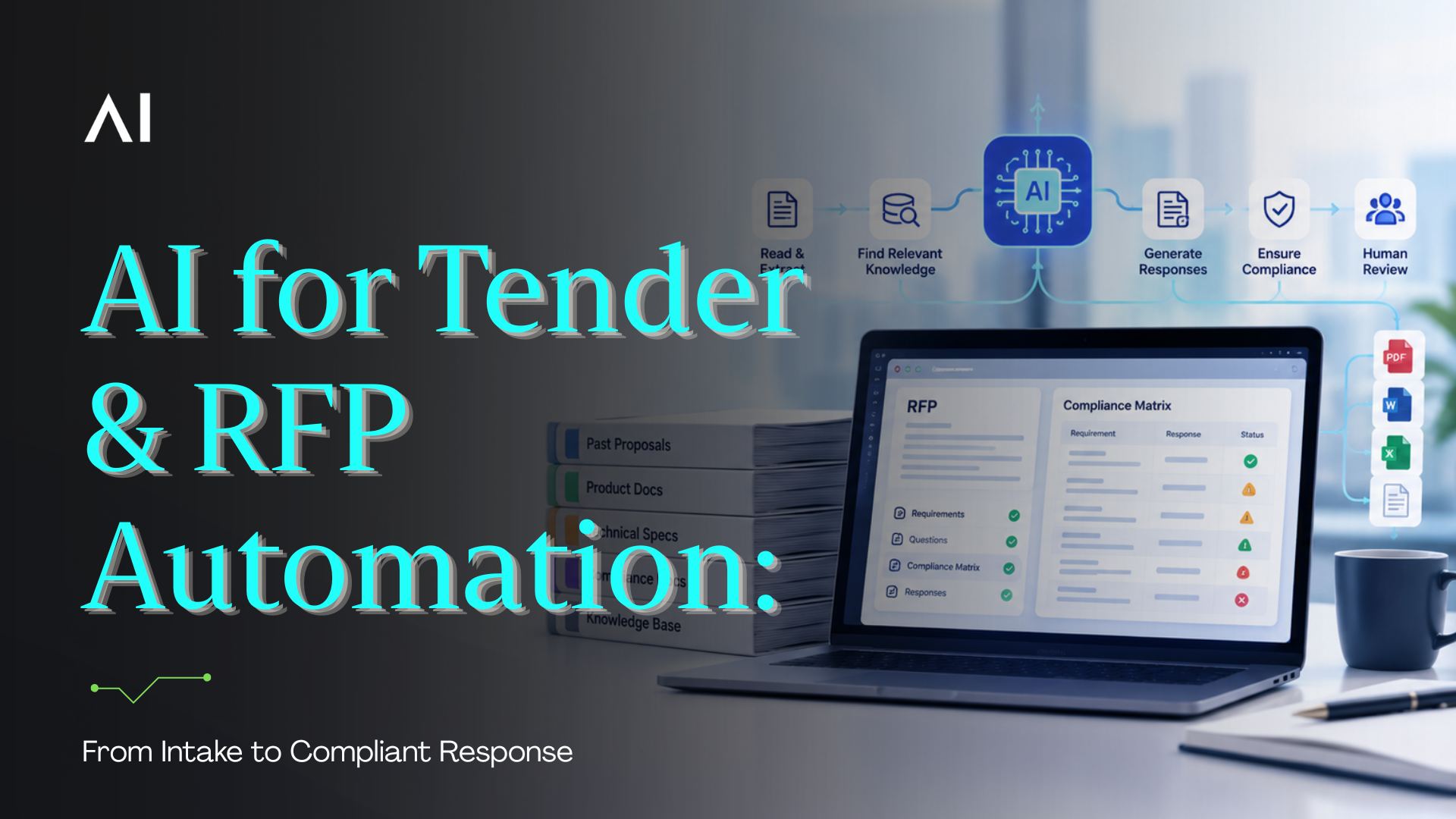
The tender arrives in any format and the system ingests it. AI extracts requirements, deadlines, and submission conditions. It classifies them and flags the mandatory items. For each one, it retrieves relevant approved knowledge and drafts a first response. Questions needing specialists route automatically to the right SME. Responses map back against the requirements, and gaps get flagged.
Then the bid team reviews: adds customer context, builds win themes, challenges weak answers, and approves. The final response is assembled in the buyer's format and submitted.
That's much closer to real tender automation than using AI to write paragraphs.
Why the compliance matrix matters more than AI copy
AI writing gets the attention. For enterprise bids, compliance matters more.
A beautifully written answer is worthless if the submission misses a mandatory requirement. Bids fail because a document wasn't attached, a mandatory question wasn't answered, a spec wasn't addressed, a certification was missing, or the format wasn't followed.
Good RFP response software doesn't treat compliance as a final checkbox. The compliance layer runs throughout, comparing the tender against the developing response and showing where work remains. That gives bid teams something more valuable than faster writing: visibility into completeness.
Using your existing enterprise knowledge
Most enterprises don't have a content shortage. They have too much of it.
Old responses sit beside product docs, security policies, certificates, methodologies, case studies, credentials, and FAQs. The challenge is knowing what's current, relevant, and approved.
This is where AI RFP response systems need more than keyword search. Two tenders often ask the same thing in different words, one asks about "information-security controls," another about your "security framework." Keyword search misses the link. An AI system understands both need related knowledge. The result isn't just faster retrieval; it's better reuse of what you already know.
Where human review still matters
Automation doesn't remove people. It makes the division of labour clearer.
AI is suited to reading documents, extracting requirements, finding information, matching questions, drafting, flagging gaps, and maintaining mappings.
People own bid strategy, win themes, pricing, commercial commitments, positioning, differentiation, risk calls, and final approval.
The purpose of proposal automation isn't to turn a bid manager into someone who rubber-stamps AI output. It's to clear the repetitive work so they can actually think about the bid.
How to evaluate RFP software
Don't buy on a polished demo. A vendor can answer one question beautifully; that doesn't prove it handles a real tender. Test the full workflow.
Can it understand a complete RFP, across long documents, tables, appendices, and formats? Can it draft from your own knowledge, not generic model output? Can it show sources, so technical, legal, and security claims are traceable? Can it automate the compliance matrix, not just generate answers? Can it route work to SMEs without another email chain? Does it fit your existing systems? And, critically, can your security team approve it?
That last question leads to the biggest divide between consumer and enterprise AI.
Why government and PSU tenders need a different architecture
Not every RFP carries the same sensitivity. A government, PSU, banking, or regulated-industry tender may contain pricing, technical architecture, security details, and confidential business information.
That changes the conversation. The question isn't only "how accurate is the AI?" It's "where does our data go?"
Serious buyers have to weigh deployment architecture, data residency, access controls, audit trails, data isolation, and model-training policies. For organisations under strict requirements, on-premise AI deployment keeps tender and pricing data inside the firewall instead of flowing into a shared cloud workflow.
This is where most RFP tools quietly fall out of contention for regulated bidders. The best platform isn't the one with the flashiest demo. It's the one that automates the workflow without creating a new security or governance problem.
How to measure ROI
Don't measure only hours saved. Better metrics tell the real story.
Response time, from tender received to complete first draft, shows whether bottlenecks are actually gone. SME effort shows how much specialist time is reclaimed from repetitive answering. Tender capacity, how many opportunities you can pursue without adding headcount, may be the most important of all: if automation lets you bid on opportunities you used to decline, the value goes beyond productivity. Content reuse shows how well you're turning institutional knowledge into an asset. And compliance gaps caught before submission measure fewer avoidable losses.
Win rate matters too, but read it carefully. AI doesn't win a tender by itself. Better compliance, faster turnaround, sharper strategic review, and more capacity all contribute.
The bottom line
RFP automation is usually sold as a faster way to write proposals. That's the surface.
The real opportunity is to automate everything between receiving a tender and getting the right people focused on the right decisions. AI can extract requirements, find relevant knowledge, draft first responses, route questions, build the compliance matrix, and flag gaps. The advantage comes from combining those into one controlled workflow.
And for enterprises handling complex, high-value, government, PSU, or regulated tenders, that workflow also has to meet strict security and deployment requirements, which is exactly where a generic cloud tool stops and an enterprise-grade one begins.
The future of RFP automation isn't replacing the people who win bids. It's removing the work that stops them from doing their best work.
Frequently asked questions
What is RFP automation?
The use of AI and workflow software to handle the repetitive parts of responding to tenders, reading the document, extracting requirements, drafting from approved content, and building the compliance matrix, while people own strategy and final approval.
Can AI write an RFP response?
AI can draft first responses for each requirement from your approved knowledge and build the compliance matrix. A human reviews and refines, so AI removes the grind while your team keeps control of the final bid.
What is a compliance matrix?
A structured map of every tender requirement against your response, evidence, owner, and status. It ensures no mandatory requirement is missed, the most common reason strong bids get disqualified.
Is RFP automation safe for government and PSU tenders?
Only if deployed correctly. For sensitive bids and pricing, look for on-premise deployment that keeps every tender and answer inside your firewall, rather than a cloud tool that ingests confidential documents.
Does RFP automation replace the bid team?
No. It removes extraction, drafting, and compliance-mapping so the team focuses on win themes, pricing, and strategy, the work that actually wins tenders.
Book your Free Strategic Call to Advance Your Business with Generative AI!
Fluid AI is an AI company based in Mumbai. We help organisations kickstart their AI journey. If you're seeking a solution for your organisation to enhance customer support, boost employee productivity and make the most of your organisation's data, look no further.
Take the first step on this exciting journey by booking a Free Discovery Call with us today and let us help you make your organisation future-ready and unlock the full potential of AI for your organisation.
_1790254083168-CB8e8KXC.png)