The Death of the Search Bar: Why AI Assistants Are Replacing Google Search

TL;DR
The traditional search bar and Google Search experience are evolving as users shift from typing keywords to asking questions.
Instead of returning links, AI assistants and Google’s AI Mode now provide direct answers, understand context, and increasingly help complete tasks.
This marks a major shift from:
👉 search → browse → decide
to
👉 ask → get → act
The blog explains how AI assistants, conversational search, and agentic AI systems are redefining how users discover information and interact with digital platforms.

For over two decades, Google Search has been the default way people find information.
You type a query into a search bar. You get links. You click, compare, refine, and repeat.
That model defined the internet.
But that behavior is changing fast.
Today, users don’t want ten blue links. They want answers. They don’t want to search. They want to ask. And increasingly, they expect systems that can understand intent, retrieve information, and take action in one flow.
This is why AI assistants, conversational AI search, and agentic AI systems are starting to replace traditional Google Search interfaces.
The search bar is not disappearing overnight.
But it is no longer the center of how users interact with information.
What Is Replacing Google Search?
Let’s start with the obvious question.
If Google Search is losing its central role, what is replacing it?
The answer is AI assistants powered by large language models, embedded directly into products, platforms, and workflows.
Instead of typing fragmented keywords into Google Search, users are now interacting through:
- natural language queries
- chat-based AI assistants
- voice AI assistants
- agentic AI systems that can complete tasks
This shift is known as conversational AI search or AI-powered search.
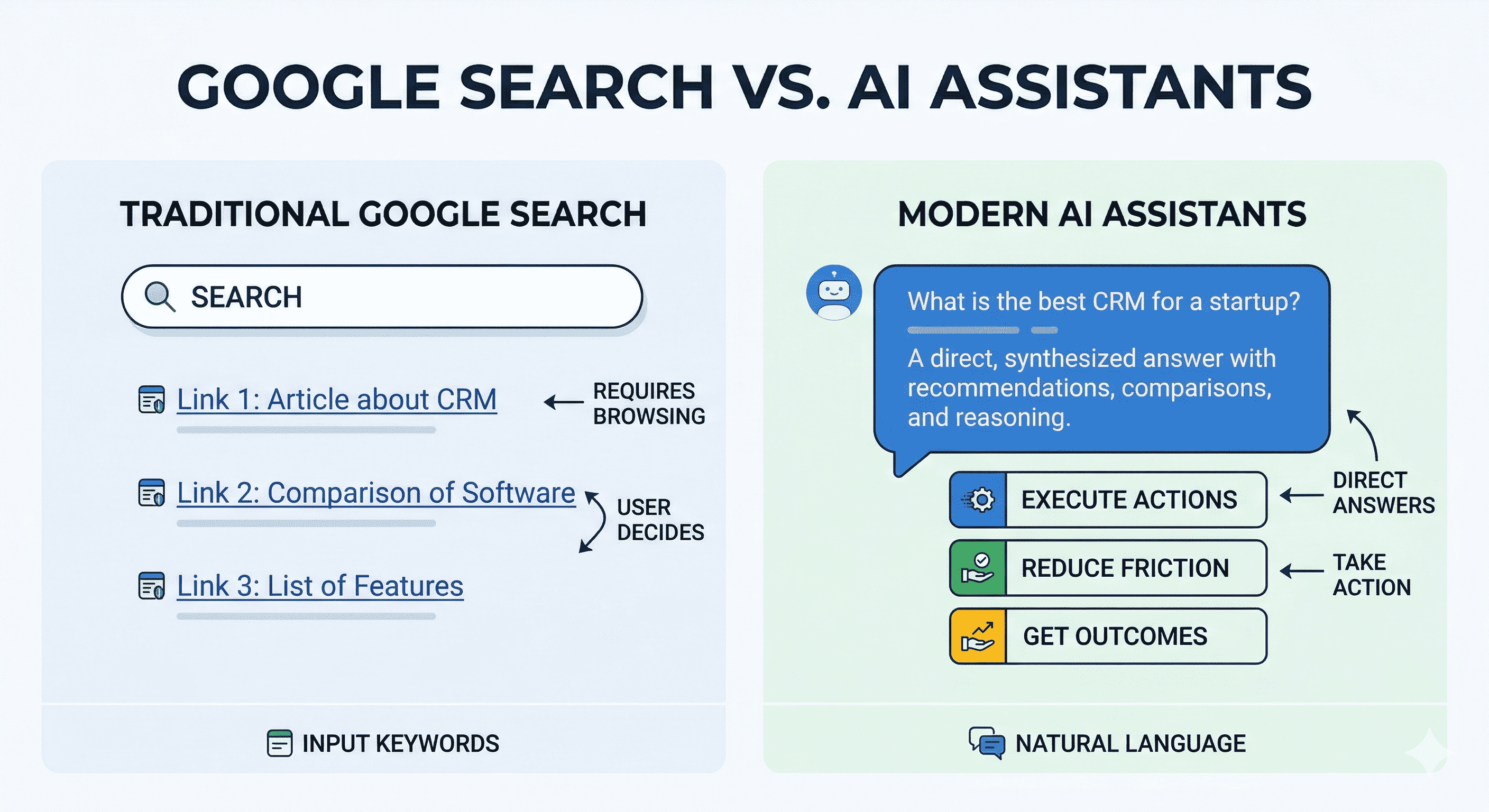
Unlike traditional Google Search results, these systems:
- understand user intent
- maintain context across interactions
- synthesize answers instead of listing links
- execute actions across tools
This changes the entire interaction model:
👉 Google Search → browse → decide
becomes
👉 ask AI assistant → get answer → take action
That shift is the beginning of the decline of the traditional search bar.
Why Google Search Interfaces Are Dying?
Here’s what’s breaking:
1. Google Search Gives Links, Not Outcomes
Even today, Google Search returns links, not solutions.
Users still need to:
- open multiple pages
- extract relevant insights
- compare sources
- piece together answers
This creates friction.
Modern users expect direct answers from AI assistants, not research workflows.
2. Search Journeys Are Fragmented
A typical workflow today still looks like:
Google Search → website → form → another tool → email → follow-up
That’s not efficient.
It’s a fragmented experience.
AI assistants eliminate this fragmentation by handling the entire flow in one place.
3. Keyword Search Is No Longer Natural
Google Search relies heavily on keywords.
But humans don’t think in keywords.
They think in problems.
AI assistants interpret:
- intent
- context
- ambiguity
This makes natural language search far more powerful than traditional Google Search queries.
4. Google Search Has No Memory
Every Google Search query starts from zero.
There is no awareness of:
- previous queries
- user goals
- ongoing tasks
AI assistants solve this with:
- persistent context
- multi-turn conversations
- task continuity
This is where agentic AI systems outperform traditional search.
How AI Assistants Are Replacing Google Search?
The shift is not just about interface. It’s about capability.
Here’s how AI assistants are actively replacing Google Search:
1. From Search Queries to Conversations
Instead of typing:
“best CRM for startups” into Google Search
Users now ask:
“I run a 20-person fintech company. What CRM should I use?”
AI assistants understand:
- business context
- constraints
- intent
This is conversational AI replacing Google Search behavior.
2. From Search Results to Decisions
Google Search gives options.
AI assistants provide:
- recommendations
- comparisons
- reasoning
This reduces decision time dramatically.
3. From Information to Action
This is the biggest disruption.
Google Search stops at information.
AI assistants go further:
- book meetings
- generate reports
- send emails
- update systems
- trigger workflows
This is powered by agentic AI platforms.
They don’t just answer.
They act.
4. From Search Engines to Embedded AI
Google Search is a destination.
AI assistants are embedded everywhere:
- inside apps
- inside CRMs
- inside banking systems
- inside enterprise tools
This is the rise of embedded AI assistants and AI copilots.
You don’t go to search anymore.
Search comes to you.
The Rise of Agentic AI Search
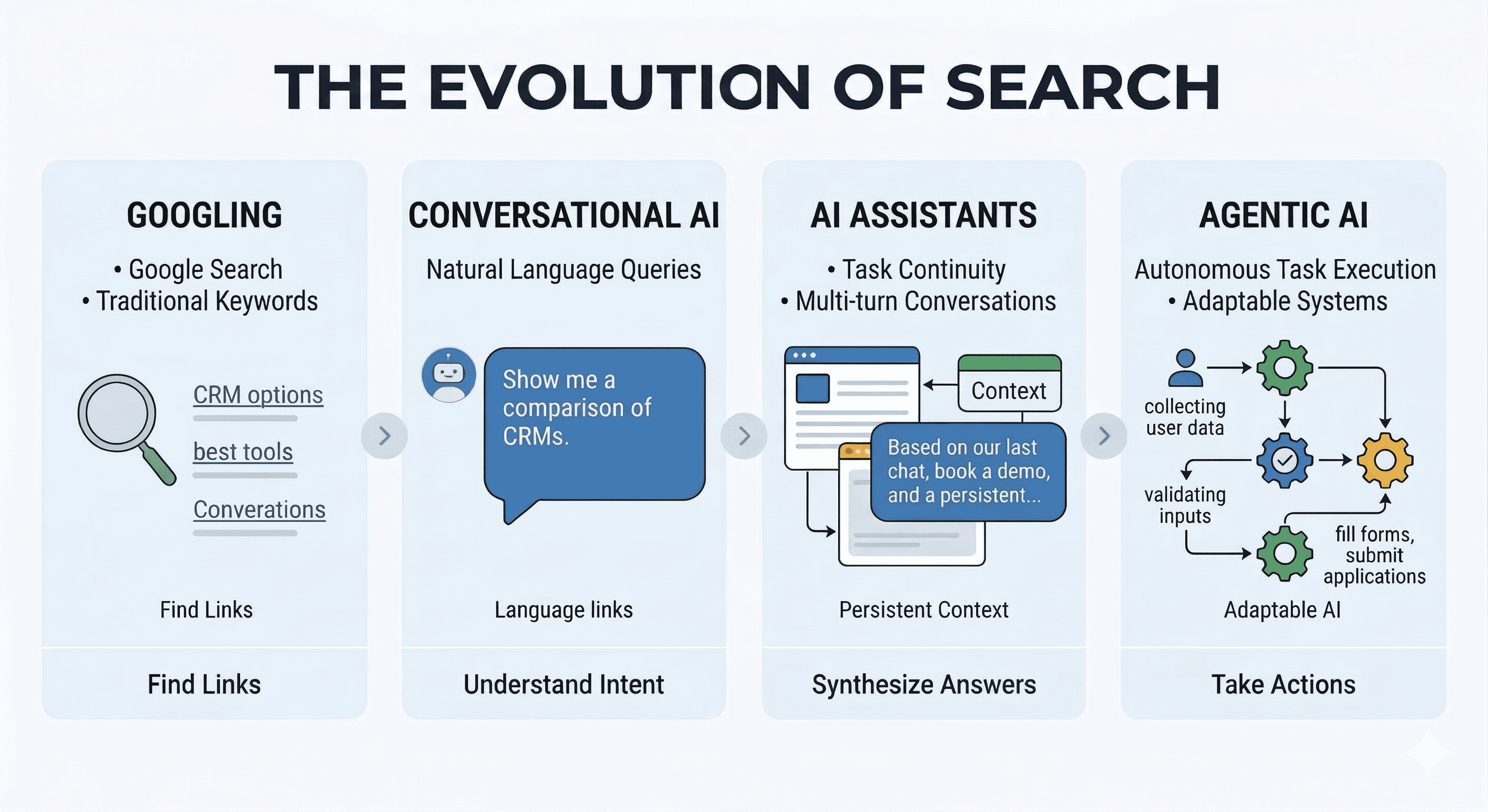
We are now entering the next phase beyond traditional Google Search.
This phase is driven by agentic AI search systems.
These systems:
- break problems into steps
- decide actions
- use tools and APIs
- adapt based on outcomes
This is no longer search. This is autonomous task execution. For example:
Instead of searching on Google Search:
“how to apply for a loan”
An AI assistant can:
- collect user data
- validate inputs
- fill forms
- submit applications
- send confirmations
This is the evolution:
👉 Google Search → AI search → AI assistants → AI agents
Real-World Examples Replacing Google Search
This shift is already happening.
Banking
Instead of using Google Search for FAQs, users interact with AI banking assistants that:
- answer queries
- check balances
- block cards
- initiate transactions
E-commerce
Instead of browsing via Google Search results, users ask:
“Find me running shoes under ₹5000”
AI systems handle:
- discovery
- filtering
- recommendations
Enterprise Software
Employees no longer rely on Google Search or dashboards.
They ask:
“Show me last quarter’s revenue insights”
AI copilots generate:
- summaries
- insights
- reports
Customer Support
Instead of searching help centers via Google Search, users interact with:
- AI support agents
- chat-based resolution systems
- voice AI assistants
These systems solve problems directly.
Google Search and the Rise of AI Mode
Here’s where things get more interesting. Google Search is not disappearing. It’s evolving.
With the introduction of Google AI Mode (AI Overviews, Gemini-powered search experiences), Google itself is moving beyond the traditional search bar.
Instead of only showing links, Google now increasingly:
- understands the full context of a query
- generates direct, synthesized answers
- maintains continuity across follow-up questions
- reduces the need for users to click multiple pages
What this really means is that Google is shifting from a search engine to an answer engine.
The experience is changing from:
👉 type keywords → scan links → find answer
to:
👉 ask a question → get a complete response
This is a fundamental shift.
Even inside Google, the search bar is no longer just a retrieval tool. It is becoming a conversational interface powered by AI.
What This Means for Businesses
If your business still relies only on Google Search traffic, you are at risk.
The future belongs to companies that:
- integrate AI assistants into their products
- enable conversational interfaces
- build agentic workflows
- reduce friction between intent and execution
The winners will not be those who rank highest on Google Search.
They will be those who provide the best AI-driven user experience.
The Bigger Shift: Google Is Adapting to AI, Not Competing With It
The important insight here is simple. Google is not being replaced by AI assistants. Google is becoming one.
AI Mode is Google’s response to a deeper behavioral shift:
Users no longer want to search, they want answers. And increasingly, they want actions.
This is why the future is not:
❌ Google vs AI assistants
It is:
✅ Search → AI-driven discovery → AI-assisted execution
Conclusion
The search bar isn’t disappearing overnight, but its role is clearly shrinking. What used to be the starting point of every digital journey is now becoming just one of many ways users interact with information. With AI assistants, Google’s AI Mode, and agentic AI systems reshaping how people discover and act on information, the center of gravity is shifting from searching to simply getting things done.
This isn’t about replacing Google, but about redefining what search means. The future belongs to interfaces that understand intent, provide direct answers, and seamlessly execute tasks. Businesses that adapt to this shift, by building for AI-driven discovery, conversational interfaces, and answer-first experiences, won’t just stay relevant; they’ll lead the next era of how users interact with technology.