Is Agentic OS the Future of AI? Benefits, Risks, Examples, and What Businesses Should Know

TL;DR
An Agentic OS, or agentic operating system, is an AI-powered layer that helps businesses coordinate AI agents, enterprise data, tools, workflows, and human approvals in one connected system.
Instead of using AI only as a chatbot or assistant, companies can use an Agentic OS to help AI agents understand goals, access approved systems, complete tasks, and escalate decisions when human judgment is needed.
For enterprises, especially in banking, insurance, telecom, retail, and customer operations, Agentic OS could become the foundation for faster service, better automation, smarter decision-making, and more governed AI adoption.
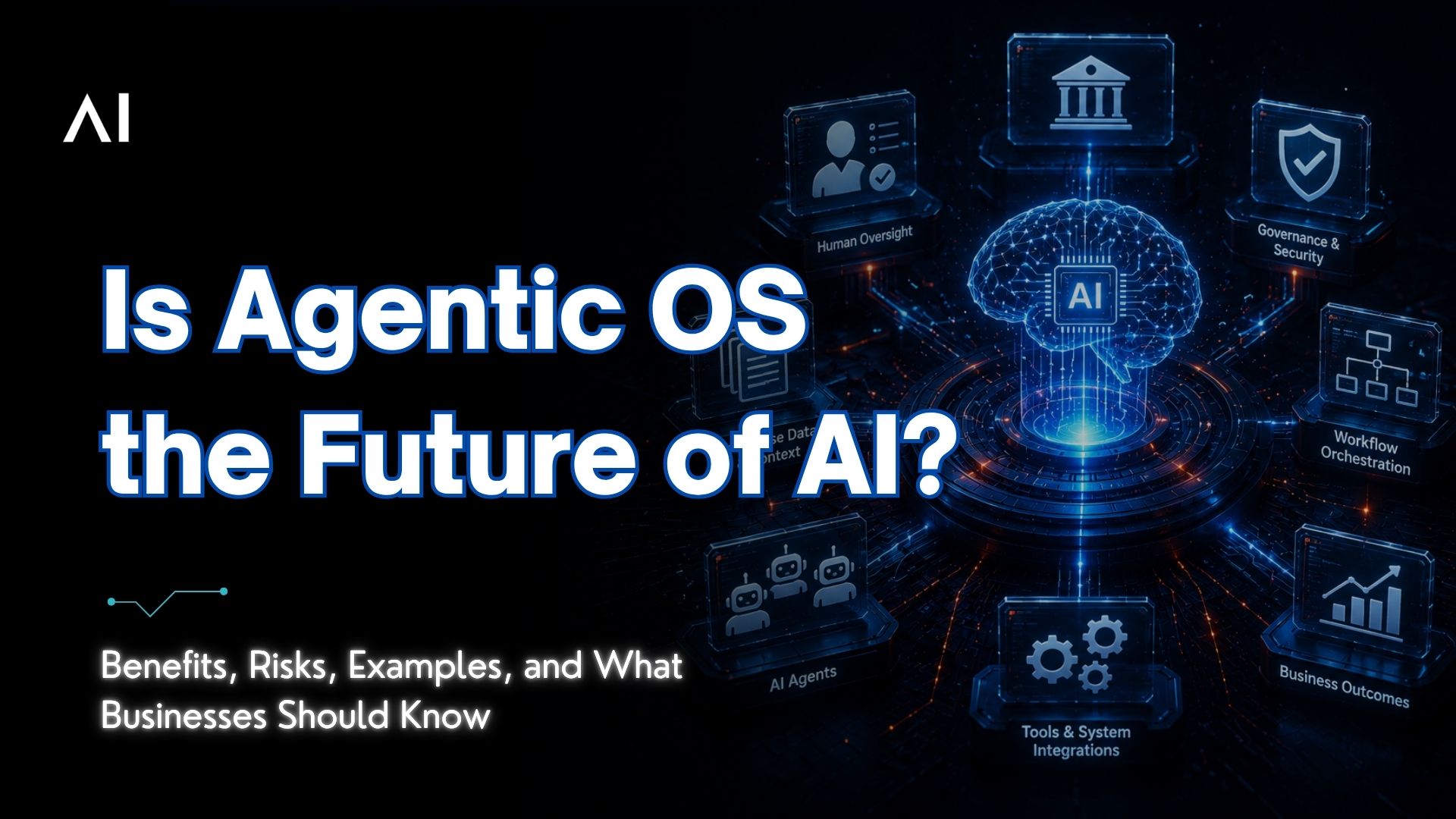
What Is an Agentic OS?
An Agentic OS is an operating layer for AI agents. It helps multiple AI agents work together across business systems, data sources, applications, and workflows.
In simple terms, an Agentic OS is the system that helps AI move from answering questions to completing work.
A traditional operating system helps people use software and hardware. An Agentic OS helps businesses use AI agents across the organization.
For example, a chatbot may answer a customer’s question. An AI copilot may help an employee write a response. But an Agentic OS can coordinate several agents to understand the customer’s issue, check account details, retrieve policy information, update a CRM, create a ticket, and escalate the case to a human when needed.
That is the real difference. Agentic OS is not just about conversation. It is about intelligent action.
Why Agentic OS Matters Now?
Businesses are under pressure to do more with less. Customers expect instant answers. Employees are overwhelmed by tools, systems, and repetitive tasks. Leaders want AI that creates measurable business value, not just impressive demos.
This is why Agentic OS is becoming important.
The first wave of enterprise AI focused on chatbots. These systems could answer basic questions but often struggled with complex workflows.
The next wave introduced copilots. Copilots helped employees draft content, summarize information, and improve productivity. But most copilots still depend heavily on human direction.
Agentic OS represents the next stage: AI systems that can understand goals, coordinate actions, and operate across workflows with the right guardrails.
This matters because modern business processes are not isolated. A single customer request may involve CRM data, payment systems, support history, compliance rules, and internal approvals. A standalone chatbot cannot manage that complexity. An Agentic OS is designed to connect those moving parts.
How Does an Agentic OS Work?
An Agentic OS usually includes several core layers.
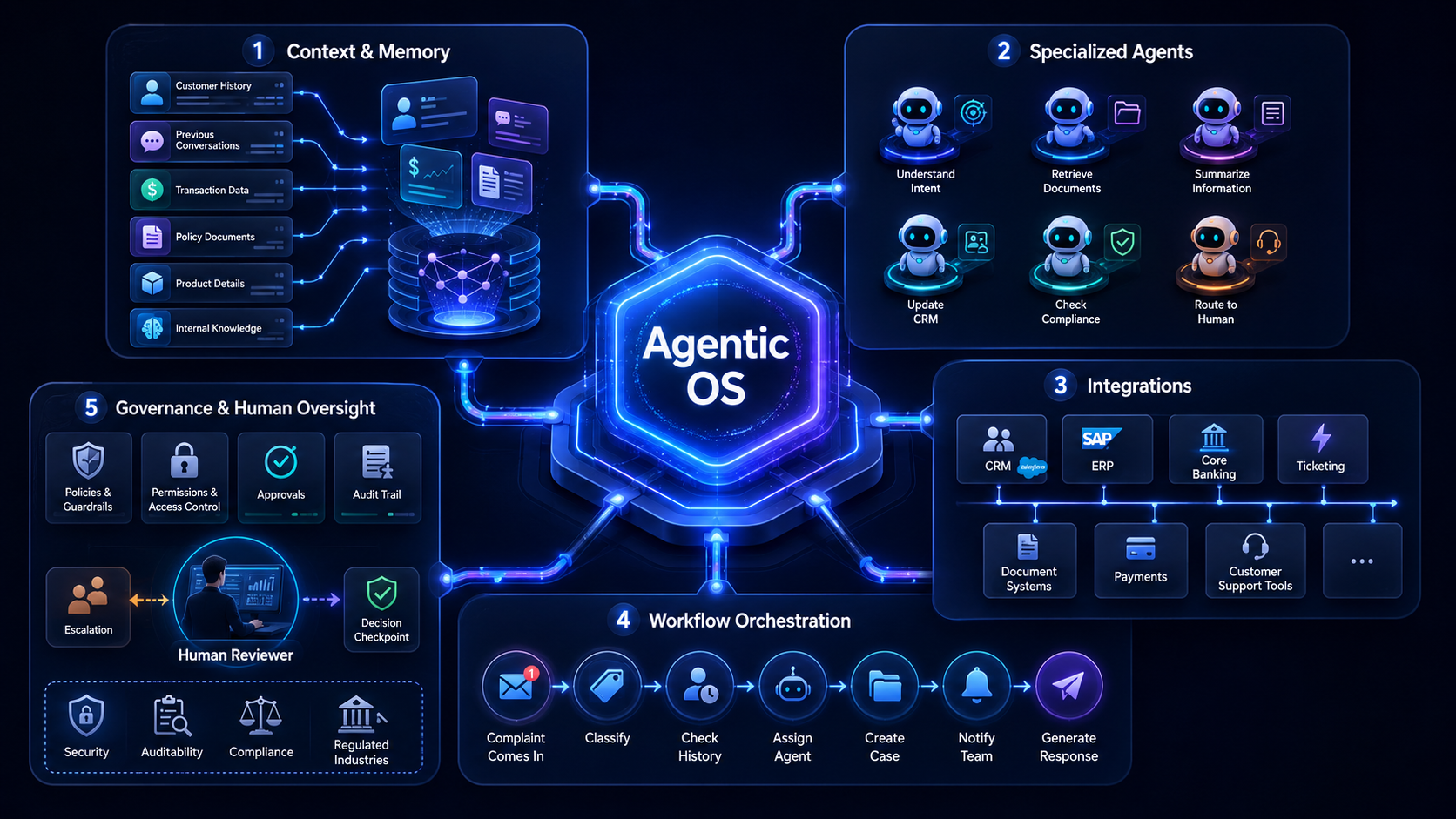
Context and Memory
AI agents need context to be useful. This may include customer history, previous conversations, transaction data, policy documents, product details, or internal knowledge.
Without context, AI gives generic answers. With context, AI can support more accurate and personalized decisions.
For example, if a banking customer asks about a failed payment, the system needs to understand the customer, the transaction, the account status, and the bank’s policies before giving a helpful response.
Specialized AI Agents
An Agentic OS can coordinate different agents for different jobs.
One agent may handle customer intent.
One may retrieve documents.
One may summarize data.
One may update a CRM.
One may check compliance rules.
One may route the case to a human.
The goal is not to make one AI model do everything. The goal is to let specialized agents work together within a controlled environment.
Tool and System Integrations
Enterprise work happens inside real systems: CRMs, ERPs, banking platforms, ticketing tools, document systems, payment platforms, and customer support software.
An Agentic OS connects AI agents to these systems so they can retrieve information, update records, trigger workflows, and complete approved tasks.
This is where AI becomes operational instead of just conversational.
Workflow Orchestration
Orchestration is the process of deciding what happens next.
If a customer raises a complaint, the Agentic OS may classify the issue, check customer history, assign the right agent, create a case, notify a team, and generate a response.
This is not one AI answer. It is a coordinated workflow.
Governance and Human Oversight
Governance is essential. AI agents need clear limits.
They must know what data they can access, what actions they can take, when they need approval, and when they should escalate to a human.
This is especially important in regulated industries such as banking, insurance, healthcare, and financial services. For these sectors, AI must be secure, auditable, and compliant.
Key Benefits of Agentic OS for Businesses
Agentic OS can create value across multiple areas of an enterprise.
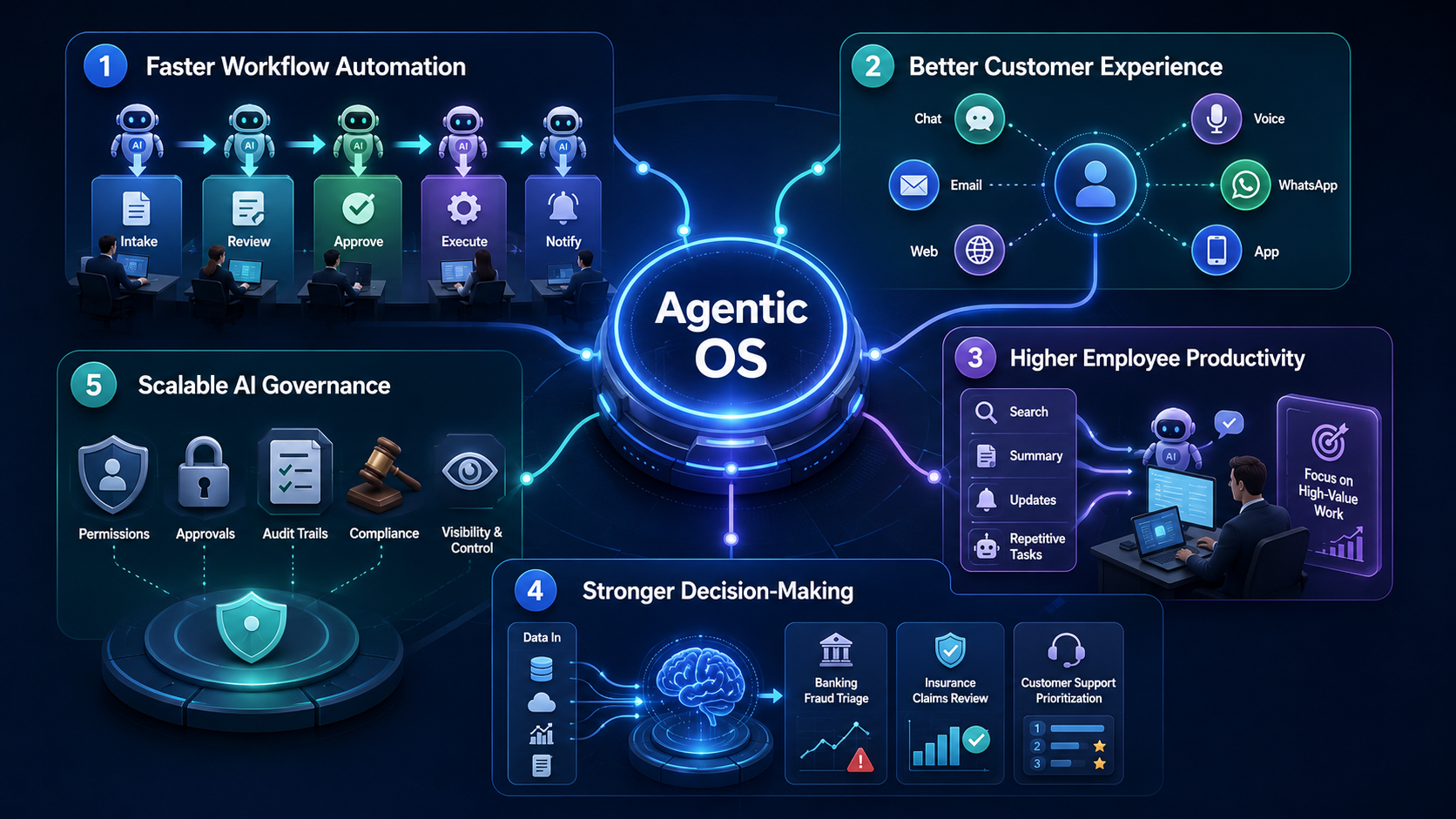
Faster Workflow Automation
Many business processes are slowed down by manual handoffs, repeated checks, and disconnected systems. Agentic OS can help automate multi-step workflows across departments.
For example, instead of an employee manually checking records, writing updates, and routing a request, AI agents can handle those steps within approved boundaries.
Better Customer Experience
Customers want fast, accurate, and personalized service. They do not want to repeat their problem every time they switch channels or speak to a new representative.
An Agentic OS can maintain context across channels such as chat, voice, email, WhatsApp, websites, and apps. This helps businesses deliver more connected customer experiences.
For Fluid AI | Agentic AI Platform for Enterprises , this is especially relevant. Enterprise AI is not only about reducing costs. It is about creating smarter, faster, and more human-like digital interactions at scale.
Higher Employee Productivity
Employees spend too much time searching for information, updating systems, creating summaries, and handling repetitive requests.
Agentic OS can reduce this workload by allowing AI agents to assist with routine tasks. Employees can then focus on higher-value work such as complex decisions, customer relationships, and strategic problem-solving.
Stronger Decision-Making
When AI agents can access relevant data and business context, they can help teams make faster, more informed decisions.
In banking, this could support fraud triage, loan servicing, customer segmentation, and risk review. In insurance, it could support claims processing, document checks, and policy servicing. In customer support, it could help prioritize urgent cases.
Scalable AI Governance
As companies deploy more AI tools, governance becomes harder. Agentic OS gives businesses a central way to manage permissions, approvals, audit trails, and compliance rules.
This helps organizations scale AI without losing visibility or control.
Real-World Examples of Agentic OS
Agentic OS can be used across many industries and departments.
Banking and Financial Services
In banking, Agentic OS can support onboarding, customer service, account servicing, transaction queries, fraud alerts, loan support, and document verification.
For example, when a customer asks why a transaction failed, AI agents can verify the customer, check transaction status, identify the reason, create a support case, and escalate sensitive issues to a human advisor.
This requires secure access, workflow orchestration, compliance controls, and human oversight.
Insurance
In insurance, Agentic OS can support claims intake, policy servicing, renewals, document review, and customer updates.
An AI agent may collect claim details, check missing documents, summarize the case, update the claims system, and notify the customer about next steps.
This can reduce delays while keeping humans involved in complex or sensitive decisions.
Customer Support
Customer support is one of the strongest use cases for Agentic OS.
Instead of only answering common questions, AI agents can understand intent, retrieve customer history, recommend solutions, update tickets, and route complex cases with full context.
This improves response time and reduces frustration for both customers and agents.
Sales and Revenue Operations
Sales teams can use Agentic OS to support lead qualification, CRM updates, follow-up emails, proposal preparation, and customer research.
For example, AI agents can summarize recent customer activity, identify high-priority leads, recommend next steps, and update pipeline records automatically.
HR and Internal Operations
Internal teams can use Agentic OS to answer employee questions, manage requests, support onboarding, route approvals, and update internal systems.
This reduces repetitive work for HR, IT, finance, and operations teams.
The Risks of Agentic OS
Agentic OS has major potential, but it also introduces risk. The more autonomy AI agents have, the more important governance becomes.
Data Privacy and Security Risks
AI agents may need access to sensitive customer, employee, or financial data. Without proper controls, this can create privacy and security issues.
Businesses must define what data agents can access, how they use it, and how information is protected.
Incorrect or Unapproved Actions
An AI mistake is not always just a wrong answer. In an agentic system, a mistake could mean updating the wrong record, sending the wrong message, or triggering the wrong workflow.
That is why approval rules, testing, monitoring, and human review are essential.
Lack of Transparency
Enterprises need to understand what AI agents did and why. Without logs, explanations, and audit trails, it becomes difficult to trust agentic systems.
Transparency is especially important for regulated industries and customer-facing workflows.
Over-Automation
Not every process should be automated. Some decisions require empathy, judgment, legal review, or executive approval.
A strong Agentic OS should not remove humans from every workflow. It should bring humans in at the right moment.
How Businesses Can Adopt Agentic OS Safely
Businesses should not start by automating everything. The best approach is to begin with focused use cases that are valuable, measurable, and manageable.
1. Start With High-Value, Low-Risk Workflows
Good starting points include customer support, document review, onboarding assistance, ticket routing, CRM updates, and internal service requests.
These workflows are often repetitive enough for automation but still easy to monitor.
2. Define Clear Permissions
Every AI agent should have boundaries.
What systems can it access?
What actions can it perform?
What data can it use?
When does it need approval?
When should it escalate?
Clear permissions reduce risk and make AI easier to govern.
3. Keep Humans in the Loop
For sensitive workflows, humans should remain involved. AI can prepare summaries, recommend actions, and complete routine steps, but humans should approve high-risk decisions.
This creates a balance between automation and accountability.
4. Measure Business Outcomes
Agentic OS should be measured by real business impact. Useful metrics include response time, resolution rate, customer satisfaction, employee productivity, cost reduction, compliance accuracy, and workflow completion time.
If the system does not improve outcomes, it is only adding complexity.
What Businesses Should Look for in an Agentic OS
Not every AI platform is ready for enterprise agentic workflows. Business leaders should look for capabilities that support real-world deployment.
1. Security and Compliance
The platform should protect sensitive data and support enterprise security requirements.
2. Integration With Core Systems
Agentic OS must connect with the systems businesses already use, including CRMs, ERPs, support platforms, data tools, and industry-specific applications.
3. Multi-Channel Support
Customers and employees interact across many channels. A strong Agentic OS should support connected experiences across chat, voice, email, messaging apps, and web platforms.
4. Governance and Auditability
The platform should provide visibility into AI actions, approvals, escalations, and decision history.
5. Deployment Flexibility
Regulated businesses may need private cloud, on-premise, or hybrid deployment options. Flexibility matters when security and compliance are priorities.
Is Agentic OS the Future of AI?
Agentic OS is likely to become a major foundation for the future of enterprise AI.
The first stage of AI helped users find answers. The next stage helped employees complete tasks. The agentic stage will help businesses coordinate intelligent workflows across systems, teams, and customer journeys.
However, the future will not belong to companies that deploy the most AI agents. It will belong to companies that deploy them safely, strategically, and with measurable value.
Agentic OS is not about replacing every human process. It is about creating a smarter operating layer where AI agents and human teams work together.
For businesses in regulated or customer-intensive industries, this shift is especially important. They need AI that is not only powerful, but also secure, governed, explainable, and connected to real workflows.
Conclusion
Agentic OS represents a major shift in how businesses use AI.
Instead of treating AI as a chatbot, search tool, or productivity assistant, enterprises can use Agentic OS as a connected layer for automation, decision support, customer experience, and workflow execution.
The benefits are clear: faster processes, better customer service, higher productivity, stronger governance, and more scalable AI adoption.
But success depends on responsible implementation. Businesses need clear permissions, secure integrations, human oversight, audit trails, and measurable outcomes.
For Fluid AI | Agentic AI Platform for Enterprises and the enterprises it supports, Agentic OS is more than a technology trend. It is a practical foundation for the next era of intelligent, secure, and scalable business operations.
Book your Free Strategic Call to Advance Your Business with Generative AI!
Fluid AI is an AI company based in Mumbai. We help organizations kickstart their AI journey. If you’re seeking a solution for your organization to enhance customer support, boost employee productivity and make the most of your organization’s data, look no further.
Take the first step on this exciting journey by booking a Free Discovery Call with us today and let us help you make your organization future-ready and unlock the full potential of AI for your organization.
_1790254083168-CB8e8KXC.png)