Understanding Tokens and Parameters in AI: The Building Blocks Behind Language Models

TL;DR
Tokens are the small units of data an AI model reads and generates, while Parameters are the internal learned settings that help the model understand patterns and make predictions.
Tokens affect how much text or data a model can process at once, while parameters influence the model’s intelligence, complexity, cost, and ability to handle nuanced tasks.
Understanding tokens and parameters helps you evaluate AI models more clearly instead of assuming that more tokens or more parameters automatically means better performance.
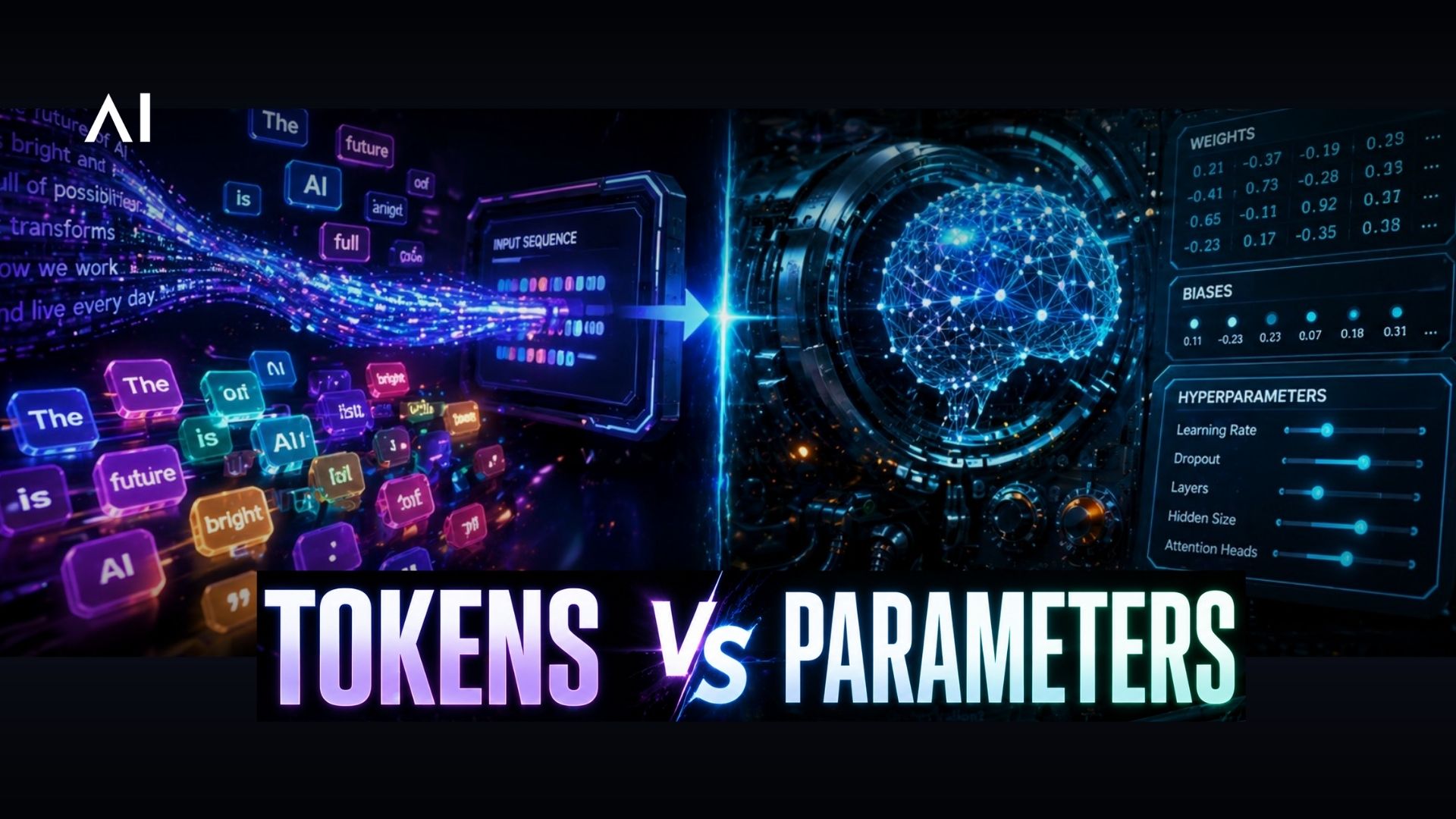
In the rapidly evolving world of artificial intelligence and machine learning, terms like "token" and "parameter" are frequently tossed around. However, these two concepts have entirely distinct meanings and serve completely different, foundational roles in how an AI model operates and learns.
At a high level, tokens represent the smallest units of data, such as chunks of words or pixels, that a model receives and processes. Parameters, on the other hand, are the internal variables and settings that the model continuously adjusts during its training to improve its accuracy and performance.
Whether you are an engineer looking to implement modern AI technologies, or simply an everyday user wondering why an incredibly smart AI might fail at a simple task like counting the letters in a word, grasping the mechanics behind these two components is absolutely essential.
In this deep dive, we will pop the hood of generative AI to explore exactly what tokens and parameters are, how they differ from one another, and the crucial role their interaction plays in model training and AI performance.
What are Tokens?

Tokens are the fundamental building blocks or "units of thought" that an AI uses to process and understand data. Instead of reading full words or sentences the way humans do, language models break your text down into these smaller, more manageable chunks.
A token can be a single character, a part of a word, an entire word, a number, an emoji, or a punctuation mark.
For example,
A model might not see the word "strawberry" as a single word, but rather break it down into two separate chunks: "straw" and "berry". While tokens are primarily used for text, they can also represent other types of data, such as segments of an image or individual pixels in computer vision tasks.
You can think of tokens like Lego bricks. While each piece is small and simple on its own, the AI can connect them together to build complex paragraphs, essays, or computer code. When an AI model writes a response to you, it is actually doing mathematical calculations to predict which token is the most likely to appear next in the sequence.
Types of Tokens
Tokens can take many different forms depending on the data being processed and the specific task the AI is trying to accomplish. While they can broadly represent elements like whole words, numbers, emojis, or punctuation marks, here are the specific types of tokens commonly used in AI model training:
Word Tokens: This is a straightforward approach where each individual word is treated as a separate token.
Subword Tokens: This method breaks words down into smaller, meaningful units. For example, the word "cats" might be divided into the tokens "cat" and "s". This helps models better handle new or unfamiliar words that aren't in their vocabulary.
Phrase Tokens: These group multiple words together into a single token, such as "New York City" or "machine learning".
Character Tokens: These break data down to its smallest textual level, where each token represents a single, individual character within a word.
Image Tokens: Used primarily in computer vision tasks, these tokens can represent individual pixels, specific segments of an image, or other visual features.
Additionally, a common method used to create tokens in natural language processing and speech recognition is Byte-Pair Encoding (BPE). BPE is an algorithm that tokenizes data by finding and merging the character pairs that appear most frequently together in a given text
What are Parameters?

Parameters are internal variables within an AI model that dictate how it behaves and what results it produces. If tokens are the data building blocks fed into an AI, parameters are the learned rules that determine how that input data is transformed into output predictions.
For example,
You can think of parameters as millions or billions of tiny adjustment knobs and switches inside the AI's "brain". Each of these knobs is a number, and together, they hold all of the compressed knowledge, patterns, and connections the AI has learned during its training.
Another helpful analogy is to think of them like the internal settings of a video game, such as speed, sound, and difficulty, that control how the game reacts to your controller inputs.
Types of Parameters
Depending on the type of model and the specific task it is performing, parameters can take several different forms. Here are the common types of parameters used in AI models:
Weights: These are the numerical values assigned to each input feature (such as a token) that determine its importance when the model is making predictions.
Biases: These are constant values that are added to the weighted inputs in order to adjust the final output of a neuron.
Learning Rate: This is a hyperparameter that controls exactly how much the model's weights and biases are updated during the training process. While a higher learning rate allows the model to learn faster, it can also make it more difficult for the model to properly converge on the correct answer.
Activation Functions: These are mathematical functions (with common examples including sigmoid, relu, and tanh) that dictate how the combined input signal is transformed into the final output signal in a neural network.
Kernel Size: Used specifically in convolutional neural networks, this is a hyperparameter that determines the size of the filter used to extract visual features from an input image.
What is the difference between Tokens and Parameters?

While tokens and parameters are both essential components of how generative AI works, they serve entirely different purposes. In short, tokens are the data the model processes, while parameters are the internal rules and knowledge the model uses to process that data.
Here is a breakdown of the key differences:
1. What They Are
Tokens are the fundamental "building blocks" or "units of thought" of the data itself. When you interact with an AI, it breaks your text down into tokens, which can be whole words, subwords, individual characters, or even pixels in an image. You can think of tokens like individual Lego bricks.
Parameters are the internal variables, weights, and biases inside the AI model. You can think of them as the "size of the AI's brain," or millions of "tiny little knobs" and "settings" that control how the model behaves.
2. Their Role in the AI
Tokens represent the inputs and outputs. They are the actual information fed into the model for it to read, and the model generates new tokens to build its response.
Parameters represent the rules and learned knowledge. During the model's training phase, parameters are continuously adjusted and fine-tuned using optimization algorithms to minimize errors and help the model learn the relationships between the input tokens and the correct output. All the compressed knowledge from an AI's training is stored within these parameters.
3. What They Control
Tokens dictate the AI's "context window" (how much short-term working memory it has for a given conversation) and determine the cost of using the model, as users are billed based on the number of tokens consumed and generated.
Parameters determine the overall complexity, cost to run, and depth of intelligence of the model. A higher number of parameters generally means the AI has a larger "brain" and is better equipped to understand nuance and perform complex tasks, though it will require more computing power.
To put it together using an analogy: if an AI model is like a video game, tokens are the inputs and actions you provide, while parameters are the game's underlying engine settings (like difficulty and physics) that control how the game reacts to your inputs.
The Core Formulas of Tokens and Parameters
Here is the conceptual breakdown of the "formulas" an AI uses, along with the standard mathematical notations:
1. The Basic Prediction Formula (Weights and Biases):
Weights: Numerical values assigned to each input feature (token) that determine its importance in making a prediction.
Biases: Constant values that are added to the weighted inputs to adjust the output of a neuron.
The Conceptual Formula: Output = (Input Token × Weight) + Bias.
In standard machine learning notation, this linear equation is typically written as z=wx+b.
2. The Activation Function Formula
Once the weights and biases are calculated, the model applies an activation function. These functions (with common types being sigmoid, relu, and tanh) determine how the combined input signal is transformed into the final output signal of a neural network.
The Conceptual Formula: Final Prediction = Activation_Function( Output ).
3. The Loss Function (Calculating the Error)
During training, the model needs to know if its formula produced the right answer. It does this by processing the result through a loss function, which acts as a score that measures the difference between the model's prediction and the actual correct value from the training data. The ultimate goal of the AI is to minimize this loss score.
The Conceptual Formula: Loss (Error Score) = Actual Value - Model's Predicted Value.
4. The Update Formula (Learning Rate)
To improve for the next time, the model uses an optimization algorithm to adjust its parameters in order to minimize the error. It updates its weights and biases based on a hyperparameter called the learning rate, which controls exactly how much those parameters are updated during the training process. A higher learning rate allows for faster learning, but can make it harder for the model to successfully converge on the right answer.
Mathematically, this update rule is often represented in a process called Gradient Descent as wnew=wold−(learning_rate×gradient_of_loss).
In short, the AI constantly runs these mathematical formulas to multiply your input tokens by its parameter weights, adds a bias, checks how wrong its answer was using a loss function, and then updates those weights to be more accurate the next time.
Final thought
The ultimate takeaway when understanding tokens and parameters is that evaluating an AI model is not as simple as just counting how many parameters it has or how many tokens it was trained on.
Think of an AI model like a recipe: simply adding more of one ingredient, like an enormous amount of parameters, does not automatically make the final dish better. Instead, an AI's true strength comes from the balance and harmony of how it uses its tokens, its parameters, the quality of its training data, and its overall design.
The real power in using these tools comes from understanding these underlying mechanics rather than just blindly trusting public AI leaderboards or assuming the model with the biggest "brain" is always superior.
When sizing up an AI, you should take a holistic view and simply choose the model whose specific mechanics best fit your exact task and your budget
Book your Free Strategic Call to Advance Your Business with Generative AI!
Fluid AI is an AI company based in Mumbai. We help organizations kickstart their AI journey. If you’re seeking a solution for your organization to enhance customer support, boost employee productivity and make the most of your organization’s data, look no further.
Take the first step on this exciting journey by booking a Free Discovery Call with us today and let us help you make your organization future-ready and unlock the full potential of AI for your organization.
_1790254083168-CB8e8KXC.png)